

On this page
When seawater dries in a salt pan, sodium chloride crystallises first. The thick liquor left behind is called bittern, and it holds the bromide that the salt did not take. Our post on how salt is made in Gujarat's salt pans stops at the salt. This one follows the bittern. In the early 1970s, CSIR-CSMCRI in Bhavnagar, Gujarat developed a process to recover bromine from salt-industry bittern and licensed it to industry, as a CSMCRI scientist's article records. The key step is the Class 10 displacement reaction, Cl₂ + 2Br⁻ → 2Cl⁻ + Br₂. Each step around it hides a Class 11 or 12 idea.
How is bromine extracted from bittern, step by step?
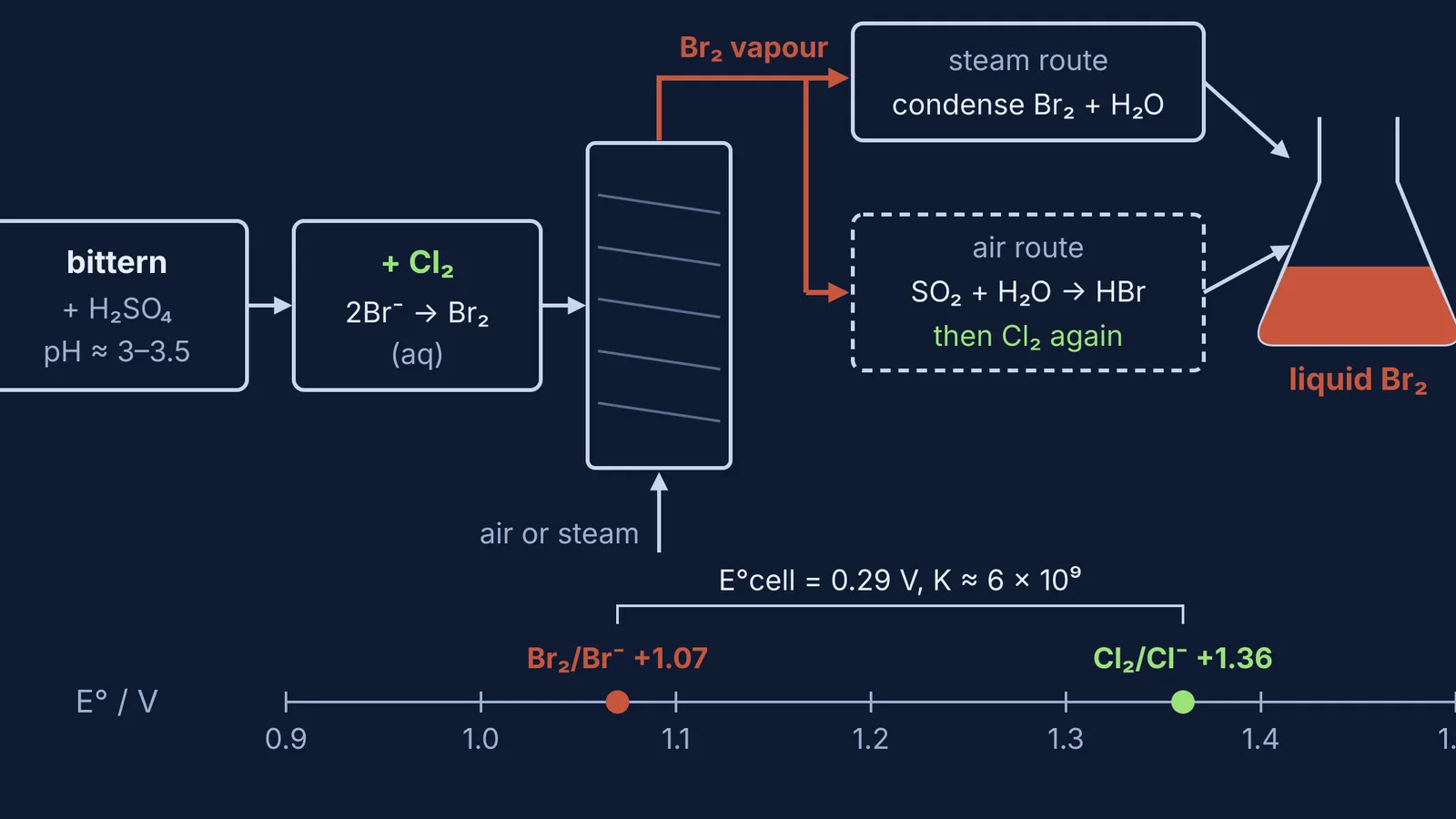
An Indian Chemical Engineer paper by A. S. Mehta (2003), cited in a US patent on potash recovery, describes the main steps for bittern:
Acidify. Sulphuric acid brings the bittern to pH 3.0–3.5.
Chlorinate. Chlorine oxidises bromide to bromine: Cl₂ + 2Br⁻ → 2Cl⁻ + Br₂.
Strip. Steam carries the bromine out of the liquid.
Bromine boils at about 59 °C, so it leaves the hot brine easily as vapour. When the vapour is condensed, the dense bromine settles below the water and is then purified by distillation. Some plants blow air through the brine instead of steam. Air is cheaper to blow through very large volumes but carries the bromine away very dilute, so the air route needs an extra concentration step, described below.
Why is the brine acidified before adding chlorine?
In neutral or alkaline solution, bromine does not stay as Br₂. It reacts with hydroxide and disproportionates:
Br₂ + 2OH⁻ → Br⁻ + BrO⁻ + H₂O
3BrO⁻ → 2Br⁻ + BrO₃⁻
Add them, using three times the first: 3Br₂ + 6OH⁻ → 5Br⁻ + BrO₃⁻ + 3H₂O. Check: 6 Br, 6 O and 6 H on each side, and charge −6 = −5 − 1. Bromine at 0 goes to −1 and +5. The Wikipedia article on bromine notes that hypobromite disproportionates readily to bromide and bromate.
That is a disaster for the plant. Most of the bromine you just made turns back into bromide, and bromate cannot be blown or steamed out because it is an ion, not a volatile molecule. Chlorine is also wasted in alkali, as Cl₂ + 2OH⁻ → Cl⁻ + ClO⁻ + H₂O. Acid keeps OH⁻ very low, so both halogens stay as molecules. By Le Chatelier's principle, extra H⁺ also pushes the hydrolysis Br₂ + H₂O ⇌ HOBr + H⁺ + Br⁻ back to the left, so more bromine stays as free Br₂.
Why does chlorine displace bromine so completely?
Use standard reduction potentials: Cl₂/Cl⁻ is +1.36 V and Br₂/Br⁻ is +1.07 V. Our post on why chlorine displaces bromine and iodine from their salts covers the E° logic and the layer test. Here is the step it skips: how large K is.
E°cell. Chlorine is reduced (cathode), bromide is oxidised (anode). E°cell = 1.36 − 1.07 = 0.29 V.
Electrons transferred. Cl₂ + 2e⁻ → 2Cl⁻, so n = 2.
K from E°. At 25 °C, log K = nE°/0.0592 = (2 × 0.29) ÷ 0.0592 = 9.80.
Answer. K = 10⁹·⁸ ≈ 6 × 10⁹.
A K this large means almost all the bromide is oxidised once enough chlorine is added. The limit on the plant is not the equilibrium. It is how much water the bromine is dissolved in. If deriving K from E° still feels uncertain, our guide to calculating K from ΔG° shows the link.
Why does the air route trap bromine with SO₂?
When air strips bromine from dilute brine, the air leaves with only a little Br₂ in it. Condensing that directly would mean cooling huge volumes of air. So the bromine is first trapped chemically. An older process for seawater, described in a 1970s US patent on bromine preparation, works like this: chlorinate seawater at pH 3.5, blow the bromine out with air, then fix the vapour with sulphur dioxide and water:
Br₂ + SO₂ + 2H₂O → 2HBr + H₂SO₄
Check: 2 Br, 1 S, 4 O and 4 H on each side. Bromine goes from 0 to −1 and sulphur from +4 to +6, so here SO₂ is the reducing agent. The products are HBr and H₂SO₄, not HBrO₃. The same patent says this gives a solution of 120–150 g of HBr per litre, far richer than the brine. That solution is chlorinated a second time and steamed to release concentrated bromine. So HBr is a detour that concentrates a very dilute product.
Worked example: why start from bittern, not seawater?
(a) Seawater. Wikipedia gives about 65 ppm of bromide in seawater, about 65 mg per kg. For 1.00 kg of Br₂ at 100% recovery:
Mass of bromide needed = 1.00 kg (bromine atoms are not lost when Br⁻ becomes Br₂).
Seawater needed = 1,000 g ÷ 0.065 g per kg ≈ 15,400 kg, about 15 cubic metres.
(b) Bittern. Bromide in bittern depends on how far evaporation has gone. As an illustrative figure only, take 2.0 g of Br⁻ per litre. Then 1,000 g ÷ 2.0 g/L = 500 L, about 30 times less liquid to heat with steam. That is why steaming out suits bittern.
(c) Chlorine. Cl₂ (70.90 g/mol) gives one Br₂ (159.81 g/mol). Per kg of Br₂: 70.90 ÷ 159.81 = 0.444 kg of Cl₂. The air route chlorinates twice, so it needs about 0.89 kg, plus 64.07 ÷ 159.81 = 0.40 kg of SO₂. Real plants use some excess.
If you want to practise chains like this, the Fermi Problem Library has worked problems with a step-by-step solver that explains the reasoning rather than printing an answer.
Is this the same reaction Balard used?
Yes. Our story on who discovered bromine in 1826 shows Balard passing chlorine through seaweed-ash liquor and distilling off the red liquid. The plant adds acid, steam or air, and sometimes SO₂, to do the same thing at scale. Bromine is corrosive and its vapour is toxic. In school, the NCERT layer test with dilute bromide and chlorine water is as far as you should go.
Quick checklist
Acid (pH about 3–3.5) stops Br₂ from disproportionating to Br⁻ and BrO₃⁻.
Cl₂ + 2Br⁻ → 2Cl⁻ + Br₂: E°cell = 0.29 V, K ≈ 6 × 10⁹.
Steam suits richer brines such as bittern. Air suits very dilute brine but needs a trap.
SO₂ trap: Br₂ + SO₂ + 2H₂O → 2HBr + H₂SO₄, then chlorinate again.
About 0.444 kg of Cl₂ per kg of Br₂ for each chlorination.


