

On this page
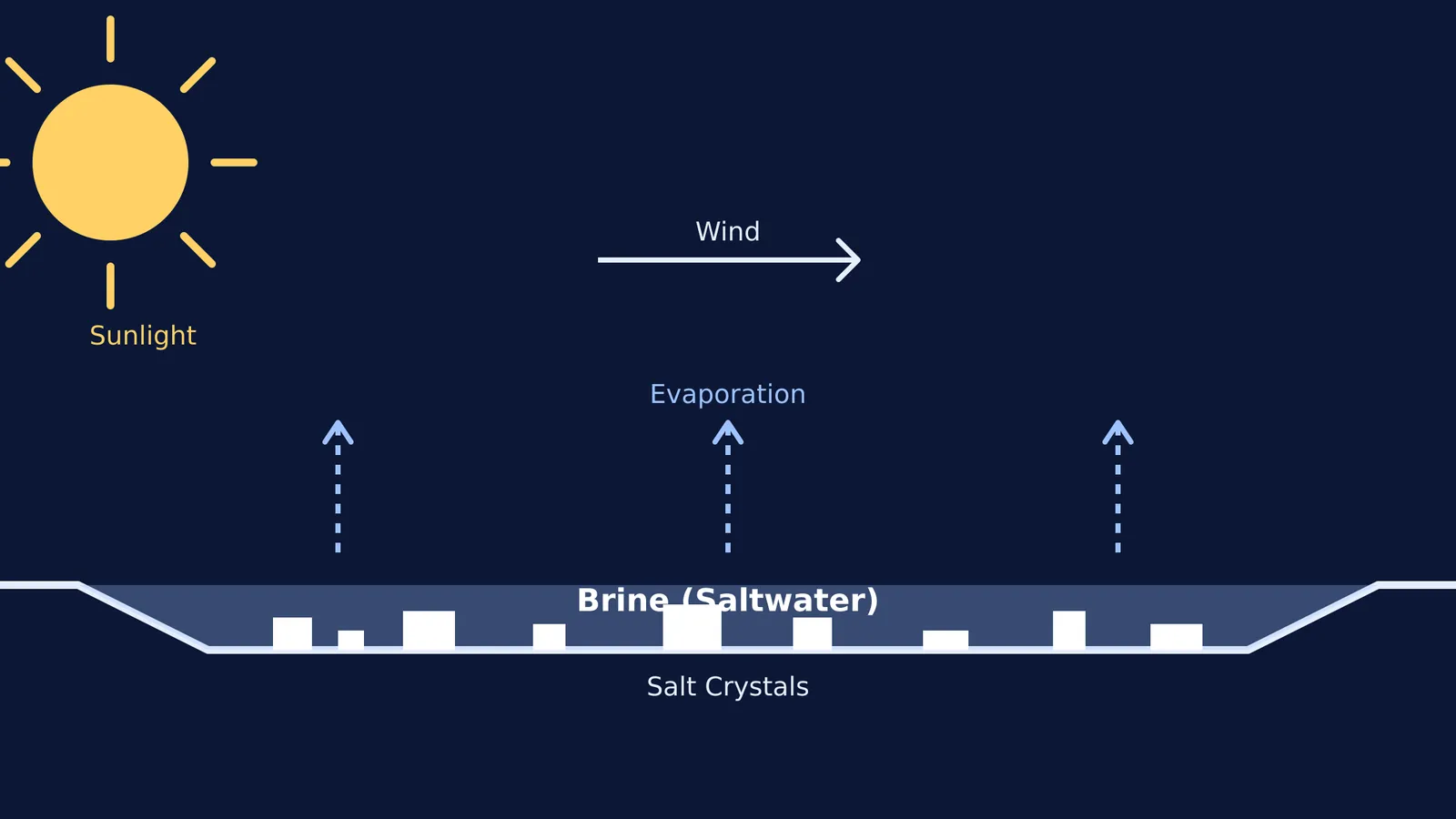
A salt evaporation pond is a shallow artificial basin designed specifically to extract salts from sea water or other brines. The process begins when seawater is pumped or fed into a series of these expansive ponds and left exposed to the weather. Over time, the sun's heat provides the thermal energy needed to vaporise the water, while the wind carries the saturated water vapour away from the surface.
The design of the salt pan is crucial to its success. Because the ponds are built to be very shallow, a vast surface area of water is exposed directly to the elements. This maximises the evaporation rate. If the pools were deep, the lower layers of the water would remain too cool and shielded from the sun, slowing the entire production cycle down drastically. As the liquid slowly evaporates, the dissolved salt cannot evaporate with it and is left behind in the basin. This centuries-old method is a large-scale, real-world application of the phase changes you study in high school chemistry.
If you are learning about phase changes and states of matter, you can visualise how temperature affects particles in the Fermi Simulation Lab.
What is the chemistry of evaporation and crystallisation?
Seawater has an average salinity of about 3.5%, which means every kilogram—roughly one litre by volume—contains approximately 35 grams of dissolved salts. The principal component is sodium chloride, though trace amounts of magnesium, potassium and calcium salts are also present in the mix.
As the sun evaporates the water, the volume of the liquid steadily decreases, but the total mass of salt remains exactly the same. This gradually increases the concentration of the brine. When the concentration of sodium chloride exceeds its solubility limit in water, the solution becomes saturated. At this point, the liquid can no longer hold all the dissolved sodium and chloride ions apart. They begin to bond together, and solid salt crystals precipitate out, settling at the bottom of the pan. This physical transformation from a dissolved state to a solid state is known as crystallisation.
Understanding how saturation limits work is essential for chemistry students tackling equilibrium problems. You can explore a related idea by trying a salt solubility simulation to predict the exact moment when a solution becomes saturated.
How does Gujarat produce so much of India's salt?
India is one of the world's top salt producers, and the state of Gujarat alone gives the country about 66% of its national requirement of salt. The state's long coastline, arid climate and intense sunlight make it an ideal location for large-scale solar evaporation.
A major hub for inland salt production is the Little Rann of Kutch, a vast seasonal salt marsh that stretches across thousands of square kilometres. During the monsoon season, the underground water table fills completely with saltwater. When the floodwaters recede around October, the local salt workers pump this subterranean brine into temporary, hand-dug fields.
These workers rely on the natural climate conditions to evaporate the water over a continuous period of 6 to 7 months. They use diesel or solar-powered pumps to keep the shallow pans constantly topped up with brine. Eventually, a thick, hard crust of pure salt crystals forms on the ground, which is then manually raked and harvested before the next monsoon arrives.
Why does the weather matter for salt pans?
The efficiency and yield of a salt pan depend heavily on the local weather patterns. Solar evaporation works best in regions that experience high temperatures, low rainfall and steady, dry winds.
If it rains heavily during the harvesting season, the fresh rainwater dilutes the highly concentrated brine, and the evaporation process must effectively start all over again. This is why salt production in places like the Rann of Kutch is a seasonal activity, halting during the wet monsoon months. The wind also plays a critical, often overlooked role: it constantly replaces the humid, moisture-heavy air sitting just above the water's surface with drier air, allowing more water molecules to escape into the atmosphere.
This continuous movement of water vapour into the air is driven by the same physics that explains why a glass of cold water gets wet outside, where water vapour in the air condenses back into liquid when it hits a cold surface. In a salt pan, the goal is the exact opposite: to push as much liquid water into the vapour phase as possible, leaving the solid salt behind to be gathered.


