

On this page
Tertiary halides are supposed to react quickly by SN1. 1-Bromobicyclo[2.2.1]heptane (1-bromonorbornane) is a tertiary bromide, yet it barely reacts by SN1, cannot react by SN2, and cannot even eliminate. The reason is not electronic in the usual sense. It is geometry. The bromine sits on a bridgehead carbon, and the cage around that carbon blocks every pathway you learned for haloalkanes. This post shows why, and how to rank it against other "slow" halides in an exam question.
What is a bridgehead halide?
Bicyclo[2.2.1]heptane, also called norbornane, is two fused five-membered rings sharing two carbons. Those shared carbons, C1 and C4, are the bridgehead carbons. Three bridges join them: two of two carbons each (C2–C3 and C5–C6) and one of a single carbon (C7).
Put a bromine on C1 and you get 1-bromonorbornane. C1 is bonded to C2, C6 and C7, so on paper it is a tertiary carbon, just like the central carbon of tert-butyl bromide. If you apply the usual rules from SN1 vs SN2 in haloalkanes, you would predict a fast SN1 reaction. The prediction is wrong, and seeing why is the whole point of this topic.
Why can't a bridgehead halide react by SN2?
In SN2 the nucleophile must attack from the side exactly opposite the leaving group, at 180° to the C–Br bond. As it bonds, the other three groups on carbon flip over like an umbrella turning inside out (Walden inversion).
At a bridgehead both steps are impossible:
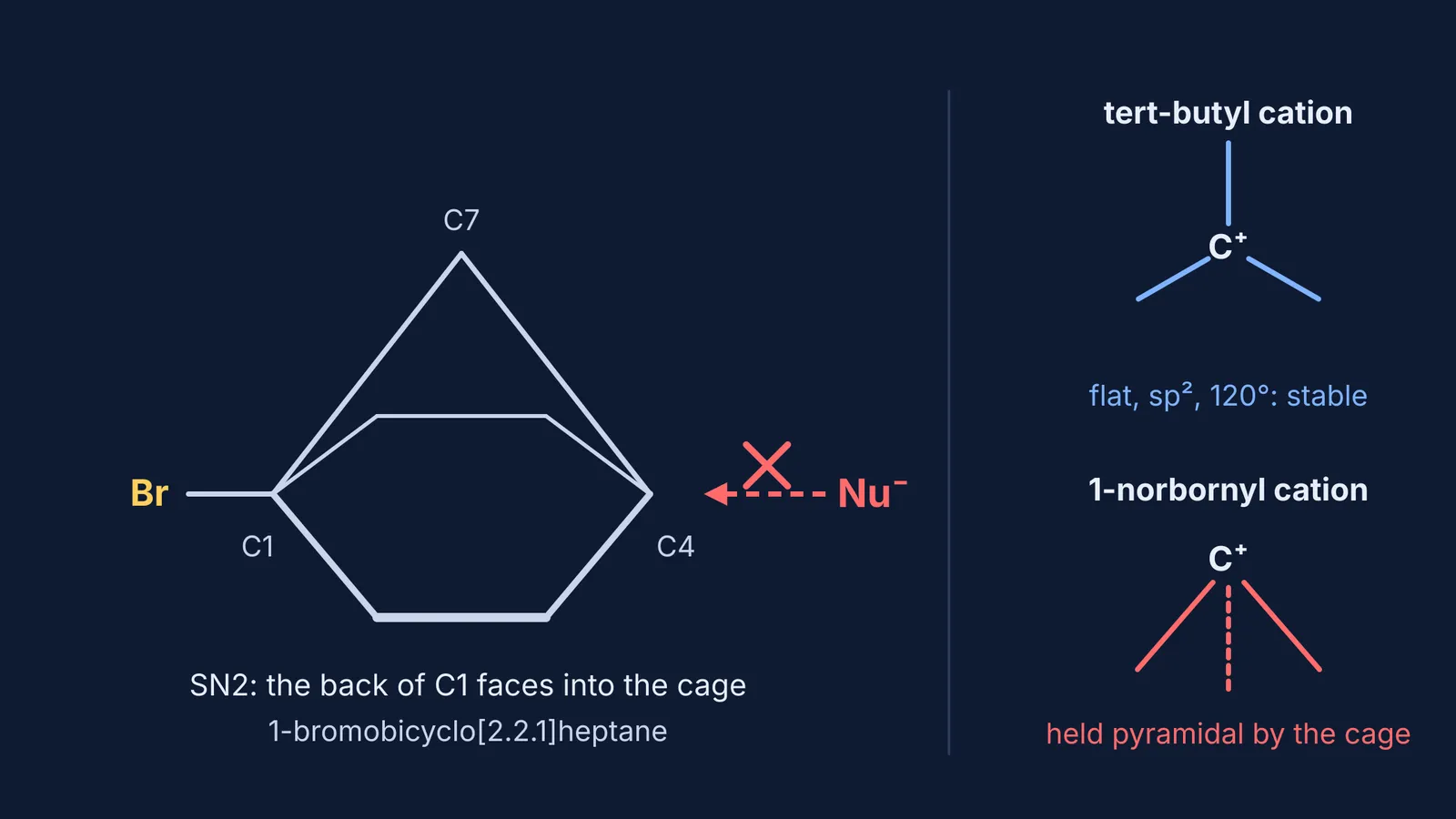
No path for the nucleophile. The direction opposite to the C1–Br bond points into the middle of the cage, toward C4. The nucleophile would have to pass through the ring system to get there.
No room to invert. Even if it could arrive, C1 cannot flip its three bonds through a flat arrangement, because each of them is part of a ring that ties C1 back to C4. Inversion would mean turning the whole cage inside out.
This is a stronger block than ordinary crowding. In tert-butyl bromide, three methyl groups make backside attack very hard. In 1-bromonorbornane, backside attack is not just hard; there is no backside to reach.
Why can't it react by SN1 either?
SN1 needs the C–Br bond to break first, giving a carbocation. A carbocation is most stable when it is planar: the carbon is sp² hybridised, its three bonds lie at 120° in one plane, and the empty p orbital sits above and below that plane. That empty p orbital is what hyperconjugation and solvent stabilise.
For C1 to become planar, its three bonds to C2, C6 and C7 would have to spread out into one flat plane. But the cage holds them pulled back toward C4, in a pyramidal shape. The bridges are too short to allow C1 to flatten. So the cation would be:
Pyramidal, with an empty orbital that has some s character instead of a pure p orbital, which is a high-energy place for a positive charge.
Poorly stabilised by hyperconjugation, because the neighbouring C–H and C–C bonds cannot line up with that empty orbital properly.
Highly strained, because the cage is fighting the geometry the cation wants.
The transition state for ionisation looks like this unstable cation, so its energy is very high and the SN1 rate is tiny. Solvolysis of 1-bromonorbornane is many orders of magnitude slower than that of tert-butyl bromide, even though both are tertiary. Tert-butyl bromide gives a precipitate of AgBr with ethanolic silver nitrate quickly; bridgehead halides of this kind barely react even on long heating.
Does the size of the cage matter?
Yes, and this confirms the explanation. The bigger and more flexible the cage, the closer the bridgehead cation can get to planar, and the faster SN1 becomes. 1-Bromoadamantane, which has a larger cage, does ionise and undergoes SN1 reactions, though still more slowly than tert-butyl bromide. 1-Bromonorbornane, with the smallest and tightest cage of the common examples, is the least reactive.
Why can't it undergo elimination?
With a strong base, tert-butyl bromide gives an alkene by E2. A bridgehead halide cannot do this either, because the double bond would have to form at the bridgehead. A C=C at a bridgehead in a small ring system needs the p orbitals on the two carbons to line up side by side, which the cage prevents. This is Bredt's rule, explained in why no double bond forms at a bridgehead. E1 is ruled out too, since it needs the same carbocation as SN1.
So 1-bromonorbornane is the textbook case of a halide that reacts by neither SN1 nor SN2, nor by elimination, under ordinary conditions.
How is this different from a neopentyl halide?
Neopentyl bromide, (CH₃)₃CCH₂Br, is the other famous "slow for both" halide, covered in why neopentyl halides react slowly in SN1 and SN2. The reasons are different, and examiners test exactly that difference.
Neopentyl, SN2: the carbon is primary, but the bulky tert-butyl group next door crowds the backside. SN2 is very slow, but the path exists.
Neopentyl, SN1: ionisation would give an unstable primary cation. When forced, the reaction goes with a methyl shift to a tertiary cation, giving rearranged products.
Bridgehead, SN2: no backside path and no inversion possible. Blocked by geometry, not just crowding.
Bridgehead, SN1: the cation is tertiary but cannot be planar. Blocked by geometry, not by the degree of substitution.
Worked example: rank four bromides for SN1 and SN2
Rank tert-butyl bromide, 1-bromonorbornane, neopentyl bromide and benzyl bromide (C₆H₅CH₂Br) for SN1 and for SN2.
SN1: think about the cation.
Benzyl bromide gives the benzyl cation, stabilised by resonance with the ring. Fast.
tert-Butyl bromide gives a planar tertiary cation, stabilised by hyperconjugation. Fast. Benzyl and tert-butyl are both quick, and which is faster depends on the solvent, so at JEE level treat them as the two fast ones.
Neopentyl bromide would give a primary cation. Very slow, and any product is rearranged.
1-Bromonorbornane would give a cation that cannot be planar. Slowest of all, essentially unreactive.
SN1 order: benzyl ≈ tert-butyl > neopentyl > 1-bromonorbornane.
SN2: think about the backside.
Benzyl bromide: primary, open backside, and the ring's π system helps stabilise the transition state. Fast.
Neopentyl bromide: primary, but the backside is crowded by the tert-butyl group. Very slow, but it does react.
tert-Butyl bromide: tertiary, backside blocked by three methyl groups. Effectively no SN2; with a strong base it eliminates instead.
1-Bromonorbornane: no backside at all. No SN2, and no E2 either.
SN2 order: benzyl > neopentyl > tert-butyl ≈ 1-bromonorbornane (both effectively zero).
For more mechanism-ranking problems like this, the Fermi Problem Library has a step-by-step solver that explains the reasoning at each step.
Quick checklist
A bridgehead carbon is shared by two rings; 1-bromonorbornane has Br on one.
SN2 fails: the back of the C–Br bond faces into the cage, and the carbon cannot invert.
SN1 fails: the bridgehead cation cannot become planar, so it is strained and poorly stabilised.
E2 fails too, because a bridgehead double bond breaks Bredt's rule.
Larger cages (adamantyl) allow slow SN1; the smaller the cage, the slower the reaction.
Neopentyl is slow for different reasons: crowding for SN2, a primary cation for SN1.


