

On this page
You draw a neat bicyclic skeleton, put a double bond on the carbon where the rings join, and your teacher crosses it out. That carbon is a bridgehead, and the rule you broke is Bredt's rule. It comes straight from geometry, so you can picture it rather than memorise it.
What does Bredt's rule say?
A bridgehead is a carbon shared by all the rings of a bridged bicyclic molecule, like C1 and C4 in norbornane (bicyclo[2.2.1]heptane).
Bredt's rule says a double bond cannot be placed at the bridgehead of a small bridged ring system, as Master Organic Chemistry puts it. Julius Bredt published the rule in 1924 in Justus Liebigs Annalen der Chemie, and Frank Fawcett's 1950 review in Chemical Reviews, "Bredt's Rule of Double Bonds in Atomic-Bridged-Ring Structures", gathered the evidence for it.
The word "small" matters: large bicyclic rings can carry one.
Why can't a bridgehead carbon form a double bond?
The π bond in a C=C comes from sideways overlap of one p orbital on each carbon, and that overlap is strongest when the two p orbitals are parallel. That is why an alkene is flat: both carbons are sp², and they and their four neighbours sit in one plane.
At a bridgehead, the cage decides the shape. The bridgehead carbon is tied to three bridges, so it cannot flatten into a trigonal planar sp² carbon. As Master Organic Chemistry explains, the bridgehead stays pyramidal and its p orbital ends up staggered relative to the p orbital on the next carbon, so they barely overlap and the π bond hardly forms.
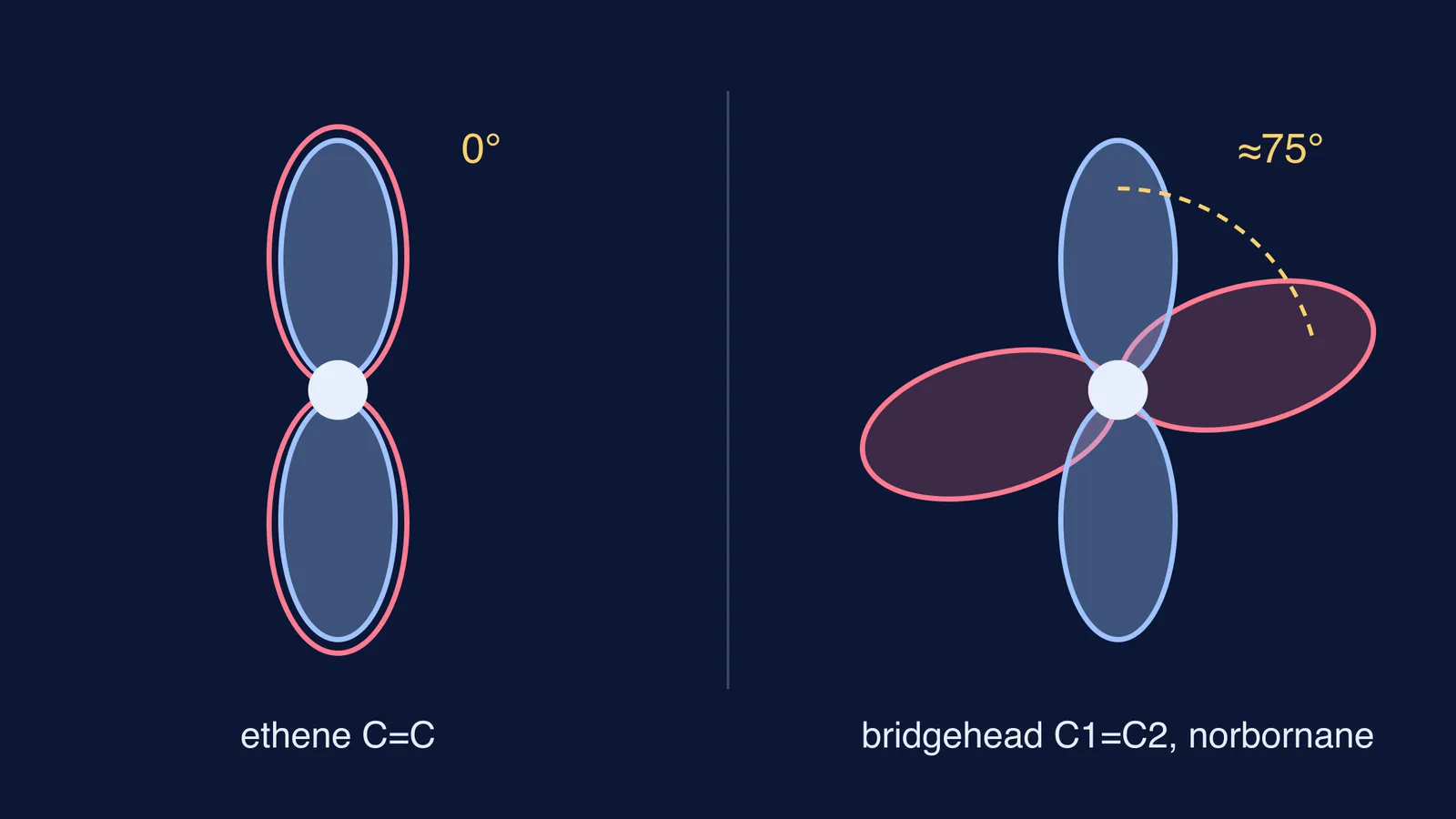
The diagram at the top puts a number on it. In a rigid norbornane frame with ordinary bond lengths (our own calculation, described in the image caption), the orbital on bridgehead C1 and the p orbital on C2 are twisted about 75° apart when you look down the C1–C2 bond, against 0° in ethene. A real molecule would bend to ease this, but that strain makes the alkene too unstable to keep.
How do you check if a bridgehead double bond is possible?
Look at the ring the double bond would sit in. A bridgehead double bond is trans in the larger of its two rings, and its stability tracks that trans-cycloalkene: trans-cyclohexene and trans-cycloheptene are too unstable to exist at room temperature, while trans-cyclooctene is stable, as Master Organic Chemistry sets out. John Wiseman's 1967 paper in the Journal of the American Chemical Society reported bicyclo[3.3.1]non-1-ene.
Use these four steps:
Mark the bridgeheads (the carbons shared by all the rings).
Draw the proposed double bond from a bridgehead to its neighbour.
Find the two rings that contain that double bond and count the atoms in the larger one.
If the larger ring has 7 atoms or fewer, expect no stable alkene. If it has 8 or more, one can exist.
Worked example 1: norbornane, C1=C2. The double bond sits in the five-membered ring C1–C2–C3–C4–C7 and the six-membered ring C1–C2–C3–C4–C5–C6. The larger ring has 6 atoms, which would need a trans-cyclohexene. Not allowed.
Worked example 2: bicyclo[3.3.1]nonane, C1=C2. The rings are C1–C2–C3–C4–C5–C9 (6 atoms) and C1–C2–C3–C4–C5–C6–C7–C8 (8 atoms). The larger ring has 8 atoms, a trans-cyclooctene. Allowed, and this is the compound in Wiseman's paper.
Where does Bredt's rule show up in exam questions?
Mostly in elimination. For E1 or E2 you usually pick the more substituted alkene, the rule Zaitsev described in 1875. Bredt's rule comes first: if the more substituted alkene would put the double bond at the bridgehead of a small cage, it does not form.
2-Bromonorbornane: the β-carbons are C1 and C3. C1 is a bridgehead, so the only alkene is C2=C3, norbornene.
1-Bromonorbornane: every β-carbon (C2, C6 and C7) would give a bridgehead double bond, so no ordinary elimination product forms.
Other rules still apply: E2 needs an anti-periplanar hydrogen, and a bulky base can favour the less substituted Hofmann alkene. In a cage, run the Bredt check first: circle the bridgeheads and cross out any product with a C=C at one.
Has anyone made an anti-Bredt alkene?
Yes, as short-lived intermediates. In 2024 a UCLA team led by Neil Garg reported in Science a way to make anti-Bredt olefins and use them in reactions. According to the UCLA release on ScienceDaily, the team treated silyl (pseudo)halides with a fluoride source to cause an elimination that forms the alkene, and added a second chemical to trap it, because the alkene is too unstable to isolate. "People aren't exploring anti-Bredt olefins because they think they can't," Garg said in that release.
The alkenes were trapped, not bottled, as the strain picture predicts. For board and JEE answers, treat Bredt's rule as a firm guide for small bicyclic rings.
If you keep jumping straight to the Saytzeff product, practise a few bicyclic eliminations in the Fermi Problem Library, where a step-by-step solver explains the reasoning rather than printing an answer. If the gap is the orbital picture itself, the Fermi Concept Library gives every chemistry concept its own lesson and its place in the map.


