

On this page
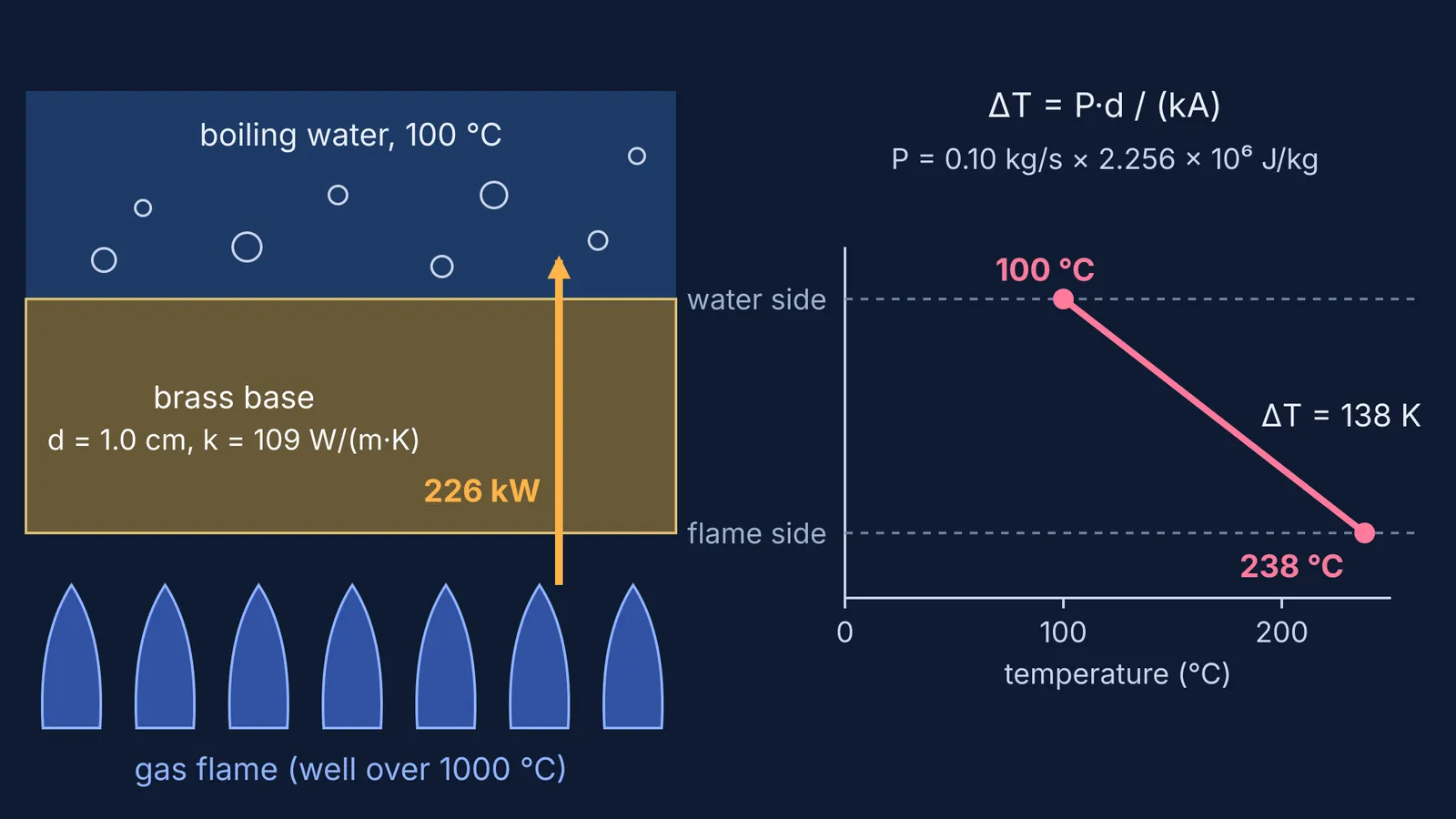
A brass boiler sits on a gas stove and boils away 6.0 kg of water every minute. Its base is 0.15 m² in area and 1.0 cm thick. How hot is the underside of the base, the side the flame touches? This NCERT Class 11 exercise from Thermal Properties of Matter joins two ideas you usually meet separately: latent heat and steady conduction. The answer is 238 °C, and getting there takes four lines. Understanding what that number does and does not mean takes a little longer.
Where does the heat go when the water is already boiling?
The water in the boiler is at 100 °C and stays there. Every joule that passes through the base goes into turning liquid water into steam. None of it raises the water's temperature, so there is no m·c·ΔT term in this problem.
That means the rate at which heat flows through the base equals the rate at which water evaporates, multiplied by the latent heat of vaporisation:
P = (mass boiled away per second) × L_v
If you want to see why L_v is so large compared with the latent heat of fusion, read why latent heat of vaporisation is greater than fusion.
How do you turn a heat flow into a temperature difference?
In steady state, heat flows through a flat slab at a rate given by Fourier's law of conduction:
P = kA(T₁ − T₂)/d
Here k is the thermal conductivity, A the area, d the thickness, T₁ the hot face and T₂ the cold face. Rearranged:
ΔT = T₁ − T₂ = P·d/(kA)
It helps to read d/(kA) as the thermal resistance of the base, in K W⁻¹. Then ΔT = P × R, just like V = IR. The same idea handles slabs in series and in parallel, covered in thermal resistance of rods in series and parallel.
The water side of the base is touching boiling water, so NCERT takes T₂ = 100 °C. Then T₁ = 100 °C + ΔT.
Worked example: the 238 °C answer
Data: A = 0.15 m², d = 1.0 cm, k (brass) = 109 W m⁻¹ K⁻¹, rate of boiling = 6.0 kg min⁻¹, L_v = 2256 J g⁻¹.
Convert the rate to SI. 6.0 kg min⁻¹ = 6.0/60 = 0.10 kg s⁻¹.
Convert the latent heat. 2256 J g⁻¹ = 2.256 × 10⁶ J kg⁻¹.
Heat flow through the base. P = 0.10 × 2.256 × 10⁶ = 2.256 × 10⁵ W, about 226 kW.
Thermal resistance of the base. R = d/(kA) = 0.010/(109 × 0.15) ≈ 6.1 × 10⁻⁴ K W⁻¹.
Temperature difference. ΔT = P × R = 2.256 × 10⁵ × 6.1 × 10⁻⁴ ≈ 138 K. A difference of 138 K is the same as a difference of 138 °C.
Flame-side temperature. T₁ = 100 + 138 = 238 °C, which matches NCERT's answer.
Check the units: (W) × (m)/(W m⁻¹ K⁻¹ × m²) = K. The temperature falls steadily across the brass, at about 1.4 × 10⁴ K per metre, or 13.8 °C for every millimetre.
Is 238 °C the temperature of the flame?
No. It is the temperature of the brass surface that the flame touches. The flame gases themselves are far hotter, typically well over 1000 °C for a gas burner.
The large drop from flame to metal happens in a thin layer of hot gas next to the brass. Gases are very poor conductors, so even a thin film of slow-moving gas has a thermal resistance much larger than the 1 cm of brass. Soot on the underside adds more. Think of the path from flame to steam as resistances in series: gas film, brass, and the boiling layer on the water side. The brass is the smallest of them, which is why the base is far cooler than the flame.
There is a smaller simplification on the water side as well. For water to boil vigorously at a surface, the surface has to be somewhat above 100 °C. NCERT ignores that and sets the water-side face at exactly 100 °C, which is fine for this estimate.
How realistic are NCERT's numbers?
The 226 kW in this problem is an idealised figure, not a kitchen. A domestic gas burner delivers roughly 2–3 kW. Here is what that changes.
Boiling rate. At 2.5 kW, the water boils away at about 2500/(2.256 × 10⁶) kg s⁻¹, which is roughly 66 g per minute, not 6 kg.
Temperature difference across the brass. ΔT = 2500 × 6.1 × 10⁻⁴ ≈ 1.5 K. In a real kitchen, the brass base is only a degree or two hotter on the flame side than on the water side.
Metal choice. At NCERT's 226 kW, the same base in stainless steel (k roughly 16 W m⁻¹ K⁻¹) would need a ΔT of about 940 K, while copper (k roughly 385 W m⁻¹ K⁻¹) would need only about 39 K. Conductivity matters most when the heat flux is large. Why kitchen vessels use copper to spread heat sideways is a different question, covered in why steel cooking vessels have copper bottoms.
Scale. A layer of hard-water scale on the water side has a conductivity of only about 1–2 W m⁻¹ K⁻¹. Just 1 mm of it has roughly 5–11 times the thermal resistance of the whole 1 cm brass base. That is why scaled boilers waste fuel and run their metal hotter.
So treat 238 °C as the answer to the problem as set, and treat the method (heat flow from latent heat, then ΔT = P·d/kA) as the part that carries over to real systems.
If heat flow through a slab is easier to picture than to read about, the Simulation Lab has interactive simulations for ideas that are easier to see than read.
What mistakes cost marks here?
Adding an m·c·ΔT term. The water is already boiling, so all the heat goes into vaporisation.
Forgetting to convert kg min⁻¹ to kg s⁻¹, or J g⁻¹ to J kg⁻¹.
Using the thickness in cm in Fourier's law. d must be 0.010 m.
Calling 238 °C the flame temperature. It is the flame-side surface of the brass.
Thinking a temperature difference of 138 K needs converting to °C. Differences are the same in both scales.
Quick checklist
Boiling water stays at 100 °C: heat flow P = (kg s⁻¹) × L_v.
P = 0.10 × 2.256 × 10⁶ = 2.256 × 10⁵ W for NCERT's data.
ΔT = P·d/(kA) = 138 K across 1.0 cm of brass.
Flame-side surface: 100 + 138 = 238 °C.
The flame is much hotter; the gas film carries most of the drop.
Real burners are about 2–3 kW, so a real base is only a degree or two hotter than the water.


