

On this page
Anyone who has cooked a meal on a gas stove knows the frustration of a hot spot. You place a pan over the flame, add oil, and within seconds the centre is smoking while the edges remain entirely cold.
If you look closely at high-quality pots and pans, you will often notice a distinct, warm-coloured layer of metal bonded to the base. This is not for decoration. It is an engineering solution to a very specific physics problem regarding how heat moves through metals.
Why do steel cooking vessels have copper bottoms?
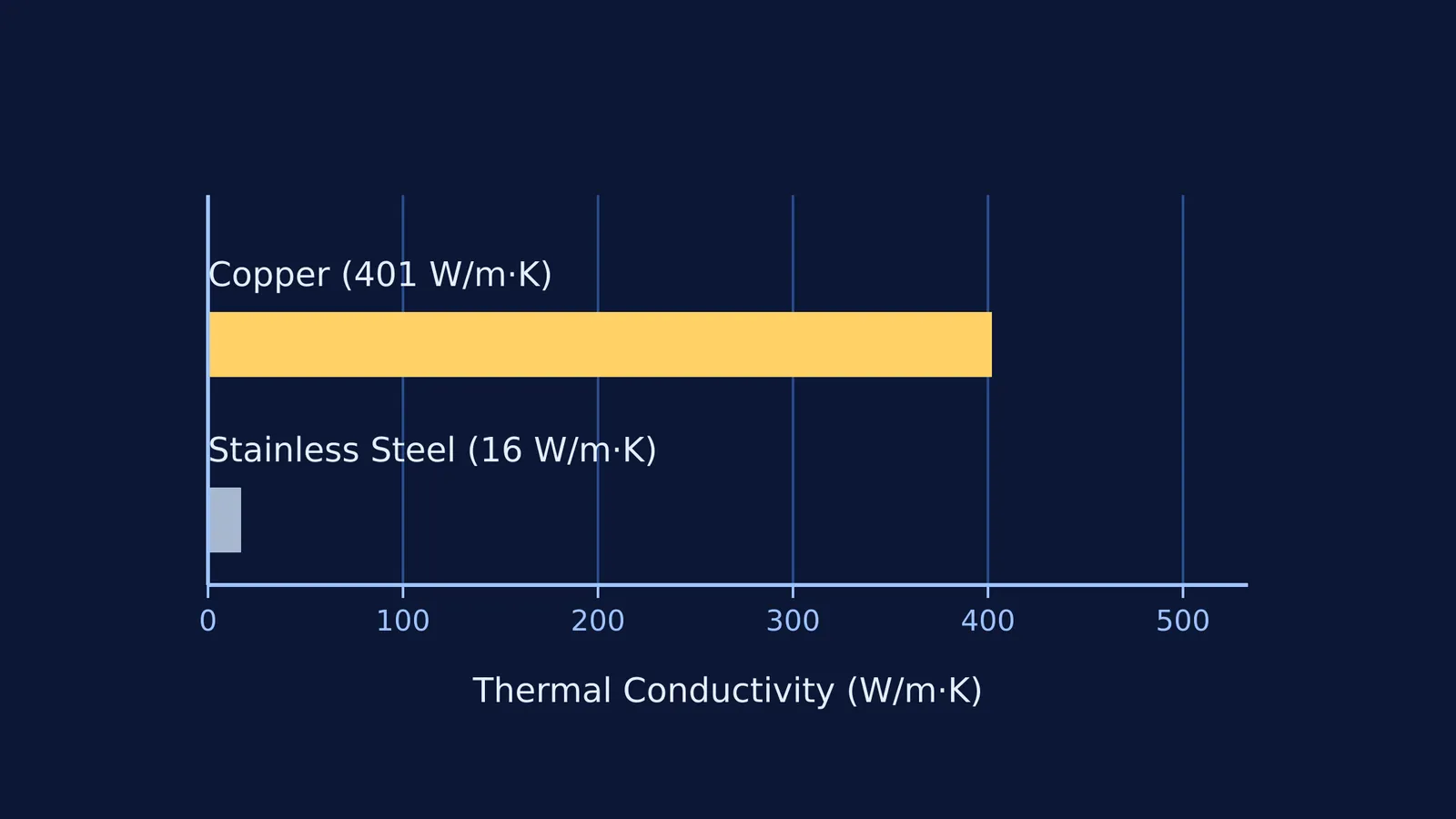
Stainless steel is a popular choice for cookware because it does not rust and will not react with acidic foods like tomatoes or vinegar. But it has a major flaw: it is a terrible conductor of heat. According to the Engineering ToolBox, standard stainless steel has a thermal conductivity of just 16 W/(m·K) at room temperature. When you put a plain steel pan on a burner, the thermal energy struggles to move sideways. The heat stays exactly where the flame hits it, resulting in a scorched circle in the middle of your pan.
Copper, on the other hand, is one of the best thermal conductors available. Its thermal conductivity is 401 W/(m·K) according to the Engineering ToolBox. This makes it about 25 times more efficient at transferring heat than stainless steel. By bonding a layer of copper to the bottom of a steel pan, manufacturers combine the best of both materials. The copper quickly pulls the heat from the stove and spreads it sideways across the entire base. By the time the heat travels upwards through the thin steel lining to touch your food, the temperature is uniform.
How does a copper base prevent hot spots?
The science at work here is heat transfer by conduction. When atoms at the bottom of the pan absorb energy from the stove, they vibrate faster and collide with their neighbours, passing the kinetic energy along.
In metals, free electrons also zip through the crystalline lattice, carrying heat with them. Copper has an abundance of these highly mobile electrons. Because of this, thermal energy races outwards to the edges of the pan rather than piling up in one place. Stainless steel is an alloy containing iron, carbon, chromium, and nickel, which creates an irregular lattice that scatters electrons and severely slows down the transfer of heat.
Visualising how heat flows through different metals is one of the ideas that are easier to see than to read, which is why you can explore it in the Fermi Simulation Lab. Watching the temperature gradient spread in a virtual metal block helps make the abstract numbers of thermal conductivity intuitive and memorable.
Why not make the whole pan out of copper?
If copper is such a brilliant conductor, it might seem logical to build the entire vessel from it. Professional French kitchens do often use solid copper pans, but they require constant and careful maintenance.
Bare copper is highly reactive. If you cook something acidic in it, the acid will dissolve copper ions into your food, giving it a harsh metallic taste and potentially causing nausea. To prevent this, traditional solid copper pans must be lined with a non-reactive metal, usually tin. However, tin melts at 232 °C according to PubChem. If a tin-lined pan is left empty on a hot stove, the lining will melt and the pan must be sent away to be professionally re-tinned.
Stainless steel, while a poor conductor, is virtually indestructible and completely inert. Cladding a steel pan with a copper bottom gives you the bulletproof cooking surface of steel combined with the thermal speed of copper.
A checklist for your next physics problem
Thermal conductivity problems frequently appear in exams, often asking you to compare rods of different materials or calculate the rate of heat flow. When you encounter a question about heat conduction, use this framework:
Identify the materials and note the thermal conductivities for each material involved.
Determine the arrangement. Check if the materials are in series (heat flows through one, then the other, like the horizontal layers of a clad pan) or parallel (like two rods side-by-side).
Apply Fourier's law. The rate of heat transfer is proportional to the area and the temperature difference, and inversely proportional to the thickness.
Link to other topics. Conduction relies on the same free electrons that carry electrical current. If you are revising this area, you might also want to review why metals act as conductors compared to insulators.
Practice with time. Heat flow problems can also involve changes over time as boundaries shift. Try solving problems involving thermal conduction over time, such as the classic scenario of ice forming on a pond.
Understanding the physics of your kitchen makes both cooking and science much more predictable. Next time you fry an egg, you will know exactly why the pan behaves the way it does.


