

On this page
The Bombay blood group was first identified in 1952 by Dr. Bhende in Bombay, now Mumbai, according to a 2024 case report in Cureus. It is rare, easy to miss in a routine test, and a classic real-life example of epistasis: one gene hiding what another gene does.
What is the Bombay blood group?
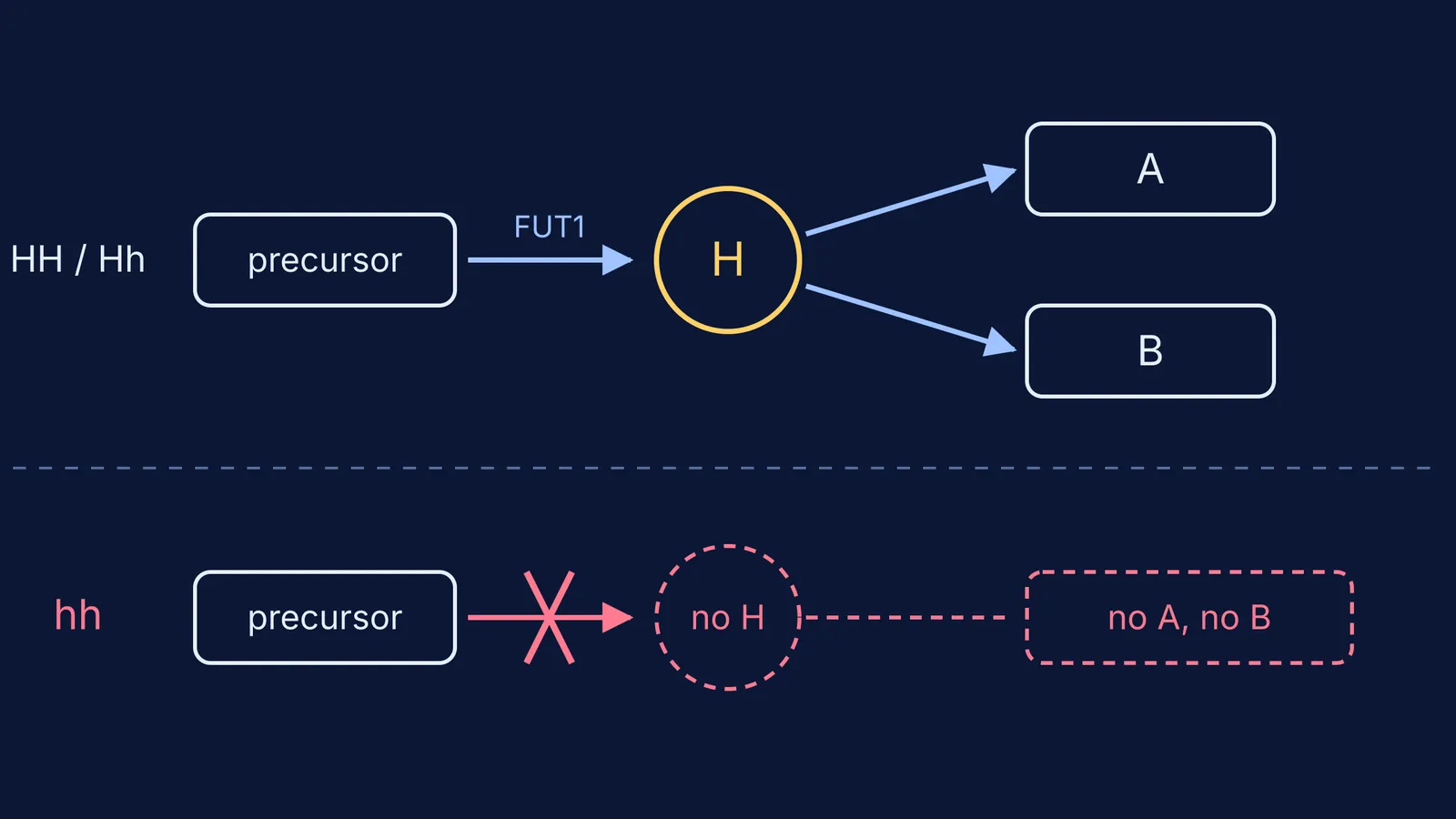
Your ABO group depends on sugar chains on your red blood cells, built in steps, as the same Cureus report describes:
A precursor chain sits on the red cell.
A fucosyltransferase made by the H gene (FUT1) turns it into the H antigen. FUT1 works in people who are HH or Hh.
The A or B enzyme converts the H antigen into the A or B antigen. In group O the H antigen stays unmodified.
The hh genotype gives the Bombay phenotype: no H antigen, so the A and B enzymes have nothing to work on, and red cells lack A, B and H. The ABO genes are still there, though. A 2025 report in Hematology, Transfusion and Cell Therapy notes that people with the Bombay phenotype inherit a normal ABO gene even though their red cells show no H, A or B antigen.
Why is the Bombay blood group so rare?
The Bombay phenotype occurs in about 1 in 10,000 people in India and about 1 in a million in Europe, according to the Cureus case report. The h allele is recessive, so a child is Bombay only if both parents pass on a copy, and that is likelier when parents are related. In a 2011 study at a tertiary care hospital in Tirupati, Andhra Pradesh, 13 of 26,638 people tested (donors, patients and relatives of the first cases found) had the Bombay phenotype (0.048%), and their parents were related in 10 of the 13 cases (77%). The same paper cites reported figures of 0.004% for Tamil Nadu and 0.005% for Karnataka.
Why does Bombay blood test as O but cannot take O blood?
A routine forward test mixes your red cells with anti-A and anti-B. Bombay cells react with neither, so the card reads O. The Cureus authors describe two patients an outside laboratory had labelled group O.
The problem is in the plasma. People with Bombay blood naturally make anti-H antibodies, which can destroy red cells inside blood vessels and cause an acute haemolytic transfusion reaction, the same report explains. Group O red cells carry the most H antigen, so the universal donor is exactly what a Bombay patient cannot take. They can receive blood only from another Bombay donor.
Labs catch it by mixing the patient's serum with pooled O cells (ordinary O serum leaves them alone; Bombay serum makes them clump) and by testing red cells with anti-H lectin, which clumps O cells but not Bombay cells.
For the rules between ordinary groups, see our interactive guide to blood group transfusion compatibility.
Pedigree puzzle: how can an O mother have an AB child?
This really happens: in the 2025 case report, a mother typed as O (with a weaker relative of Bombay, called para-Bombay) had a newborn typed as AB. Try the textbook version first. ABO alleles are IA, IB and i.
The puzzle. Asha tests as group O. Her husband Ravi is group A. Their daughter is AB. A relative says the babies were swapped. Right?
Spot the clash. Under plain ABO rules an O parent is ii and cannot pass on IB.
Rule out Ravi. Group A is IA IA or IA i: no IB.
Bring in the H gene. If Asha is hh IB IB or hh IB i, she tests as O but can pass on IB and h.
Build the daughter. From Ravi she gets IA and H. She is Hh IA IB, makes H antigen and then both A and B on it. Group AB, no swap.
Follow-up. Two cousins are both Hh. One is IA i, the other IB i. What fraction of their children will test as O?
hh turns up 1/4 of the time; these children test as O regardless.
Of the other 3/4, a quarter are ii (true O): 3/4 x 1/4 = 3/16.
Total testing as O: 4/16 + 3/16 = 7/16. A, B and AB are 3/16 each.
The usual 1:1:1:1 ABO ratio becomes A:B:AB:O = 3:3:3:7, because hh hides whatever ABO alleles a child carries: recessive epistasis at work.
If the 3:3:3:7 step felt shaky, the Fermi Problem Library has worked problems with a step-by-step solver that explains the reasoning rather than printing an answer. Revise how IA, IB and i combine with our explainer on ABO multiple alleles and inheritance, and how to tell whether a pedigree is dominant or recessive. The Fermi Concept Library gives each inheritance concept its own lesson and its place in the map.


