

On this page
Most blood group questions in a Class 11 test or a NEET-UG mock come down to one check you can do in your head. Once you see it, you can rebuild the whole donor chart instead of memorising it.
What decides which blood group can donate to which?
Your blood group is named after the antigens on your red blood cells. NHS Blood and Transplant lists them simply: group A has A antigens and anti-B antibodies, group B has B antigens and anti-A antibodies, group AB has both antigens and no antibodies, and group O has neither antigen but both antibodies. The positive or negative part of your group depends on the D antigen of the Rh system, the same page explains.
Antibodies recognise foreign antigens and tell your immune system to destroy them, which is why NHS Blood and Transplant says giving blood from the wrong ABO group can be life-threatening. For how these groups were found, see our profile of Karl Landsteiner and the discovery of blood groups.
So here is the one rule for ABO and RhD: donor red cells are compatible if they carry no antigen that the recipient's own cells lack.
How do you predict a compatible transfusion in three checks?
Write the donor's antigens. Use A, B and D (D for positive). O negative has none.
Write the recipient's antigens the same way.
If every donor antigen also appears in the recipient's list, the red cells are compatible. If even one is missing, they are not.
Worked example 1: A negative donor, AB positive recipient. Donor {A}. Recipient {A, B, D}. A is on the list, so this is compatible.
Worked example 2: B positive donor, B negative recipient. Donor {B, D}. Recipient {B}. D is missing, so this is not compatible. Canadian Blood Services states the Rh rule directly: “Rh-negative blood is given to Rh-negative patients, and Rh-positive or Rh-negative blood may be given to Rh-positive patients.”
Worked example 3: O positive donor, A negative recipient. Donor {D}. Recipient {A}. D is missing, so no.
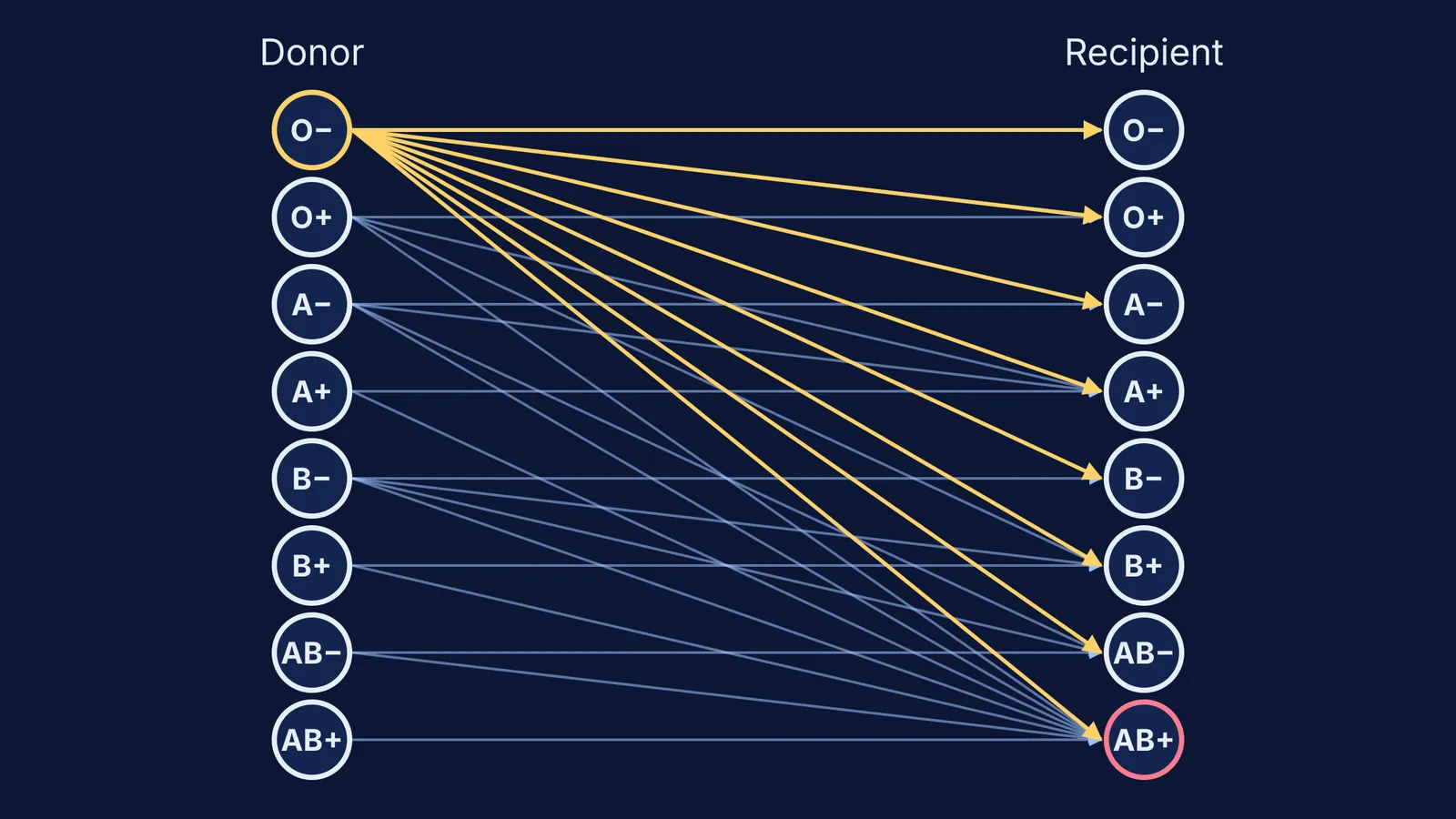
Run the three checks on all 64 donor and recipient pairs and you get 27 compatible red cell transfusions. Those are the 27 arrows in the diagram at the top of this post.
Who is the universal donor and universal recipient?
“The universal red cell donor has Type O negative blood,” says the American Red Cross. In the three-check method, that is because O negative cells carry none of the three antigens. The same page's interactive chart says group AB “can donate to other AB’s but can receive from all others”. AB positive carries all three antigens, so nothing a donor brings is foreign to it.
Why is O negative not always safe?
India has the textbook exception. People with the Bombay blood group lack the H antigen and naturally develop anti-H antibodies. A 2013 case report on the related para-Bombay variant in the Indian Journal of Anaesthesia notes that the Bombay phenotype was first discovered in Bombay by Dr Y. M. Bhende in 1952, and that in patients with high-titre anti-H, only H antigen negative red cells are compatible. Group O cells carry H, so the universal donor does not work for them.
It is rare. A study of 26,638 donors and patients screened at the blood bank of a tertiary care hospital in Tirupati, Andhra Pradesh, published in the Asian Journal of Transfusion Science, found 13 with the Bombay phenotype, a prevalence of 0.048%. Every group O sample was tested for the H antigen.
Canadian Blood Services also counts about 360 known antigens on red blood cells, which is one reason hospitals test and match blood before a transfusion. For questions about your own blood group, ask a doctor or your nearest blood bank.
How do you practise blood group questions?
Can A positive give red cells to AB negative?
Can O positive give red cells to O negative?
Can B negative give red cells to AB positive?
Which ABO groups can give plasma to a group O patient?
Answers: no, because D is missing from AB negative; no, for the same reason; yes; and all four, because plasma runs backwards and group O red cells carry no A or B antigen for donor antibodies to attack.
If ideas click faster when you can see them move, the Fermi Simulation Lab has interactive simulations for ideas that are easier to see than to read. When you get stuck on a question, Fermi's AI tutor can work out what you already know and check your understanding as you go.
For the rest of the chapter, see our guides to body fluids and circulation and the formed elements of blood.


