

On this page
Both effects describe haemoglobin trading oxygen for carbon dioxide, which is why students mix them up. Ask one question: which gas is being pushed off? Oxygen means the Bohr effect. Carbon dioxide means the Haldane effect.
What is the Bohr effect?
The Bohr effect is the link between pH and haemoglobin's oxygen affinity: a lower, more acidic pH makes oxygen dissociate from haemoglobin more easily (OpenStax Anatomy and Physiology 2e).
Christian Bohr, Karl Hasselbalch and August Krogh described how the CO2 pressure of blood changes its oxygen binding in a 1904 paper in Skandinavisches Archiv für Physiologie (Bohr, Hasselbalch and Krogh, 1904).
It matters in the tissues. NCERT gives tissue pO2 as 40 mm Hg and pCO2 as 45 mm Hg, against 95 and 40 mm Hg in oxygenated blood (NCERT Class 11 Biology, chapter 14). CO2 entering the blood forms HCO3- and H+, helped by carbonic anhydrase, and NCERT lists low pO2, high pCO2, more H+ and higher temperature as the conditions that favour oxygen release.
What is the Haldane effect?
The Haldane effect is the link between oxygen and haemoglobin's affinity for carbon dioxide: haemoglobin saturated with oxygen does not readily bind CO2, while haemoglobin without oxygen binds it readily (OpenStax Anatomy and Physiology 2e).
It is named after J. S. Haldane, who with Johanne Christiansen and C. G. Douglas published a 1914 study of how human blood absorbs and releases CO2 in The Journal of Physiology (Christiansen, Douglas and Haldane, 1914).
It matters in the lungs. NCERT says about 20-25 per cent of CO2 is carried by haemoglobin as carbamino-haemoglobin, about 70 per cent as bicarbonate and about 7 per cent dissolved in plasma (NCERT Class 11 Biology, chapter 14). Where pCO2 is low and pO2 is high, as in the alveoli, CO2 comes off carbamino-haemoglobin and you breathe it out.
Bohr vs Haldane: what is the difference, side by side?
Read each line as two columns, Bohr first, Haldane second.
Gas pushed off haemoglobin: Bohr, oxygen. Haldane, carbon dioxide.
What does the pushing: Bohr, CO2 and H+ (lower pH). Haldane, oxygen.
Where it matters most: Bohr, the tissues. Haldane, the lungs.
What it achieves: Bohr, more O2 unloaded where cells are making CO2. Haldane, more CO2 unloaded where blood is picking up O2.
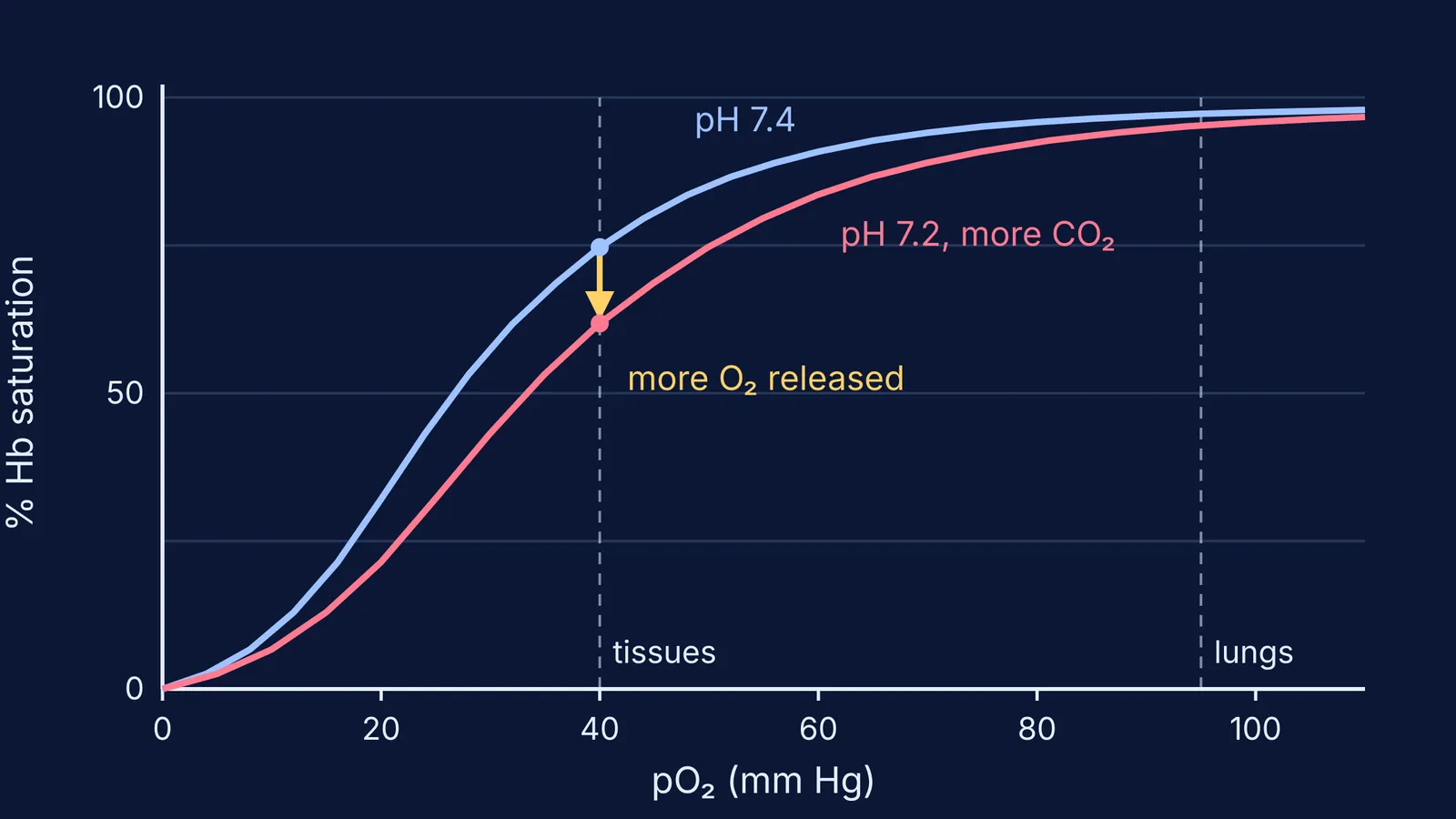
On a graph: Bohr, the oxygen dissociation curve shifts right. Haldane, oxygenated blood holds less CO2 at the same pCO2.
First described: Bohr, 1904. Haldane, 1914.
How big is the Bohr effect in the tissues?
John Severinghaus published an equation and table for the standard human curve at pH 7.4 and 37 °C; his revised text gives a conventional Bohr factor of -0.48 change in log10 pO2 per unit of pH (Severinghaus, 1979; revised text with tables).
At tissue pO2 of 40 mm Hg and pH 7.4, Severinghaus's table gives 74.69 per cent saturation.
Let the blood turn more acidic, to pH 7.2 (a round number for the arithmetic, not a measured tissue value).
A pH drop of 0.2 multiplies the pO2 needed for the same saturation by 10^(0.48 × 0.2), about 1.25.
So at 40 mm Hg, acidic blood behaves like normal blood at about 32 mm Hg: 61.69 per cent.
About 13 percentage points more of haemoglobin's oxygen is released, with no change in tissue pO2.
At the lungs' 95 mm Hg: 97.25 per cent at pH 7.4 against about 95 per cent at pH 7.2, a drop of only about 2 points.
The steep middle of the curve turns a small pH change into a large release in the tissues, while the flat top leaves loading in the lungs almost untouched. Severinghaus notes the real Bohr effect falls off at high saturation and varies along the curve, so treat these numbers as an illustration.
If the arithmetic is where you get stuck, the Fermi Problem Library has worked problems with a step-by-step solver that explains the reasoning rather than printing an answer.
How do exam questions test the two effects?
Run this check on each recall, assertion-reason or graph question:
Which gas is leaving haemoglobin? Oxygen points to Bohr, CO2 to Haldane.
Where are you? Tissues have low pO2 and high pCO2, alveoli the reverse.
A right shift of the oxygen curve from high pCO2 or H+ is Bohr, not Haldane.
Watch for swapped statements, such as "the Haldane effect lowers haemoglobin's affinity for oxygen". That is wrong.
Practise with these assertion-reason questions on breathing and exchange of gases, revise with our Breathing and Exchange of Gases Class 11 notes, and see why blood is red.
If pH, carbonic anhydrase and the dissociation curve still feel like separate facts, the Fermi Concept Library gives every concept in biology its own lesson and its place in the map, so you can see how they link.
Next time a question pairs haemoglobin with two gases, ask which gas is leaving. The name follows.


