

On this page
Every blood group practical works the same way. One drop of blood goes into each of three antisera, anti-A, anti-B and anti-D, and you watch which drops turn grainy. Those three yes-or-no answers name any of the eight common blood groups.
What do anti-A, anti-B and anti-D sera detect?
The NCERT Class 11 chapter Body Fluids and Circulation says ABO grouping is based on whether two surface antigens, A and B, are present on red blood cells. Its table lists the antibodies in plasma: group A has anti-B, group B has anti-A, group AB has neither, and group O has both. The chapter also describes the Rh antigen, named after a similar antigen in Rhesus monkeys. People who carry it are Rh positive, and people who lack it are Rh negative.
An antiserum is a reagent that contains one known antibody. Anti-A reacts with cells carrying antigen A, and anti-D detects the main Rh antigen. A review by Li and Guo (2022) in Frontiers in Medicine explains that routine blood typing rests on haemagglutination: red blood cells clump when their antigens react with a specific antibody.
How do you find your blood group using anti-A and anti-B?
In a school lab, follow your teacher and the kit leaflet. The usual steps are:
Label a clean glass slide or white tile with three spots: A, B and D.
Put one drop of anti-A, anti-B and anti-D on the matching spots.
Clean a fingertip with a spirit swab and prick it with a sterile, single-use lancet.
Add one drop of blood next to each drop of serum.
Mix each pair with a separate clean stick, so no serum is carried into another drop.
Rock the slide gently for the time the leaflet gives.
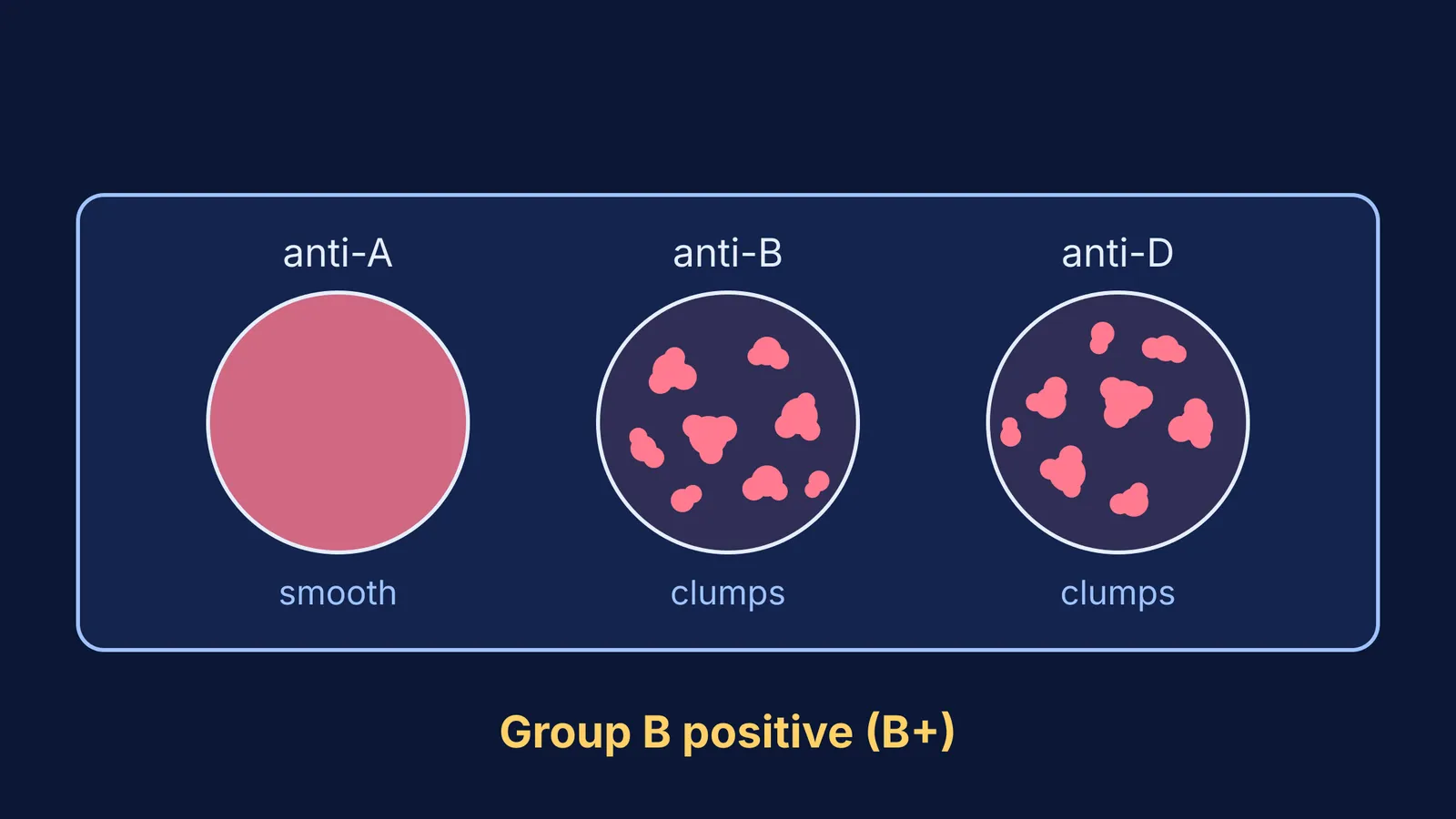
Look against a white background. Red flecks in clear fluid mean agglutination. An even, smooth red means no reaction.
How do you read the result?
In this key, a plus sign means anti-D clumped and a minus sign means it stayed smooth.
Anti-A clumps, anti-B smooth, anti-D clumps: A positive (A+)
Anti-A clumps, anti-B smooth, anti-D smooth: A negative (A−)
Anti-A smooth, anti-B clumps, anti-D clumps: B positive (B+)
Anti-A smooth, anti-B clumps, anti-D smooth: B negative (B−)
Anti-A clumps, anti-B clumps, anti-D clumps: AB positive (AB+)
Anti-A clumps, anti-B clumps, anti-D smooth: AB negative (AB−)
Anti-A smooth, anti-B smooth, anti-D clumps: O positive (O+)
Anti-A smooth, anti-B smooth, anti-D smooth: O negative (O−)
A worked example. Riya's anti-A drop stays smooth, while her anti-B and anti-D drops show red flecks. Her cells carry antigen B and the Rh antigen but not antigen A, so she is B positive. NCERT's table adds two things: her plasma holds anti-A, and for ABO she can receive blood from groups B and O. NCERT also says the Rh group should be matched before a transfusion. To try other pairs, open our interactive blood group compatibility explainer.
Is the slide test accurate enough for a transfusion?
Not on its own. Li and Guo describe the slide method as simple and rapid, at 5 to 10 minutes, and used for emergency grouping. They also say its sensitivity is low, it is hard to standardise, and weak or rare antigens are hard to detect with it. They call the tube method a more sensitive alternative, and they note that ABO testing is always mandatory before a transfusion.
So treat a classroom result as a way to learn the biology, not as a medical record. Hospitals and blood banks do their own grouping and matching before any transfusion.
How common is each blood group in India?
The first multicentric Indian study of ABO and Rh(D) groups, by Agrawal and colleagues (2014), included 10,000 healthy blood donors at blood banks in five regions of the country. O was the most common group at 37.12%, followed by B at 32.26%, A at 22.88% and AB at 7.74%. In that study, 94.61% of donors were Rh positive.
NCERT gives a different figure: it says the Rh antigen is found in "nearly 80 per cent" of humans. Learn both numbers, and check whether a question is about people in general or about Indian donors.
If antigens and antibodies still blur together, the Fermi Concept Library has a lesson for every biology concept and shows where each one sits on the map. For practice questions, the Fermi Problem Library has a step-by-step solver that explains the reasoning rather than printing an answer.
Next, find out how blood groups pass from parents to children: how multiple alleles decide ABO inheritance and why the Rh factor is inherited as a dominant trait.


