

On this page
A battery that keeps working for a century sounds like a sales pitch. It is real, but the catch is in the size of the output. A betavoltaic cell turns the beta particles from a radioactive source straight into electric current, using a semiconductor junction much like a solar cell. With nickel-63 the source lasts a human lifetime. The power is measured in microwatts, and only a small part of the decay energy becomes electricity. Working out both numbers is a good exercise in radioactivity and semiconductors together.
What is a betavoltaic battery?
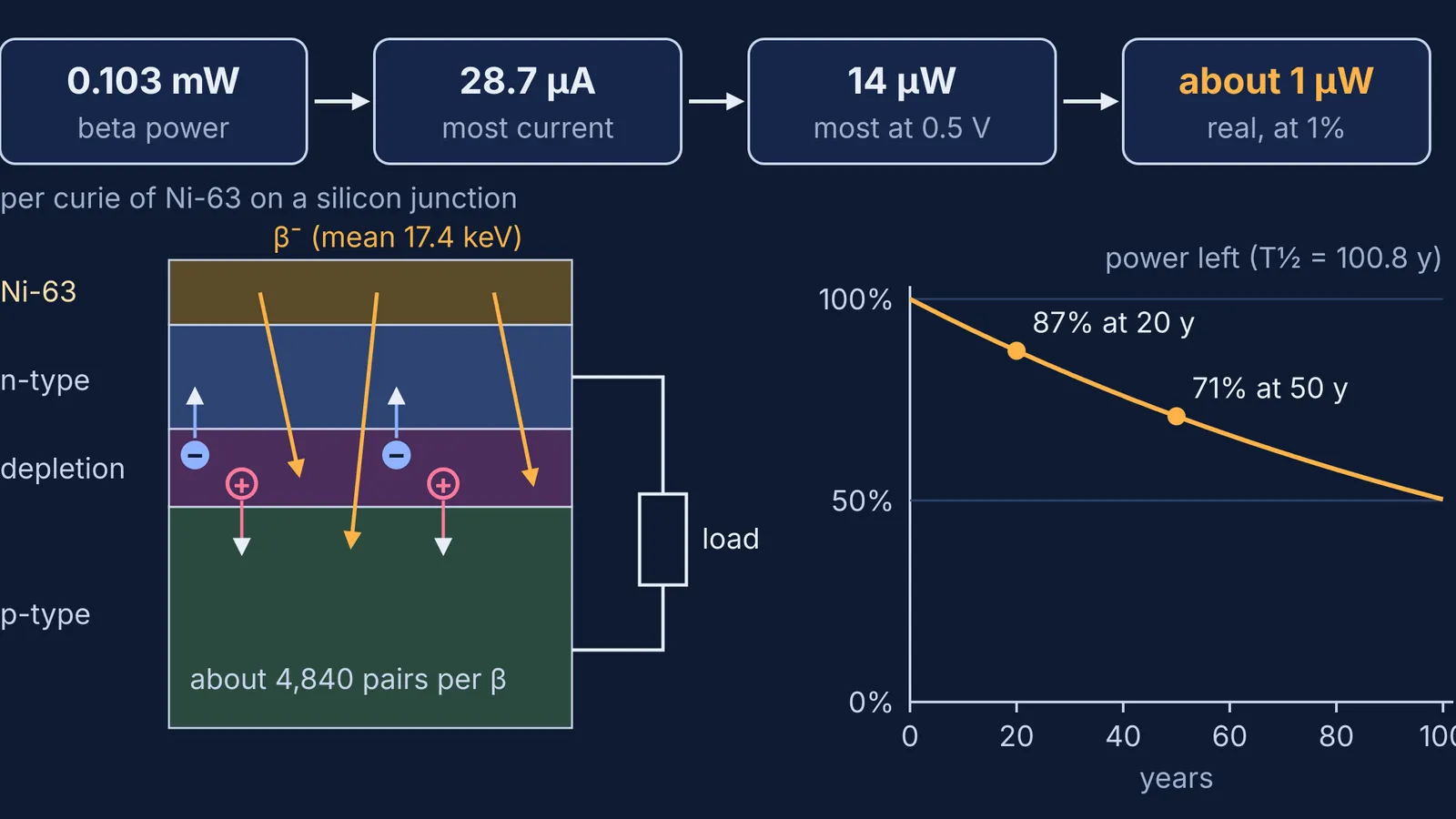
A betavoltaic cell has two parts: a thin layer of a beta-emitting isotope, and a p–n junction placed against it. Each beta particle is a fast electron. When it enters the semiconductor it knocks loose thousands of electrons from the valence band, creating electron–hole pairs. The built-in electric field of the depletion region pushes the electrons to the n side and the holes to the p side. Connect a load across the junction and that separated charge flows as current.
This is the same process as in a photodiode, except that a beta particle, not a photon, makes the pairs. A photon makes at most one pair, which is why responsivity is quoted in amps per watt in photodiode responsivity in silicon. A 17 keV beta makes thousands.
Betavoltaics are a different route from the radioisotope generators on spacecraft. Those turn decay heat into electricity with thermocouples, as explained in why spacecraft RTGs use plutonium-238. A betavoltaic cell skips the heat stage.
How much power does a curie of nickel-63 carry?
Start with nuclear data. The NNDC NuDat decay data for Ni-63 list:
half-life 100.8 years (other evaluations give about 101 years)
maximum beta energy 66.98 keV
mean beta energy 17.44 keV
Use the mean, not the maximum. Beta decay shares its energy with an antineutrino, so most betas come out well below the endpoint, and the antineutrino's share escapes completely.
One curie is 3.7 × 10¹⁰ decays per second. Each delivers 17.44 keV on average, and 1 eV = 1.602 × 10⁻¹⁹ J:
P = 3.7 × 10¹⁰ s⁻¹ × 17,440 eV × 1.602 × 10⁻¹⁹ J/eV = 1.03 × 10⁻⁴ W = 0.103 mW per curie
The same per-curie method, applied to tritium and a phosphor, is in how tritium exit signs glow with no power.
How many curies fit in a gram? With λ = ln 2/T½ and N = N_A/63, pure Ni-63 has an activity of about 56 Ci per gram. Real sources are nickel enriched only partly in Ni-63, so they hold less.
How much current can the betas make?
Making one electron–hole pair costs more energy than the band gap, because much of each beta's energy ends up as lattice vibrations (heat). A rule of thumb from Klein, quoted in a Physics Today review of betavoltaic power sources (Olsen, Cabauy and Elkind, 2012), is that the average energy per pair is about 2.8E_g + 0.5 eV. For silicon, with E_g = 1.12 eV, that is about 3.6 eV per pair.
So one mean-energy beta in silicon makes 17,440 ÷ 3.6 ≈ 4,840 pairs. If every pair from every beta were collected, a curie would give at most:
I = 3.7 × 10¹⁰ s⁻¹ × 4,840 × 1.602 × 10⁻¹⁹ C ≈ 28.7 µA
Why does so little of the energy become electricity?
Each collected pair can deliver at most the voltage across the junction, not the 3.6 eV it cost. With an illustrative operating voltage of 0.5 V, the ceiling is 0.5/3.6 ≈ 14%, about 14 µW per curie. The same review says Klein's relation caps betavoltaic efficiency at around 35% even for wide-gap semiconductors.
Real cells fall well below that ceiling. The review discusses self-absorption, backscatter and leakage; simple geometry adds a fourth loss:
Betas go everywhere. Decay is isotropic, so from a thin source roughly half the betas head away from the junction.
Self-absorption. Betas made deep in the source lose their energy in the source itself.
Backscatter. Some betas bounce off the semiconductor surface.
Recombination and leakage. Defects let pairs recombine, and leakage current matters when the useful current is only nanoamps.
For scale, one peer-reviewed 4H-SiC Schottky cell driven by a 0.12 mCi Ni-63 source reached a power conversion efficiency of 1.01%, with an open-circuit voltage of 0.27 V (Li et al., Journal of Radioanalytical and Nuclear Chemistry, 2011). Other designs report different figures, so treat "about one to a few per cent" as the range to expect.
A wide-gap material such as SiC (E_g about 3.26 eV) needs more energy per pair, about 9.6 eV by Klein's rule, so it makes only about 1,810 pairs per beta. It can hold a higher voltage per pair, though, which is why wide-gap junctions are studied.
Worked example: a 1 Ci Ni-63 cell on silicon
A silicon betavoltaic cell carries 1.0 Ci of Ni-63. Assume 3.6 eV per pair and an operating voltage of 0.5 V. Find the beta power, the largest possible current and power, the output at 1% efficiency, and the output after 20 years.
Beta power. 3.7 × 10¹⁰ × 17,440 × 1.602 × 10⁻¹⁹ = 1.03 × 10⁻⁴ W = 103 µW.
Pairs per beta. 17,440 eV ÷ 3.6 eV ≈ 4,840.
Largest current. 3.7 × 10¹⁰ × 4,840 × 1.602 × 10⁻¹⁹ C = 2.87 × 10⁻⁵ A = 28.7 µA.
Largest electrical power. P = VI = 0.5 V × 28.7 µA = 14.4 µW, which is 14% of 103 µW.
At 1% efficiency. 0.01 × 10³ µW ≈ 1.0 µW. Units check: W = J/s, and V × A = J/C × C/s = J/s.
After 20 years. Output falls with the activity: (1/2)^(20/100.8) = 0.87, so about 0.90 µW. After 50 years it is 0.71 of the start, and after 100.8 years, half.
A microwatt runs a low-power sensor or keeps a memory chip alive. A phone draws around a million times more, which is why these cells suit tiny, long-lived electronics and not phones.
Commercial products exist, but quote them only from a source. The Physics Today review, for example, describes City Labs' tritium-powered NanoTritium cell as the first betavoltaic device to receive a general licence, in 2010.
If decay constants, activity or the depletion region need a refresher, the Concept Library covers each idea from the start.
Quick checklist
Beta power = activity × mean beta energy; for Ni-63, 0.103 mW per curie.
Use the mean beta energy (17.44 keV), never the maximum (66.98 keV).
Pairs per beta = beta energy ÷ pair-creation energy (about 3.6 eV in Si), not ÷ band gap.
Electrical power ≤ pairs collected × charge × junction voltage.
Real Ni-63 cells reach about one to a few per cent.
Power decays as (1/2)^(t/T½): 87% after 20 years.


