

On this page
Beyond Jupiter, sunlight is too weak to run a spacecraft on solar panels, and on Mars a rover has to keep working through dust storms and the long nights. So NASA's Curiosity and Perseverance rovers carry a radioisotope thermoelectric generator, or RTG. It holds a few kilograms of plutonium-238, which heats itself through alpha decay, and a ring of thermocouples turns part of that heat into electricity. This post works out where the 0.57 W per gram comes from, why plutonium-238 is chosen and not the far more common plutonium-239, and how much power is left after decades in space.
What is an RTG and how does it make electricity?
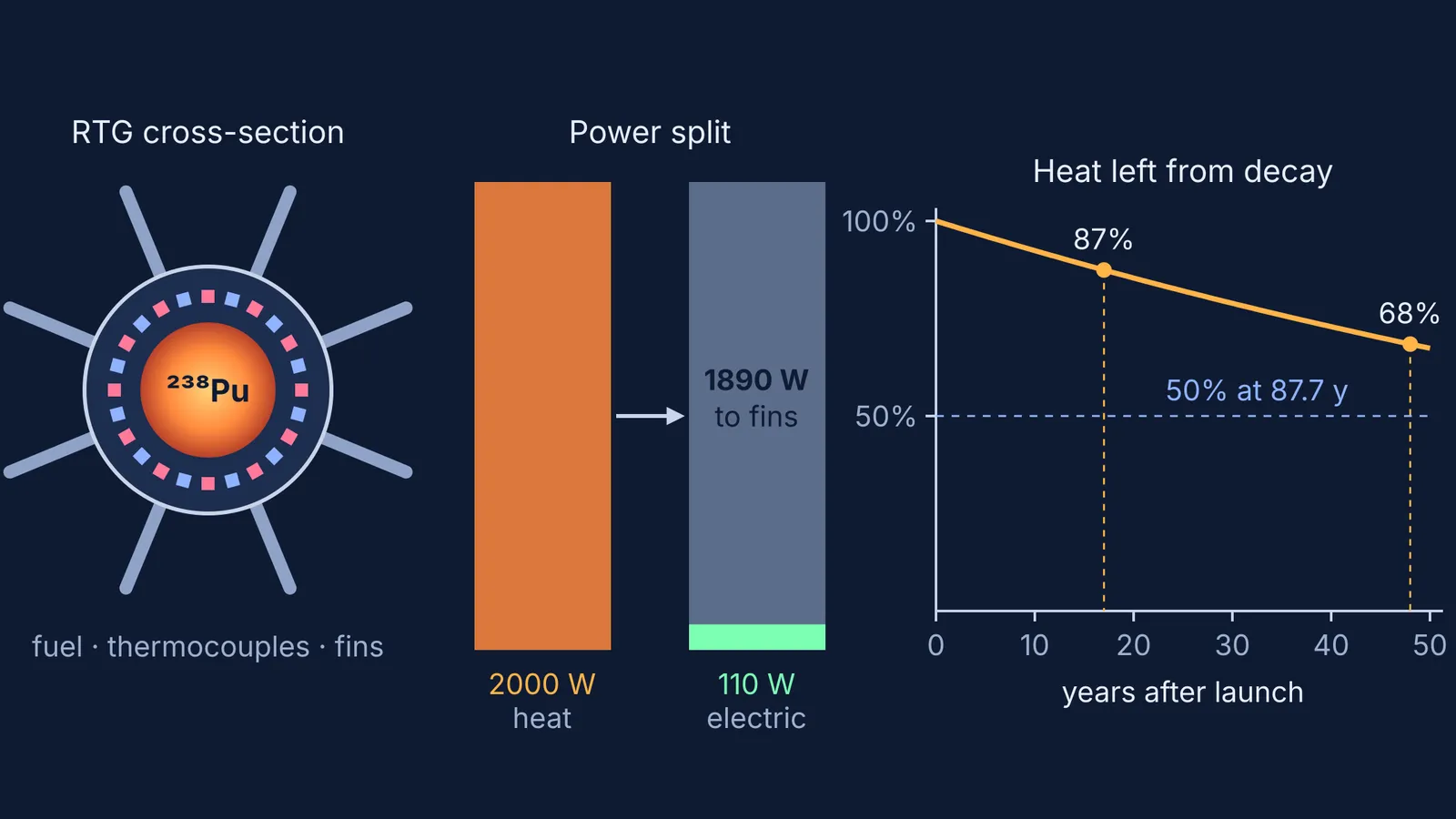
An RTG has three parts:
A heat source. Pellets of plutonium dioxide (PuO₂) packed inside protective modules at the centre of the generator.
Thermocouples. Junctions of two different semiconductors placed between the hot core and the cold outer wall. A temperature difference across a junction of two different materials drives a current. This is the Seebeck effect; its history is told in how Thomas Seebeck got electricity from a temperature gap.
Fins. The outer case has radiator fins that dump the leftover heat into space, keeping the cold side cold.
There are no moving parts, which is why an RTG can run for decades with nobody to repair it.
Why does plutonium-238 get hot?
Every ²³⁸Pu nucleus eventually emits an alpha particle and becomes uranium-234. The NNDC nuclear data for plutonium-238 give a half-life of 87.7 years and a decay energy (Q value) of 5.593 MeV, with essentially 100% alpha decay.
An alpha particle is stopped by a very thin layer of solid, far less than a millimetre. So almost every alpha particle stops inside the fuel pellet itself, and its kinetic energy becomes heat right there. The daughter nucleus recoils with the rest of the Q value and also stops in the fuel. How the 5.593 MeV is split between the alpha (about 5.50 MeV) and the recoiling uranium nucleus is worked in the post on alpha-decay recoil energy. For heating, you need the whole Q value, because both pieces stay in the pellet.
The heavy casing around the fuel is not there to stop alpha particles. It is there to keep the plutonium contained if a launch fails or the craft re-enters the atmosphere.
How do you calculate the power per gram of plutonium-238?
Heat output per second = (decays per second) × (energy per decay). Decays per second is the activity A = λN, and the post on activity units covers turning a mass into N.
Worked example: specific power of ²³⁸Pu
Decay constant. T½ = 87.7 y = 87.7 × 3.156 × 10⁷ s = 2.768 × 10⁹ s. So λ = 0.693 / 2.768 × 10⁹ s = 2.505 × 10⁻¹⁰ s⁻¹.
Nuclei in 1 g. N = (1 g / 238.05 g mol⁻¹) × 6.022 × 10²³ mol⁻¹ = 2.530 × 10²¹.
Activity of 1 g. A = λN = 2.505 × 10⁻¹⁰ × 2.530 × 10²¹ = 6.34 × 10¹¹ Bq, about 17 Ci.
Energy per decay. Q = 5.593 MeV × 1.602 × 10⁻¹³ J/MeV = 8.96 × 10⁻¹³ J.
Power. P = A × Q = 6.34 × 10¹¹ s⁻¹ × 8.96 × 10⁻¹³ J = 0.568 W.
Units check: s⁻¹ × J = J/s = W. So one gram of ²³⁸Pu gives about 0.57 W of heat, continuously. A kilogram gives 568 W, enough to make the pellet glow red if it cannot lose heat.
Why use plutonium-238 and not plutonium-239?
Repeat the calculation for ²³⁹Pu. The NNDC data for plutonium-239 give T½ = 24,110 years and Q = 5.245 MeV. The decay energy is almost the same, but the half-life is 275 times longer, so the activity per gram is 275 times smaller. The result is 0.0019 W/g, about 294 times less than ²³⁸Pu.
The trade-off is set by the half-life:
Too short (days or months): lots of power at launch, but it is gone before the craft reaches Saturn.
Too long (thousands of years): very stable, but each gram gives almost nothing, so the fuel would weigh tonnes.
About a century, as with ²³⁸Pu: high power per gram, and still most of it left after a few decades.
It also matters that ²³⁸Pu emits alphas and very little penetrating gamma radiation, so the instruments and electronics nearby need little shielding.
How much power does a real RTG give?
NASA's MMRTG fact sheet lists 4.8 kg of plutonium dioxide giving approximately 2,000 W of heat, 110 W of electricity at the beginning of life, and an expected 72 W after 17 years. NASA states that ²³⁸Pu makes up about 71% of the oxide by weight.
Mass of ²³⁸Pu. 0.71 × 4.8 kg = 3.41 kg.
Heat. 3,408 g × 0.568 W/g = 1,935 W. This agrees with NASA's "approximately 2,000 watts".
Efficiency. 110 W / 2,000 W = 5.5%. NASA rounds it to 6%. The other 1,890 W leaves through the fins as heat.
Thermocouples are a poor heat engine, far below the Carnot limit. Engineers accept this because they have no moving parts to wear out.
How fast does an RTG's power fall?
Heat output follows the same law as the number of nuclei: P = P₀ × 2^(−t/T½).
After 14 years: 2^(−14/87.7) = 0.895, so 89.5% of the heat remains.
After 17 years: 0.874. From decay alone, 110 W would fall to 96 W.
After 48 years: 0.684, so 68.4% remains.
NASA's design figure at 17 years is 72 W, not 96 W. The extra loss comes from the thermocouples themselves, which slowly degrade at high temperature. So 72/96 = 75% of the decay-only value is reached. This is a useful exam point: radioactive decay sets the upper limit, and real hardware falls below it.
If you want to check these steps on a similar decay-power problem, the Fermi Problem Library has a step-by-step solver that explains the reasoning at each stage.
Quick checklist
An RTG converts alpha-decay heat into electricity with thermocouples; there is no fission.
Specific power = λ × (N_A/M) × Q; for ²³⁸Pu it is about 0.57 W/g.
Use the full Q value, because both the alpha and the recoiling nucleus stop in the fuel.
²³⁹Pu gives about 294 times less power per gram because its half-life is 275 times longer.
MMRTG: about 2,000 W of heat, 110 W of electricity, about 5.5% efficient.
Power falls as 2^(−t/87.7 y), and thermocouple ageing lowers it further.


