

On this page
Long before refrigerators, people in the Ganga plains made ice on winter nights when the air never dropped to 0 °C. They left water in shallow clay pans on beds of straw, and by dawn the pans held ice. No chemical trick was involved. The water froze because it was losing heat to the clear night sky faster than the air could give heat back.
How did people make ice in Bengal and Allahabad?
The clearest first-hand account is a letter by Sir Robert Barker, published in the Philosophical Transactions of the Royal Society in 1775 (The Process of Making Ice in the East Indies, Phil. Trans. 65). He describes ice made at Allahabad, Mootegil and Calcutta, from December to February. His account, in short:
Workers dug pits on an open plain, about thirty feet square and two feet deep.
They filled the bottom with eight inches to a foot of dry sugar-cane or corn stalks.
On the straw they set rows of small, shallow, unglazed earthenware pans, about an inch and a quarter deep, made of porous clay.
At dusk the pans were filled with boiled soft water. Before sunrise the ice was collected and packed into a deep, straw-lined store.
Barker noted that the weather decided everything. The most ice came on calm, serene nights with a thin, dry atmosphere and little dew. Changing winds and clouds stopped it. He also wrote that water could freeze when the air was some degrees above the freezing point, though he admits he did not record the night temperatures himself.
Why can water freeze when the air is above 0 °C?
Every surface emits thermal radiation, and the amount follows the Stefan–Boltzmann law, εσT⁴. How Stefan found the fourth power is told in how Josef Stefan found the radiation law. The water in the pan emits upward as a body near 273 K. The sky sends radiation back down, from water vapour and carbon dioxide in the air above.
A clear, dry sky sends back much less than a blackbody at air temperature would. Physicists describe this with a sky emissivity ε_sky: the downward radiation is ε_sky σT_a⁴, where T_a is the air temperature near the ground. Berdahl and Martin of Lawrence Berkeley Laboratory fitted years of clear-sky measurements to a formula that depends only on the dew point T_dp in °C (Emissivity of Clear Skies, 1982):
ε_sky = 0.711 + 0.56(T_dp/100) + 0.73(T_dp/100)²
They add about 0.013 at night. Dry air (low dew point) means a low emissivity, so a colder-looking sky. That is why Barker's good nights were dry ones.
The net loss from the water surface per square metre is then
q = ε_w σ(T_w⁴ − ε_sky T_a⁴) − hΔT
The second term is heat the air gives the water by convection, with h a heat transfer coefficient and ΔT the air–water temperature difference. The air is warmer than the water, so this term is a gain. The question is which wins.
Worked example: how much ice in one night?
Assumptions, all clearly illustrative: air at 5 °C (278.15 K), dew point −5 °C, water emissivity 0.96, calm air with h = 3 W/m² K, a 1 cm layer of water starting at 8 °C, and 12 hours of clear night. Take the water surface at 0 °C (273.15 K), its temperature while it freezes.
Sky emissivity. 0.711 + 0.56 × (−0.05) + 0.73 × 0.0025 + 0.013 = 0.698.
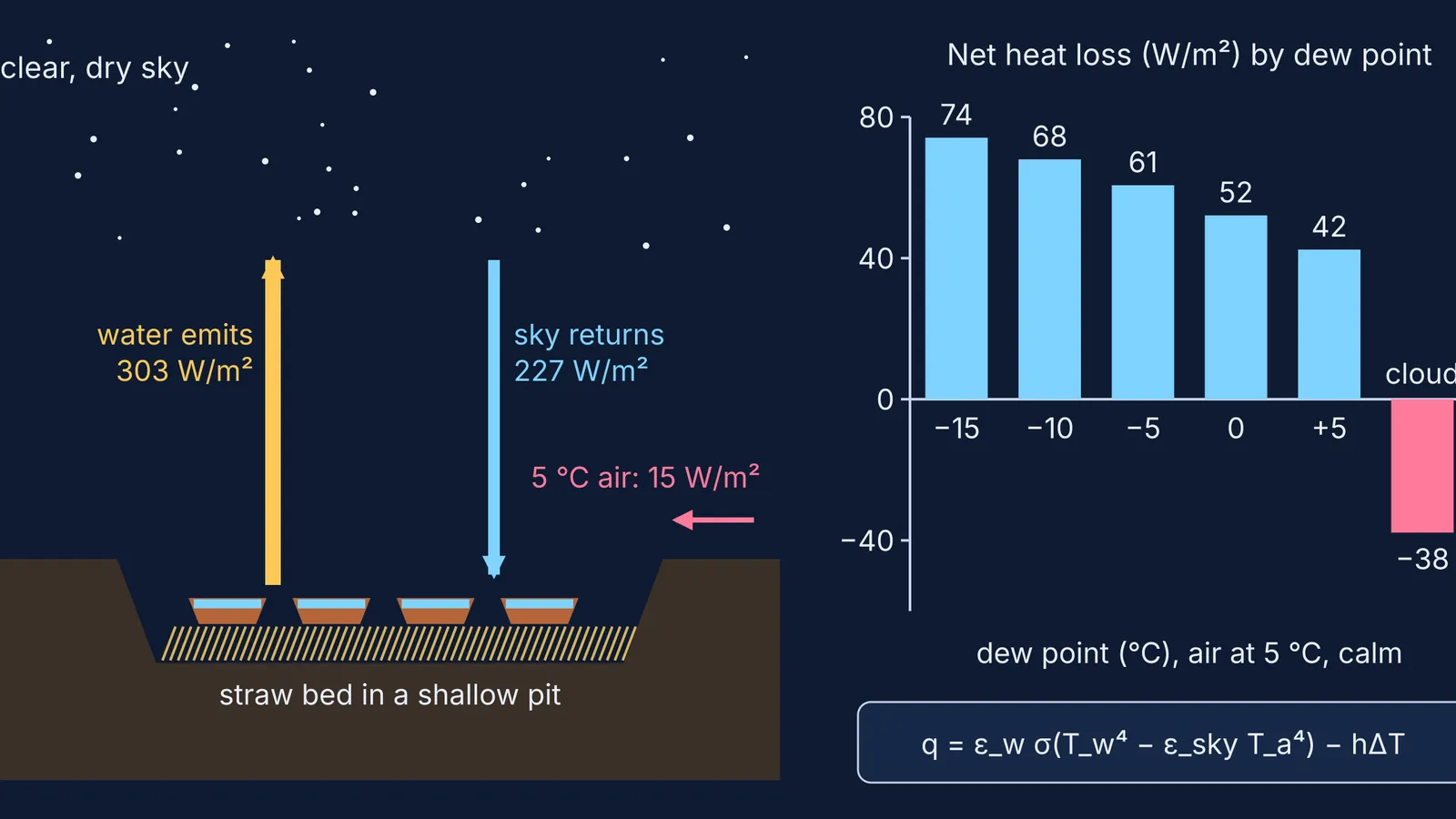
Radiation out. σT_w⁴ = 5.67 × 10⁻⁸ × 273.15⁴ = 315.6 W/m². Times 0.96: 303.0 W/m².
Radiation back from the sky. σT_a⁴ = 339.4 W/m². Times 0.698 is 236.8 W/m², and the water absorbs 0.96 of that: 227.4 W/m².
Net radiation. 303.0 − 227.4 = 75.6 W/m². The sky acts like a blackbody at 0.698^¼ × 278.15 = 254 K, about −19 °C.
Heat from the air. 3 × 5 = 15 W/m². Net loss: 75.6 − 15 = 60.6 W/m².
Energy lost in 12 hours. 60.6 × 43,200 s = 2.62 MJ per m².
Cooling the water first. A 1 cm layer is 10 kg per m². Cooling it from 8 °C to 0 °C takes 10 × 4186 × 8 = 0.335 MJ.
Ice formed. The remaining 2.28 MJ, divided by 334 kJ/kg, freezes 6.8 kg per m². That is 6.8 mm of ice: about two-thirds of the layer.
Check the units: W/m² × s = J/m², and J/m² ÷ J/kg = kg/m², which for water is millimetres of thickness.
The numbers say a thin layer freezes in a long, clear, calm night, and a thick one does not. That fits Barker's pans, only about 3 cm deep, and his note that the whole contents froze solid on the most favourable nights.
What stops the pans from freezing?
Run the same sum with different conditions.
Humid air. At a dew point of +5 °C the net loss drops to 42 W/m². At −15 °C it rises to 74 W/m².
Cloud. A low cloud deck radiates like a blackbody at about air temperature. Put ε_sky = 1 and the net radiation becomes 0.96 × (315.6 − 339.4) = −23 W/m². The water now gains heat from both sky and air, and nothing freezes.
Wind. Wind raises h. At h = 10 W/m² K the air supplies 50 W/m² and the net loss falls to about 26 W/m², less than half.
Warm ground. The ground below stays warmer than the water. Dry straw is a poor conductor and blocks that heat. Barker also thought the hollow stalks let cold air pass under the pans.
Did evaporation help too?
Yes. Porous, unglazed pans let water seep to the outer surface and evaporate, and evaporation carries off latent heat. In dry air at a dew point below the water temperature, the open water surface evaporates as well. Both add to the cooling. The worked example leaves them out, so it underestimates the ice. It also leaves out the extra radiation in the first hours, when the water is warmer than 0 °C. The same kind of clear-night cooling explains why frost forms on crops on clear winter nights; here it is pushed one step further, from frost on leaves to ice in a pan.
If you want to practise energy-balance problems like this one, the Fermi Problem Library has a step-by-step solver that explains the reasoning.
Quick checklist
The water loses heat by radiation, εσT⁴, and gains it from the sky and the air.
A clear, dry sky returns far less than σT_a⁴; its emissivity depends on the dew point.
At air 5 °C and dew point −5 °C the net loss is about 61 W/m² on a calm night.
12 hours of that freezes roughly 7 mm of a 1 cm layer.
Cloud, wind or humid air stops the freezing; straw keeps out heat from the ground.
Evaporation from porous pans adds extra cooling.


