

On this page
A jeweller's balance can show a difference of a milligram on a beam that weighs a hundred grams. What makes it that sensitive is not the knife edge alone. It is where the beam's centre of gravity sits: a tiny distance below the knife edge. Put it lower and the balance is sluggish. Put it above and the beam falls over. And the more sensitive you make it, the more slowly it swings, so a fine weighing always takes longer.
The ordinary equal-arm balance compares two masses, and the error from unequal arms is covered in the unequal-arm balance and double weighing. This post is about a different question: how small a difference the balance can show.
What decides how sensitive a beam balance is?
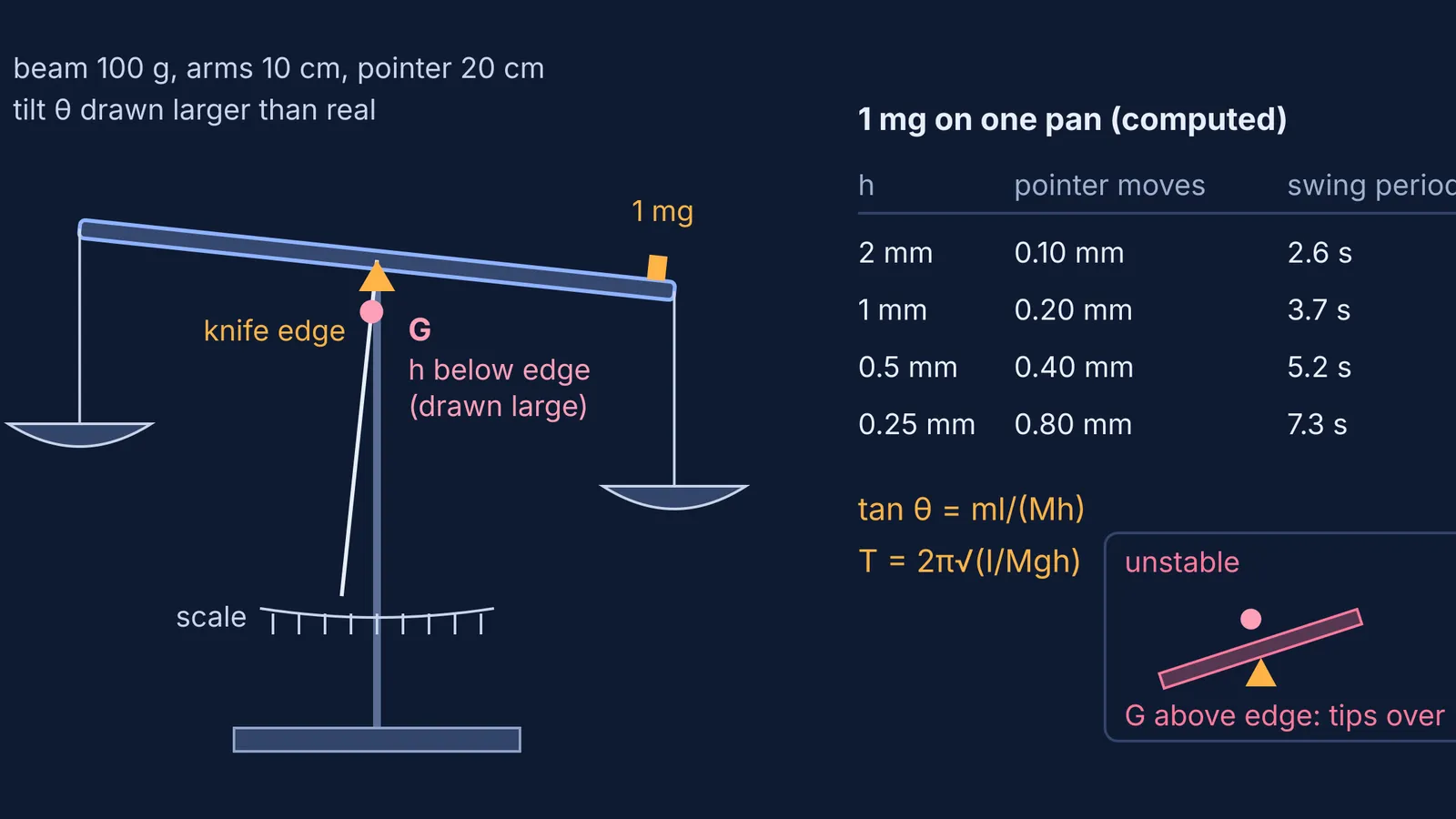
Call the sensitivity the angle the beam turns for a small extra mass m on one pan. Set up the balance like this:
the beam has mass M and pivots on a central knife edge;
each pan hangs from an end knife edge at distance l from the centre;
the centre of gravity G of the beam (with its pointer) lies a distance h directly below the central edge when the beam is level;
the three knife edges lie in one straight line.
Add m to the right pan. The beam tilts by θ. Two torques about the central edge now balance:
Turning torque from the extra mass. The weight mg hangs straight down from the end edge. Its lever arm is l cos θ, so the torque is mgl cos θ.
Restoring torque from the beam. When the beam tilts, G swings sideways by h sin θ. The weight Mg then has a lever arm h sin θ on the other side, giving Mgh sin θ.
Set them equal: mgl cos θ = Mgh sin θ, so
tan θ = ml/(Mh)
Because the end edges are in line with the centre edge, the equal loads in the two pans add no torque of their own, so this result does not depend on how much you are weighing. The 1860 Encyclopaedia Britannica article on the balance recommends exactly this layout, with the three points of action in a straight line so that the restoring force does not change with load.
The formula says a balance is more sensitive with long arms, a light beam and a small h. Makers fit a small screw bob near the middle of the beam that moves up or down to set h.
Why must the centre of gravity sit below the knife edge?
The sign of h decides the kind of equilibrium.
G below the edge (h > 0). Tilting the beam swings G to the side that pushes it back. The equilibrium is stable and the beam settles at the angle above.
G at the edge (h = 0). No restoring torque at all. The equilibrium is neutral: the empty beam rests at any angle, and any extra mass sends it to its stop.
G above the edge (h < 0). Tilting the beam moves G so that its weight tips the beam further. The equilibrium is unstable and the beam falls to one side.
The Museo Galileo's note on balance sensitivity puts it the same way: a beam is most sensitive with its centre of gravity slightly below the axis, and too far below makes it too stable to register small differences.
Worked example: what does 1 mg do to a 100 g beam?
The numbers here are illustrative, not those of a particular instrument. Take M = 100 g = 0.100 kg, l = 10 cm = 0.100 m, a pointer 20 cm long and h = 1 mm.
Tilt. tan θ = ml/(Mh) = (1 × 10⁻⁶ × 0.100)/(0.100 × 1 × 10⁻³) = 1.0 × 10⁻³. So θ = 1.0 × 10⁻³ rad, about 0.057°.
Pointer movement. The tip moves 0.20 m × 1.0 × 10⁻³ = 0.20 mm.
Smallest mass you can read. If you can read the pointer to 0.1 mm, the smallest mass you can detect is 0.5 mg.
Halve h. With h = 0.5 mm, the same 1 mg moves the pointer 0.40 mm. At h = 0.25 mm it moves 0.80 mm. At h = 2 mm it moves only 0.10 mm.
Units: kg × m over kg × m, so tan θ is a pure number, as it must be.
Why does a more sensitive balance swing more slowly?
A tilted beam does not settle at once. It rocks about the knife edge, and it is a physical pendulum, the kind worked in physical pendulum and angular SHM problems. For small swings the restoring torque is Mghθ, so
T = 2π√(I/(Mgh))
where I is the moment of inertia about the knife edge. Treat the beam as a uniform rod of length 2l, plus the offset of G: I = M(2l)²/12 + Mh². With the numbers above (beam alone, pans ignored):
h = 2 mm: T = 2.6 s
h = 1 mm: T = 3.7 s
h = 0.5 mm: T = 5.2 s
h = 0.25 mm: T = 7.3 s
The deflection goes as 1/h, but the period goes as 1/√h, because I hardly changes when h is this small. So doubling the sensitivity makes each swing √2 ≈ 1.4 times slower. Loaded pans make it slower still: 20 g hanging at each end raises the period at h = 1 mm from 3.7 s to 5.4 s, because the loads add inertia but, being in line with the centre edge, no restoring torque. The Britannica article notes that a properly adjusted sensitive balance swings "extremely slow and regular". Chemists saved time by reading the turning points of the swing instead of waiting for it to stop, and later balances added air dampers.
What if the end knife edges are not in line with the centre?
Suppose the end edges sit a distance d below the centre edge. Then the two pan loads, each of weight Pg, act like extra mass hanging below the pivot, and the restoring torque becomes (Mh + 2Pd)g sin θ. The sensitivity is now tan θ = ml/(Mh + 2Pd), which falls as you add load. With d = 0.5 mm and 50 g in each pan, the denominator grows by half, so the balance is 1.5 times less sensitive than when empty. With the end edges above the centre, the sign flips, the balance grows more sensitive with load and can turn unstable. That is the reason for the straight-line rule.
A twelfth-century precision balance, with no theory of its sensitivity given, is described in Al-Khazini's balance of wisdom. For more on torque, stability and the physical pendulum, the Concept Library covers each idea from the start.
Quick checklist
Sensitivity: tan θ = ml/(Mh), with the three knife edges in a line.
Long arms, light beam and small h make a sensitive balance.
G below the edge is stable, at the edge neutral, above it unstable.
The swing is a physical pendulum: T = 2π√(I/(Mgh)).
Sensitivity goes as 1/h and the period as 1/√h, so finer weighing is slower.
End edges below the centre make the balance less sensitive under load.


