

On this page
Every spring, bar-headed geese that spend the winter in India fly north over the Himalayas to breed around the lakes of the Tibetan plateau (Jessen et al., 1991, PNAS). Tracking showed that geese wintering at sea level in India can cross the Himalayas in one day, typically climbing 4,000-6,000 m in 7-8 hours (Hawkes et al., 2011). They climb under their own power, even at night, without relying on daytime upslope tailwinds.
How thin is the air where bar-headed geese fly?
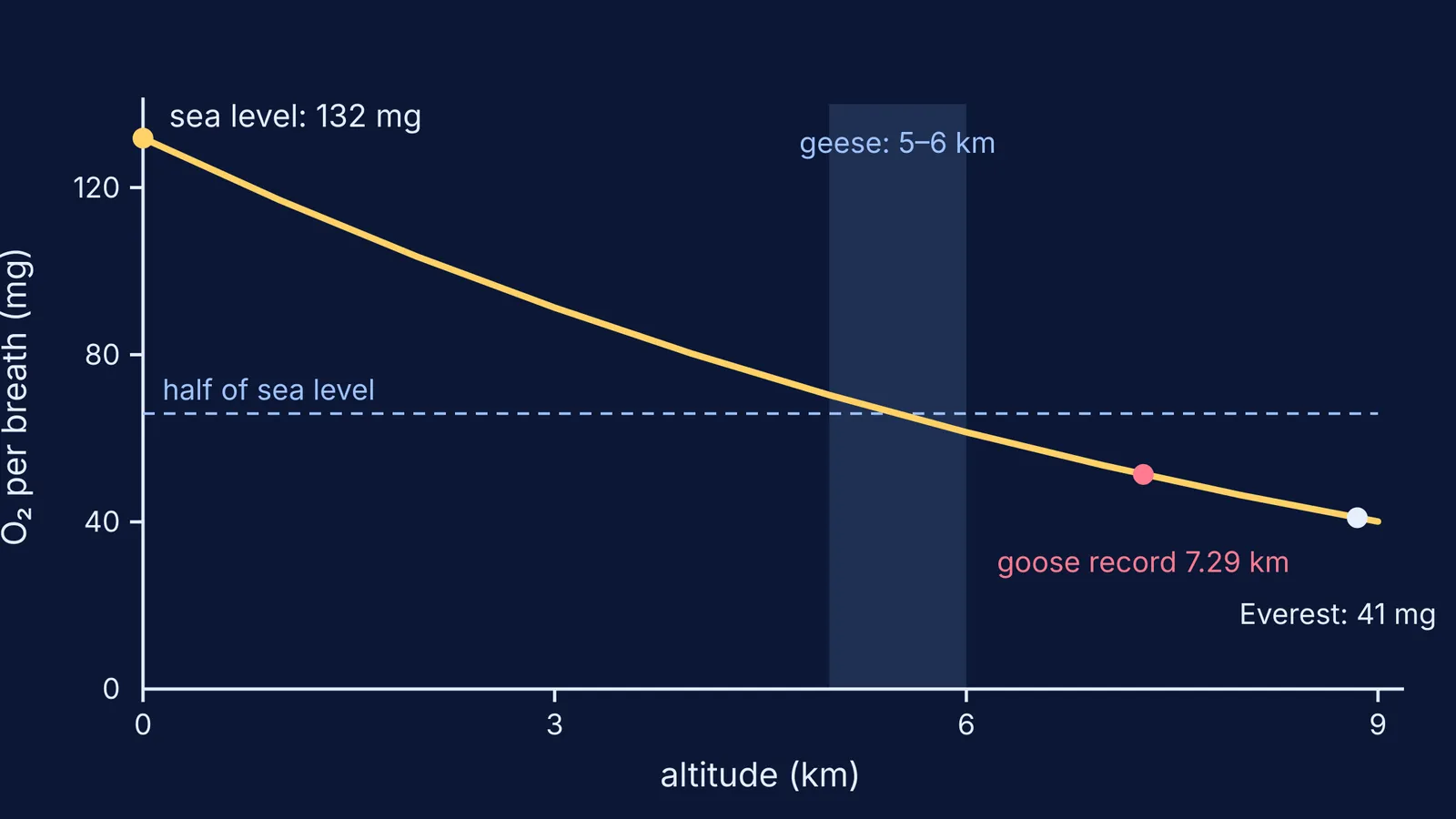
Most bar-headed geese reach 5,000-6,000 m on migration, where the oxygen partial pressure is roughly half of that at sea level, and one tracked bird reached 7,290 m (Scott et al., 2015, Physiology). The same review notes that, in wind-tunnel tests, flapping flight needs 10 to 15 times the resting oxygen use, and that these geese very rarely glide.
How much oxygen is in one breath of thin air?
You can estimate this with the ideal gas law, n = PV/RT.
Pressure. NASA's model of the lower atmosphere gives T = 15.04 - 0.00649h (°C) and p = 101.29 × [(T + 273.1)/288.08]^5.256 (kPa), with h in metres (NASA Glenn Research Center). That gives about 101 kPa at sea level, 47 kPa at 6,000 m and 32 kPa at 8,849 m.
Oxygen share. Oxygen is 20.95% of Earth's air (NASA Earth fact sheet).
Breath size. A resting breath is about 500 mL for an average man and 400 mL for a woman (University of Iowa ventilator course). Take 500 mL, warmed to about 310 K.
Sea level. n = 0.2095 × 101,400 Pa × 0.0005 m³ ÷ (8.314 × 310) ≈ 0.0041 mol, about 132 mg of oxygen.
Higher up. Only P changes, so the same breath holds about 61 mg at 6,000 m and 41 mg at Everest's summit height.
This rough estimate ignores water vapour in the lungs, which lowers every figure a little. It matches Charles Bishop's statement that at 5,500 m a lungful holds around half the sea-level oxygen (Bishop, The Conversation). At Everest height you would need to move about three times as much air for the same oxygen.
How do bar-headed geese get enough oxygen?
The Scott review describes changes at almost every step oxygen takes from air to flight muscle (Scott et al., 2015):
Breathing: in severe hypoxia, total ventilation is roughly twice that of the lowland greylag goose, with deeper, less frequent breaths that waste less air in the airways.
Lungs: about 25% larger than those of lowland waterfowl of comparable body mass.
Blood: a whole-blood P50 of 4.0 kPa, against 5.3 kPa in the greylag goose.
Heart and muscle: 30-40% higher capillary density in the left ventricle than in lowland birds, and more capillaries in flight muscle.
P50 is the oxygen pressure at which haemoglobin is half loaded; a lower P50 means haemoglobin grabs oxygen more readily from thin air.
Jessen and colleagues found that bar-headed and greylag goose haemoglobins differ by four substitutions, one of them (proline to alanine at position 119 of the alpha chain) unique among bird sequences (Jessen et al., 1991, PNAS). A later study that rebuilt the ancestral haemoglobin found this change had the largest effect of the substitutions tested, cutting its P50 by 18% (Natarajan et al., 2018, PLoS Genetics).
Do bar-headed geese fly over Mount Everest?
Probably not. Heart-rate loggers showed that migrating geese hug the landforms, repeatedly losing and regaining height, a strategy that saves energy overall (Bishop et al., 2015, Science). Bishop reports that the birds mostly stayed within about 100 m of the ground, and that a 5% rise in wingbeat frequency brought an average 19% rise in heart rate and a 40% rise in oxygen use (The Conversation). He calls sightings over Everest unlikely. Route-finding is another story: how migratory birds navigate.
How do humans cope at the same altitude?
Much more slowly. In climbers on Everest, the oxygen content of arterial blood stayed at or above sea-level values up to 7,100 m because their haemoglobin concentration rose during the expedition (Grocott et al., 2009, NEJM). At 8,400 m their mean arterial oxygen pressure was 3.28 kPa, and arterial oxygen content was 26% lower than at 7,100 m. A goose crossing in a day has no such time; its advantages are built in.
For how people manage at height, see how soldiers survive at Siachen.
How can you use this for biology revision?
The goose is a ready-made map of the oxygen pathway in Class 11 biology. At each step, ask what the goose changed:
Lungs: how much air moves, over how much surface?
Blood: where does the oxygen dissociation curve sit?
Heart and capillaries: how fast is oxygen delivered?
Muscle: how far is it from capillary to cell?
Then test yourself with breathing and exchange of gases sequence questions. If the dissociation curve still feels abstract, the Fermi Concept Library gives each concept its own lesson, and the Fermi Simulation Lab has interactive simulations for ideas easier to see than read.


