

On this page
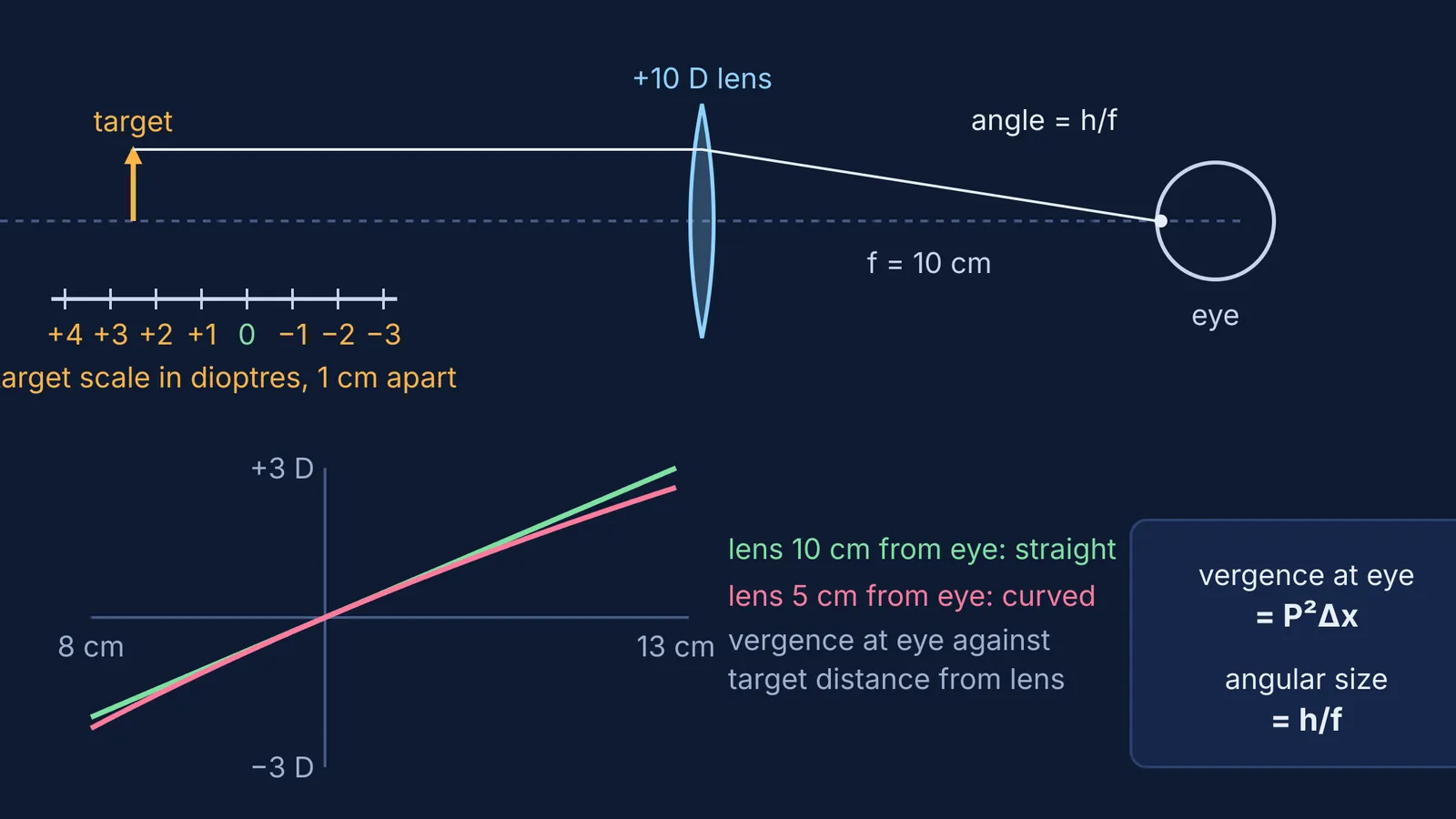
Move a small target along a rail in front of a +10 D lens, look through the lens from exactly 10 cm behind it, and something neat happens. Every centimetre you move the target changes the vergence of the light reaching your eye by exactly 1 dioptre, and the target never seems to grow or shrink. This arrangement is the Badal optometer, and the lensmeter at an optician's counter uses the same trick to read a spectacle lens's power off a straight scale. All it takes is the lens formula and one well-chosen distance.
What is vergence, and which sign convention is used here?
Vergence is how strongly light is spreading out or closing in. In dioptres it is 1 divided by the distance, in metres, to the point the light is coming from or heading towards. This post uses the optometry habit: converging light is positive, diverging light is negative. Light from a point 50 cm away diverges with a vergence of −2 D; light heading to a point 1 m ahead converges with +1 D.
Positions on the rail are given as plain distances from the lens. Where we use the lens formula, we use NCERT's Cartesian convention, 1/v − 1/u = 1/f, with u negative for a real object. Power in dioptres is P = 100/f with f in centimetres, as explained in power of a lens when focal length is in centimetres.
How does a Badal optometer work?
Put a lens of power P one focal length f in front of the eye, so that the lens's second focal point sits at the eye. Place a target a distance x in front of the lens, near the first focal point, and write Δx = x − f.
Light leaving a target at x has vergence −1/x at the lens. The lens adds P, so just after the lens the vergence is P − 1/x.
That light then travels a distance f = 1/P to the eye. A vergence V becomes V/(1 − dV) after a distance d, which gives (P − 1/x) ÷ (1 − (P − 1/x)/P) = P(Px − 1).
Since Px − 1 = P(x − f), the vergence at the eye is P²Δx.
The answer is linear in Δx: no curve, no reciprocal. Units check: P² is in m⁻², Δx in metres, so P²Δx is in m⁻¹, dioptres. For P = +10 D, P² = 100 D², so each centimetre is 100 × 0.01 = 1 D.
Researchers use this rule as a calibration. An infrared Badal optometer described in Optometry and Vision Science (Teel and colleagues, 2008) uses V = x/f² and quotes a scale of 0.178 D per millimetre, which corresponds to a Badal lens of focal length √(1/178) m ≈ 7.5 cm.
Why does the target never change size?
Follow the ray from the top of the target that runs parallel to the axis. The lens bends it through the second focal point, which is exactly where the eye is. It arrives at an angle h/f, whatever the target's distance, because a ray parallel to the axis does not care where along the axis it started. So a 5 mm target seen through a 10 cm lens always looks 0.005 ÷ 0.1 = 50 milliradians tall, about 2.9°. A shift in focus never comes with a hint from the target's size.
Worked example: a +10 D Badal lens, step by step
Take P = +10 D, so f = 10 cm, and put the lens 10 cm in front of the eye. Use the lens formula for each target position.
Target at 11 cm. 1/v = 1/10 − 1/11 = 1/110, so v = +110 cm. The image is 110 − 10 = 100 cm beyond the eye, so light reaches the eye converging with +1.000 D.
Target at 12.5 cm. 1/v = 1/10 − 1/12.5 = 1/50, so v = 50 cm, which is 40 cm beyond the eye: +2.500 D.
Target at 13 cm. 1/v = 1/10 − 1/13 = 3/130, so v = 43.33 cm, 33.33 cm beyond the eye: +3.000 D.
Target at 9 cm. 1/v = 1/10 − 1/9 = −1/90, so v = −90 cm, a virtual image 100 cm in front of the eye: −1.000 D.
Target at 10 cm. The image is at infinity: 0 D.
Exactly 1 D per centimetre, both ways. Now move the lens to 5 cm from the eye and keep the same target positions. The image distances are unchanged, but the eye is 5 cm closer to them: 11 cm gives 1/1.05 = 0.952 D, 12.5 cm gives 1/0.45 = 2.222 D, and 13 cm gives 1/0.3833 = 2.609 D. The steps are no longer equal, and the scale would need uneven markings.
A stronger lens makes the scale finer: with +20 D (f = 5 cm), P² = 400 D², so each centimetre is worth 4 D.
How does a lensmeter read a spectacle lens?
A lensmeter, or focimeter, runs the Badal idea backwards. The SPIE Field Guide to Visual and Ophthalmic Optics (Schwiegerling) describes it this way: a target is imaged through a standard lens of focal length f, the spectacle lens sits at that lens's rear focal point, and the user moves the target until it is sharp through an eyepiece set for parallel light. The light leaving the spectacle lens is then collimated.
Using the rule above, light arriving at the spectacle lens has vergence P²Δx. A spectacle lens of power F adds F, and parallel light means a total of zero. So P²Δx + F = 0, and Δx = −F/P².
With a +10 D standard lens, a −2.50 D spectacle lens is read when the target sits 2.5 cm farther from the standard lens than its focal point.
A +2.50 D lens needs the target 2.5 cm closer.
The scale is linear, so the dial can be marked in equal dioptre steps. Because the back surface of the spectacle lens sits at the focal point, the reading is its back vertex power, which is how spectacle powers are quoted. Real instruments use their own standard lens power; +10 D is just a convenient number here. The field guide also notes that rotating the target lets the instrument find the two powers of a cylindrical lens.
These instruments refine one measurement. They do not replace an eye examination by an optometrist or ophthalmologist; the profession that uses them is covered in BSc Optometry: the eye care degree after 12th.
If lens-formula sign errors keep costing you marks, the Fermi Problem Library has a step-by-step solver that explains the reasoning, and the Simulation Lab lets you move objects and lenses and watch the image shift.
Quick checklist
Badal set-up: lens of power P one focal length from the eye.
Vergence at the eye = P²Δx, linear in the target's shift.
+10 D lens: 1 D per cm. +20 D: 4 D per cm.
Angular size of the target = h/f, fixed as it moves.
Move the lens away from the focal point and the scale becomes uneven.
Lensmeter: spectacle lens at the standard lens's rear focal point; Δx = −F/P².


