

On this page
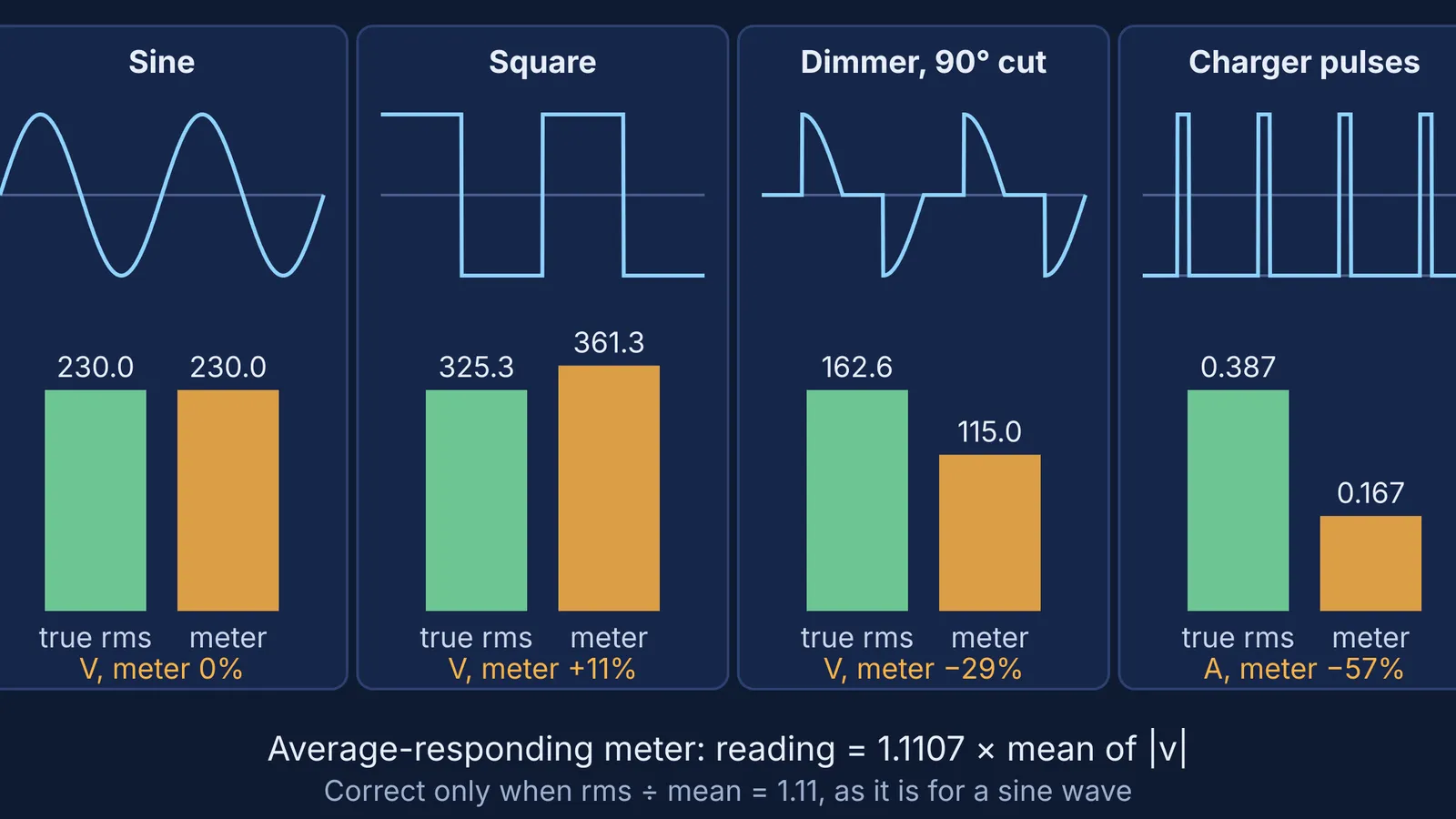
Put an ordinary low-cost multimeter on the output of a lamp dimmer and it can show 115 V when the true rms value is 163 V. It has no fault. It was built on the assumption that every AC wave is a sine wave, and a dimmer's chopped wave is not. This post shows the arithmetic behind that error, why it is about 29% for a dimmer and nearly 57% for a phone charger's current, and how true rms meters and moving-iron meters avoid it.
How does a cheap multimeter measure AC voltage?
A digital meter's converter, like the moving-coil meter before it, responds to the average of what it is fed. The plain average of symmetric AC over a full cycle is zero, which is why the AC range first rectifies the signal. The meter then has the mean of |v|, the average of the rectified wave.
But you want the rms value, because that is what sets heating and power. So the meter multiplies the mean by a fixed number, the form factor of a sine wave:
form factor = rms ÷ mean = (V₀/√2) ÷ (2V₀/π) = π/(2√2) ≈ 1.1107.
Where the 2V₀/π comes from is derived in the average value of AC over half a cycle, so it is not repeated here. Fluke, a meter maker, describes the same shortcut in its note on why non-linear loads need a true-rms tool: an average-responding meter takes the average and multiplies it by 1.11, assuming the wave is a pure sine wave.
So the rule inside the meter is: reading = 1.1107 × mean of |v|. It is exact only for waves whose rms ÷ mean is also 1.1107.
Why does a square wave read high and a triangle wave read low?
Use waves with the same peak as Indian mains, 230 × √2 = 325.3 V. All numbers below were computed numerically over one cycle.
Sine: true rms 230.0 V, mean |v| 207.1 V, reading 230.0 V. No error.
Square: the wave sits at ±325.3 V all the time, so its rms and mean are both 325.3 V. The meter multiplies by 1.11 anyway and shows 361.3 V, 11.1% high.
Triangle: rms = V₀/√3 = 187.8 V and mean = V₀/2 = 162.6 V, so rms ÷ mean = 1.155. The meter shows 180.6 V, 3.8% low.
The pattern: a flat-topped wave has a smaller rms ÷ mean than a sine, so it reads high. A peaky wave has a larger ratio, so it reads low. If you need the rms values themselves, see how to find the rms of square and triangular waves.
Why does a dimmer fool the meter by 29%?
A dimmer or a TRIAC fan regulator switches on partway through each half-cycle, so the load sees only the tail of each hump. How that regulator works and why it gets warm is covered in why a fan regulator gets hot. Here we only need the shape of the wave it leaves.
Worked example: a dimmer cutting each half-cycle at 90°
Peak. V₀ = 230 × √2 = 325.3 V.
True rms. The dimmer passes the second half of every half-cycle. A sine's square, sin²θ, has the same average over the first and second quarters, so exactly half the mean-square value survives. rms = 230 × √(1/2) = 162.6 V.
Mean of |v|. Each surviving quarter has area V₀ (from ∫ V₀ sin θ dθ from 90° to 180°), spread over a half-cycle of π radians. Mean = V₀/π = 103.5 V.
Meter reading. 1.1107 × 103.5 = 115.0 V. In fact it is exactly 230/2, because (π/2√2) × (√2 × 230/π) = 115.
Error. 115.0 ÷ 162.6 = 0.707, so the meter reads 29.3% low.
Check the dimensions: every step is volts times a pure number, so the answer is in volts. Turn the dimmer lower, cutting at 135°, and the true rms falls to 69.3 V while the meter shows 33.7 V, 51.4% low. The smaller the slice, the peakier the wave and the worse the error.
Why does a phone charger's current read 57% low?
A charger first turns AC into DC with a rectifier and a capacitor. The capacitor only takes current when the mains voltage rises above it, which happens for a short time near each peak. So the current is a train of narrow pulses, not a sine.
Take a simple model with round illustrative numbers: 1 A pulses, each 1.5 ms long, centred on each of the two peaks in every 20 ms cycle.
Fraction of time on. 2 × 1.5 ÷ 20 = 0.15.
Mean current. 1 A × 0.15 = 0.150 A.
True rms. √(1² × 0.15) = 0.387 A.
Meter reading. 1.1107 × 0.150 = 0.167 A, which is 57% low.
Fluke's note gives the real-world version: on non-linear loads an average-responding meter may read up to 40% low. Keysight, another instrument maker, says in its application note on rms measurement that errors can be as high as 40 percent or more. Our idealised pulse train is peakier than most real loads, which is why it gives a bigger figure.
How do true rms and moving-iron meters get it right?
A true rms meter does what the definition says. It squares the signal, averages the square and takes the square root, with an rms-converter chip or by sampling and computing. Shape no longer matters, within limits. Very narrow pulses carry high harmonics and a high crest factor (peak ÷ rms), which is 2.58 for our charger model and 3.32 for the 135° dimmer. Every true rms meter has a stated bandwidth and crest-factor limit, and the Keysight note warns that the higher the crest factor, the harder an accurate AC reading becomes. Check the meter's manual before you trust a reading on a very spiky wave.
A moving-iron meter gets rms from its physics. The current in a fixed coil magnetises two soft-iron vanes in the same direction, and they repel. The force on each vane depends on the field times the magnetisation, and both are proportional to I, so the deflecting torque goes as I². The pointer's spring averages that torque over many cycles, so the meter settles at a position set by the mean of I², which is the rms value squared. That is why its scale is crowded at the low end.
Mains measurements are for trained people with a meter and probes rated for mains work. This post explains why the numbers differ; it is not a guide to measuring household wiring.
To see how the meter's reading and the true rms drift apart as you change a wave's shape, try the Simulation Lab, or practise rms problems in the Fermi Problem Library, which has a step-by-step solver that explains the reasoning.
Quick checklist
Average-responding meter: reading = 1.1107 × mean of |v|.
1.1107 = π/(2√2) is the form factor of a sine wave only.
Square wave: +11.1%. Triangle: −3.8%. Dimmer at 90°: −29.3%. Narrow pulses: worse still.
Flat-topped waves read high; peaky waves read low.
True rms meters square, average and root, within their bandwidth and crest-factor limits.
Moving-iron torque ∝ I², so it responds to rms directly.


