

On this page
You meet three numbers in the Class 12 alternating current chapter, and again when you reach rectifiers in semiconductor electronics: 0, 0.637 and 0.707. Each is correct for a different question. This post shows where each one comes from and when to use it.
Throughout, the current is i = I₀ sin ωt, where I₀ is the peak current and T = 2π/ω is the time period.
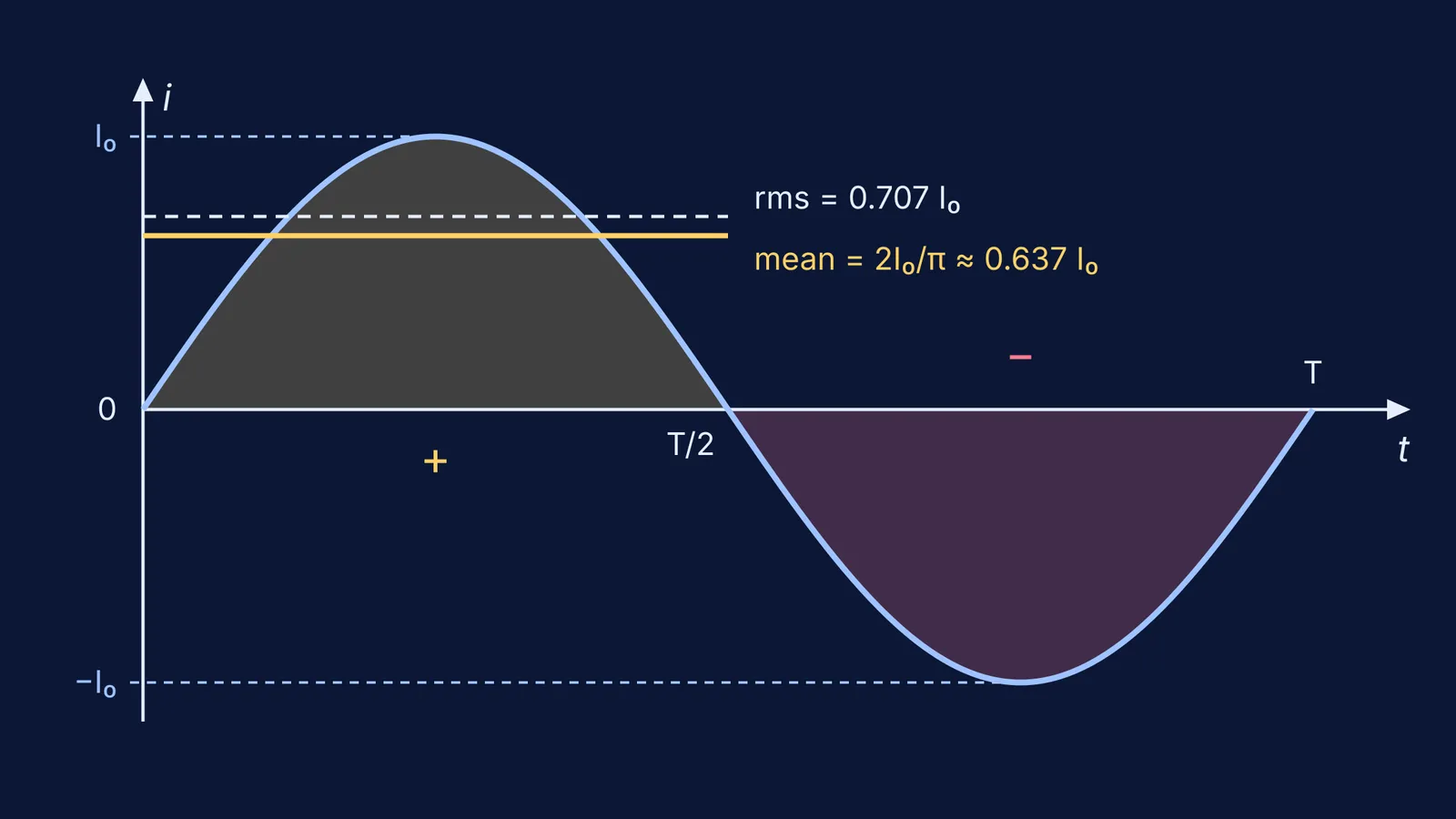
Why is the average of AC over a full cycle zero?
In the first half cycle the current is positive. In the second half it has exactly the same shape, flipped below the axis. The area above the axis equals the area below it, so they cancel.
As Electronics Tutorials puts it, the average or mean value of a symmetrical alternating quantity over a full 360° period is zero.
A zero average does not mean nothing happens. Charge moves forward and then back, so the net charge carried over one cycle is zero. But a heater still warms up, because heating depends on i², and i² is never negative. That is why mains supplies are rated by rms value, which we cover in RMS values and power in AC circuits.
What is the average value of alternating current over half a cycle?
Take only the positive half, from t = 0 to t = T/2, and find the mean in four steps:
Mean = (1 / (T/2)) × ∫ I₀ sin ωt dt, with limits 0 to T/2.
The integral is (I₀/ω) × [−cos ωt] from 0 to T/2. Since ωT/2 = π, this is (I₀/ω) × (1 − (−1)) = 2I₀/ω.
Multiply by 2/T: mean = 4I₀/(ωT).
Put ωT = 2π: mean = 2I₀/π.
The average value of a sinusoidal current over half a cycle is 2I₀/π ≈ 0.637 I₀, the same 0.637 × peak given by Electronics Tutorials. The form factor table on Wikipedia) lists the same result, 2a/π for a sine wave of amplitude a.
How are mean and rms values different?
The mean averages i itself. The rms value squares i, averages the square, then takes the square root. For a sine wave, rms = I₀/√2 ≈ 0.707 I₀, as Electronics Tutorials states.
The ratio rms/mean is called the form factor; for a sine wave it is π/(2√2) ≈ 1.11, according to both Electronics Tutorials and the Wikipedia form factor article), which adds that a form factor can never be smaller than 1.
To choose:
Use the mean when the question is about charge, a DC output, or what a DC meter shows.
Use the rms when the question is about heat, power, or the voltage printed on a supply.
How do you use mean and rms in rectifier problems?
A rectifier changes the waveform, so both values change. For a half-wave rectifier, the IIT Kharagpur Virtual Lab theory page gives the average output as Vm/π ≈ 0.318 Vm and the rms output as Vm/2. One half is simply missing, so the mean halves to I₀/π.
For a full-wave rectifier, Electronics Tutorials gives the average output as 2Vmax/π ≈ 0.637 Vmax, double the half-wave value, and the rms as 0.7071 Vmax. The full-wave rms equals that of the original AC: flipping the negative half upward changes i but not i². Diode details are in our post on half-wave and full-wave rectifiers.
Worked example: a sinusoidal supply with peak 20 V drives a 100 Ω resistor through one ideal diode. Find the average current, the rms current and the power.
Peak current: I₀ = 20/100 = 0.2 A.
Average current (half-wave): I₀/π = 0.2/3.1416 ≈ 0.0637 A, or 63.7 mA.
Rms current (half-wave): I₀/2 = 0.1 A.
Power: (0.1)² × 100 = 1 W.
The common mistake is to put the average into the power formula: (0.0637)² × 100 ≈ 0.41 W, which is wrong by a factor of (π/2)², about 2.5. With a full-wave bridge, the same supply gives an average of about 127 mA, an rms of about 0.141 A and a power of 2 W.
A four-step checklist for exam questions
Name the window: full cycle, half cycle, or rectified output.
Name the quantity: charge or DC reading (mean), or heat and power (rms).
Write the factor: 0, 2/π, 1/π, 1/√2 or 1/2.
Check the order: mean ≤ rms ≤ peak.
If you keep reaching for the wrong factor, practise on questions in the Fermi Problem Library, where the step-by-step solver explains the reasoning rather than printing an answer, so you can see the exact line where mean and rms part ways. If rms itself still feels shaky, the Fermi Concept Library gives every concept its own lesson and its place in the map.
Wondering why mains is AC in the first place? Read about Nikola Tesla and alternating current.


