

On this page
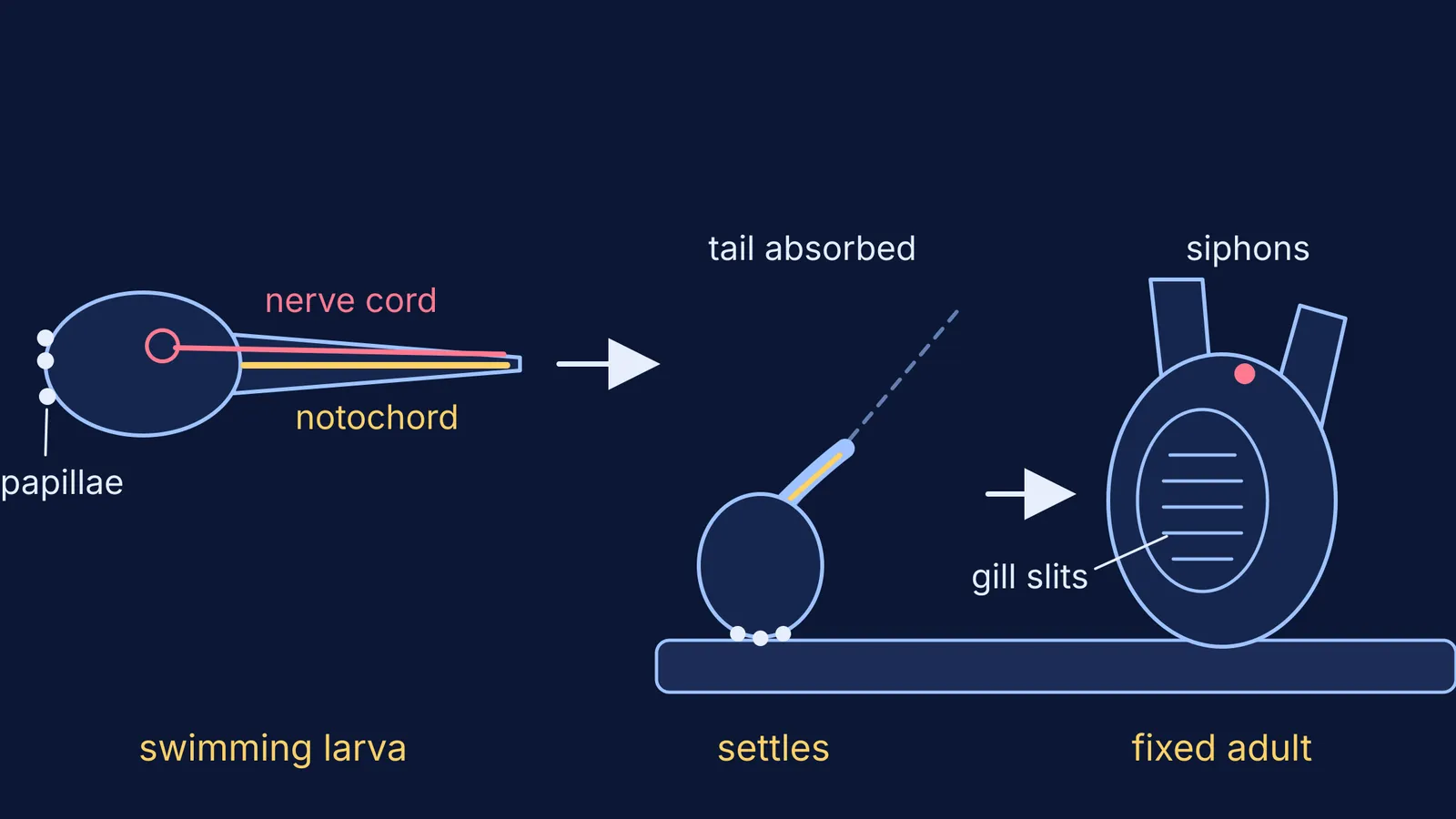
A sea squirt looks more like a typical chordate as a larva than as an adult. An ascidian such as *Herdmania* starts life as a swimming tadpole with a notochord and a nerve cord, then glues itself to a rock and loses both. That change is what exam questions mean by retrogressive metamorphosis.
What is retrogressive metamorphosis in ascidians?
Retrogressive metamorphosis is the change from a larva with all the typical chordate features to an adult that keeps only some of them. The NCERT Class 11 Biology chapter Animal Kingdom states the key fact in one line: in Urochordata, "notochord is present only in larval tail". The same page gives *Ascidia*, *Salpa* and *Doliolum* as examples of urochordates.
That NCERT page does not use the word "retrogressive"; zoology textbooks and exam questions do. Some researchers say "retrograde" instead. A 2025 study in the journal *Cells* calls tail regression "the most representative process in retrograde metamorphosis, during which the notochord tissue degenerates and disappears" (Shi et al., 2025).
*Herdmania* is a genus of solitary sea squirts; V. O. Sebastian described the development of *Herdmania pallida* in the Proceedings of the Indian Academy of Sciences in 1953.
What does the larva have that the adult loses?
The larva is a small tadpole that does not feed. In the Great Barrier Reef species *Herdmania momus*, larvae are "lecithotrophic (non-feeding)" and become competent to settle by 13.5 to 14 hours after fertilisation at 25°C, according to Ueda and Degnan in PLoS ONE (2013).
Its body plan ticks the chordate boxes from NCERT: a notochord, a dorsal hollow nerve cord, pharyngeal gill slits and a post-anal tail. A detailed anatomy of the related sea squirt *Ciona* (Hotta, Dauga and Manni, Scientific Reports, 2020) describes a hollow nerve cord lying dorsal to the notochord and three adhesive papillae on the front tip of the trunk. The *Ciona* larva's central nervous system has 177 neurons (Ryan, Lu and Meinertzhagen, eLife, 2016).
For a refresher, see the three features every chordate shares.
How does the larva lose its tail, notochord and nerve cord?
In *Herdmania momus*, Ueda and Degnan counted a larva as having started metamorphosis once half its tail was resorbed (Ueda and Degnan, 2013). The details below come from other solitary ascidians (Hotta et al., 2020; Shi et al., 2025).
Swim. The larva swims without feeding. In *Styela clava*, larvae swim for around 4 to 5 hours before settling (Shi et al., 2025).
Stick. It attaches to a hard surface by the adhesive papillae at its front end.
Absorb the tail. The tail, with its notochord, muscles and nerve cord, is pulled into the body. In *Ciona*, absorption takes about 30 minutes to reach halfway and about 1 more hour to finish (Hotta et al., 2020).
Shrink the nervous system. The neural tube "disassembles and further degenerates into ganglia" (Shi et al., 2025), so the adult has no long nerve cord.
Rotate and open up. The inner organs rotate "through an arc of about 90°" and the animal becomes "a sessile, filter-feeding adult" (Hotta et al., 2020).
Why is it called retrogressive?
Most metamorphosis you study adds structures, as in our post on how thyroxine drives frog metamorphosis. In ascidians the active, more typically chordate stage comes first, and the adult is simpler in exactly the features that define the phylum. That is the sense of "retrogressive".
It does not mean evolution running in reverse; the adult is built for a fixed, filter-feeding life. Compare the lancelet: NCERT says that in Cephalochordata the notochord "extends from head to tail region and is persistent throughout their life", which we cover in why Amphioxus keeps its notochord for life.
How should you write this in a NEET or board answer?
Use this five-line frame:
Define: a change from a larva with typical chordate features to an adult with fewer of them.
Example: *Herdmania* or *Ascidia*, subphylum Urochordata.
Larva: notochord in the tail, dorsal hollow nerve cord, gill slits, adhesive papillae; free-swimming, non-feeding.
Change: attaches by papillae; tail and notochord absorbed; nerve cord reduced to ganglia.
Adult: fixed filter feeder that keeps its gill slits.
Watch for these traps:
"Urochordates keep the notochord throughout life": false. That is Cephalochordata.
"In ascidians the notochord is replaced by a vertebral column": false. NCERT says that happens in Vertebrata.
"The adult ascidian shows no chordate feature": false. The gill slits remain.
If the three chordate subphyla blur together, the Fermi Concept Library gives every biology concept its own lesson and its place in the map. When you practise, the Fermi Problem Library has worked problems with a step-by-step solver that explains the reasoning rather than printing an answer.
Learn the NCERT line, notochord only in the larval tail, and the rest follows from it.


