

On this page
Archerfish range from India through Southeast Asia to northern Australia, mostly in fresh water, with a few species in mangroves, according to the Wikipedia summary of archerfish research, which reports shots that bring down prey up to 3 m above the surface. Each shot must knock an insect off a leaf, aimed through bent light.
How does an archer fish shoot water?
The fish presses its tongue against a groove in the roof of its mouth to make a narrow channel, then contracts its gill covers to force water through it (Wikipedia).
In 2012, Alberto Vailati, Luca Zinnato and Roberto Cerbino filmed two *Toxotes jaculatrix* at 1000 frames per second (PLOS ONE). The water leaves the mouth at about 2 m/s, and the front of the jet then speeds up to about 4 m/s.
While the jet accelerates, its tail moves faster than its head, so water keeps piling into the front, and the fish's control of the jet favours a single large drop, much like drop-on-demand inkjet printing, the authors note.
Why does the jet hit so hard?
The same PLOS ONE study found that by impact the jet carries a mass-specific power of about 3000 W/kg, while vertebrate muscle can deliver at most about 500 W/kg. The authors conclude the boost happens in the jet itself, not in any mechanism inside the fish.
The average impact force was about 200 mN. Flies and bugs up to 100 mg typically cling on with less than 20 mN, and beetles peak at about 40 mN, according to the figures the authors cite.
The fish also match the timing to the distance. Peggy Gerullis and Stefan Schuster showed in Current Biology (2014) that archerfish adjust how their mouth opening changes so the water gathers at the jet tip just before impact. In Zoology (2015), Morgan Burnette and Miriam Ashley-Ross found the force fell by less than 15% on average from the closest target (2.3 body lengths away) to the farthest (5.8).
How does the archer fish correct for light bending?
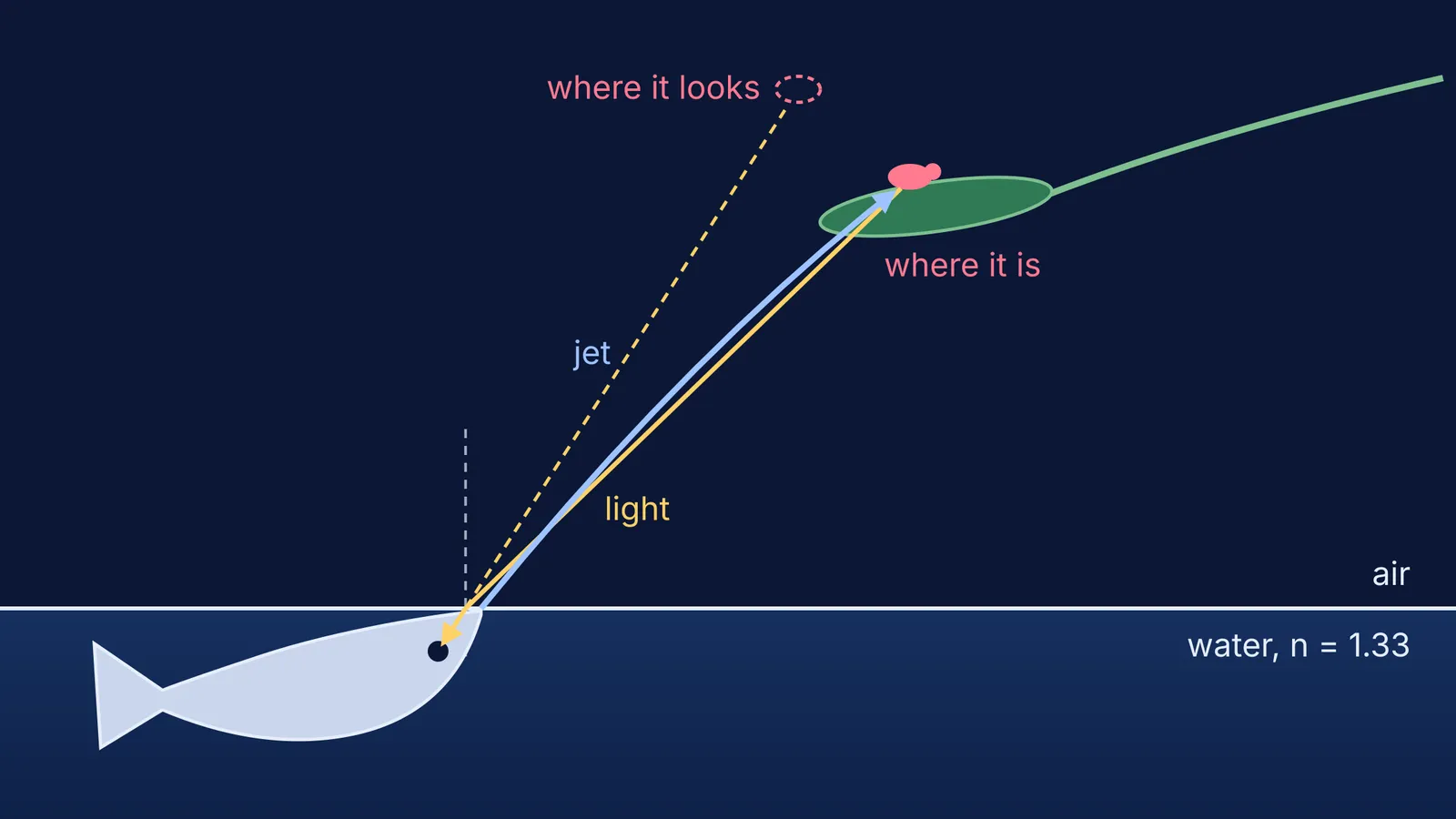
Light bends at the surface according to Snell's law, n₁ sin θ₁ = n₂ sin θ₂, and water's refractive index is about 1.333 (Refractive index, Wikipedia). Light from the insect bends towards the normal as it enters the water, so the insect looks higher than it really is. The jet, though, starts at the surface and is not bent the way the light is. A fish that aimed where the insect appears would miss.
How the fish handles this is still being studied. Stefan Schuster and colleagues showed in Current Biology (2004) that archerfish can judge the true size of aerial prey despite refraction, by learning "the laws that connect apparent size with the fish's relative position to the target". A study that measured the shots of 30 fish in Behavioural Processes (2000)00107-8) found no support for a learned refraction correction in aiming. In eLife (2024), an airflow above the tank first raised the fish's errors, which then shrank over several trials as they adapted their aim.
Worked example: how far off does the insect look?
Use the numbers in the diagram above. The eye is 3 cm below the surface; the insect is 30 cm above the surface and 33 cm across from the eye, so it really sits 45° above the horizontal.
Find where the light crosses the surface. Trying points, Snell's law balances about 2 cm from the eye horizontally.
In air, that ray makes 46° with the normal: sin 46° ≈ 0.719.
In water: sin θ₂ = 0.719 ÷ 1.333 ≈ 0.539, so θ₂ ≈ 32.7°.
The light reaches the eye travelling about 57° above the horizontal, so the insect looks about 12° higher than it is.
Now the jet. Treat it as a projectile at a steady 4 m/s (a simplification; the real jet speeds up). From the mouth (at the surface, 3 cm ahead of the eye) the target is 30 cm across and 30 cm up, so the jet must leave at about 51°. The flight takes about 0.12 s, and gravity pulls it about 7 cm below the line it was aimed along.
To practise step 1, see our guide on when light bends towards the normal; apparent depth problems show the same effect from above, where an object under water looks shallower than it is. The Fermi Simulation Lab has interactive simulations for ideas that are easier to see than to read.
What can a student take from the archer fish?
The fish is a quick self-test for ray optics and projectiles:
Draw the normal first and measure angles from it, not from the surface.
Name the denser medium. Light entering water bends towards the normal.
The eye assumes light travelled straight, so the image lies on the backward extension of the ray that reaches it.
If combining Snell's law with projectile equations trips you up, the Fermi Problem Library has worked problems with a step-by-step solver that explains the reasoning rather than printing an answer. For the fish's home, read how mangroves protect coasts from cyclones and waves.


