

On this page
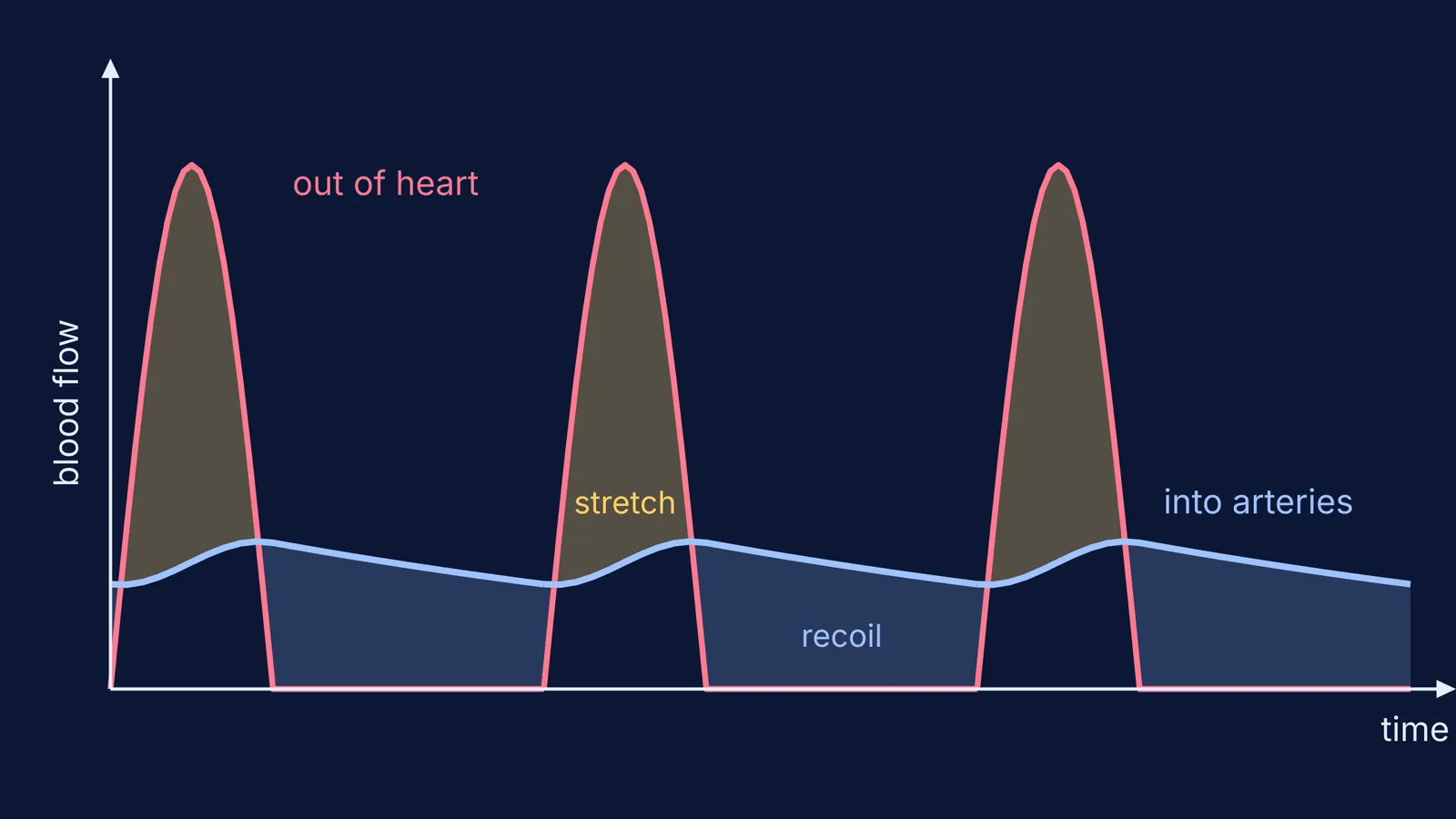
Feel your pulse and you find separate beats, not a steady hum. Your left ventricle pushes blood out only during systole, the squeeze, and refills during diastole. Yet blood keeps moving through your smallest vessels between beats, thanks to the stretchy wall of your largest artery, the aorta.
Why does blood flow continuously if the heart pumps in beats?
The aorta works like an elastic storage tank placed right after the pump. In a review of the aorta's elastic properties, Gustav Belz explains that the aorta and the large arteries near the heart store about 50% of the left ventricle's stroke volume during systole (Belz, Cardiovascular Drugs and Therapy, 1995). In diastole, the elastic walls push that stored volume on to the rest of the body, "thus creating a nearly continuous peripheral blood flow", as the review puts it.
So part of each beat goes straight through, and the rest stretches the aortic wall like a rubber band. When the aortic valve shuts, the wall springs back and keeps blood moving until the next beat. That is also why blood pressure never falls to zero between beats. Diastolic pressure, the lower number, is the pressure on your artery walls while the heart muscle rests between beats (American Heart Association). Our explainer on what systolic and diastolic blood pressure mean walks through the numbers.
What is the Windkessel effect, and why is it named after a fire engine?
Old hand-pumped fire engines had the same problem: the pump delivers water in bursts. A paper on the fluid mechanics of the effect describes how an air chamber in that equipment "serves to transform the intermittent influx from a pump to a more steady stream out of the hose", and how blood from the heart "becomes rather smooth after passing through an elastic aorta" (Mei, Zhang and Jing, Medical and Biological Engineering and Computing, 2018). The effect takes its name, Windkessel, from that air chamber.
The classic model has just two parts. Frank's Windkessel model describes the arteries "in terms of resistance and compliance" and explains how aortic pressure falls during diastole (Westerhof, Lankhaar and Westerhof, 2009). Compliance is how much the big arteries stretch for a given rise in pressure. Resistance is how hard it is to push blood through the small vessels downstream.
If you know RC circuits, this is the same maths: the aorta is a capacitor charged by bursts of current that discharges through a resistor between bursts, so outflow fades slowly instead of switching off. The diagram above solves that model for repeating beats.
How can you see elastic recoil at home?
You need a plastic syringe or squeeze bottle (the heart), a T-connector from an aquarium shop, a balloon (the aorta), a length of thin aquarium tubing (the small arteries), a bowl, and water. Work over a sink.
Fit the syringe into one arm of the T, the balloon's neck over the second, and about a metre of thin tubing on the third, ending over the bowl.
Fill the syringe with water. Pinch the balloon's neck shut with a clothes peg, so nothing can stretch.
Give short, sharp pushes, holding the plunger still between them (that plays the closed aortic valve). Water should spurt during each push and stop between them.
Remove the peg and repeat. The balloon swells on each push and shrinks between pushes, and water should keep flowing between pushes.
Film the tube's end on your phone and time how long the flow lasts after each push, with and without the balloon.
Try a stiffer "aorta" by putting one balloon inside another. Write down your prediction first, then test it.
Ideas like this, where a curve changes as you change one quantity, are easier to see than to read. The Fermi Simulation Lab has interactive simulations for that kind of idea, so you can keep testing predictions on screen.
What happens when arteries get stiff?
Belz's review notes that aortic stiffness increases with ageing, with raised blood pressure and with atherosclerosis, which raises systolic pressure and lowers diastolic pressure (Belz, 1995). A review published online in December 2025 by Jun Sugawara and Hirofumi Tanaka adds that loss of Windkessel function "amplifies pulsatile pressure, reduces diastolic perfusion" (Experimental Physiology). Stiff arteries also carry the pulse faster, as our post on pulse wave velocity and arterial stiffness explains. This is a physiology explainer, not health advice: ask a doctor about your own or a family member's blood pressure.
How do you write this up in an exam?
Use three lines:
In ventricular systole, the elastic walls of the aorta and large arteries stretch and store part of the ejected blood.
In diastole, the walls recoil and push this stored blood forward.
So the heart's output is pulsed, but flow in arterioles and capillaries is nearly continuous and diastolic pressure stays above zero.
To connect it to valves and heart sounds, try our cardiac cycle pressure graph. If compliance or RC discharge still feels shaky, the Fermi Concept Library gives every concept in physics and biology its own lesson and its place in the map.


