

On this page
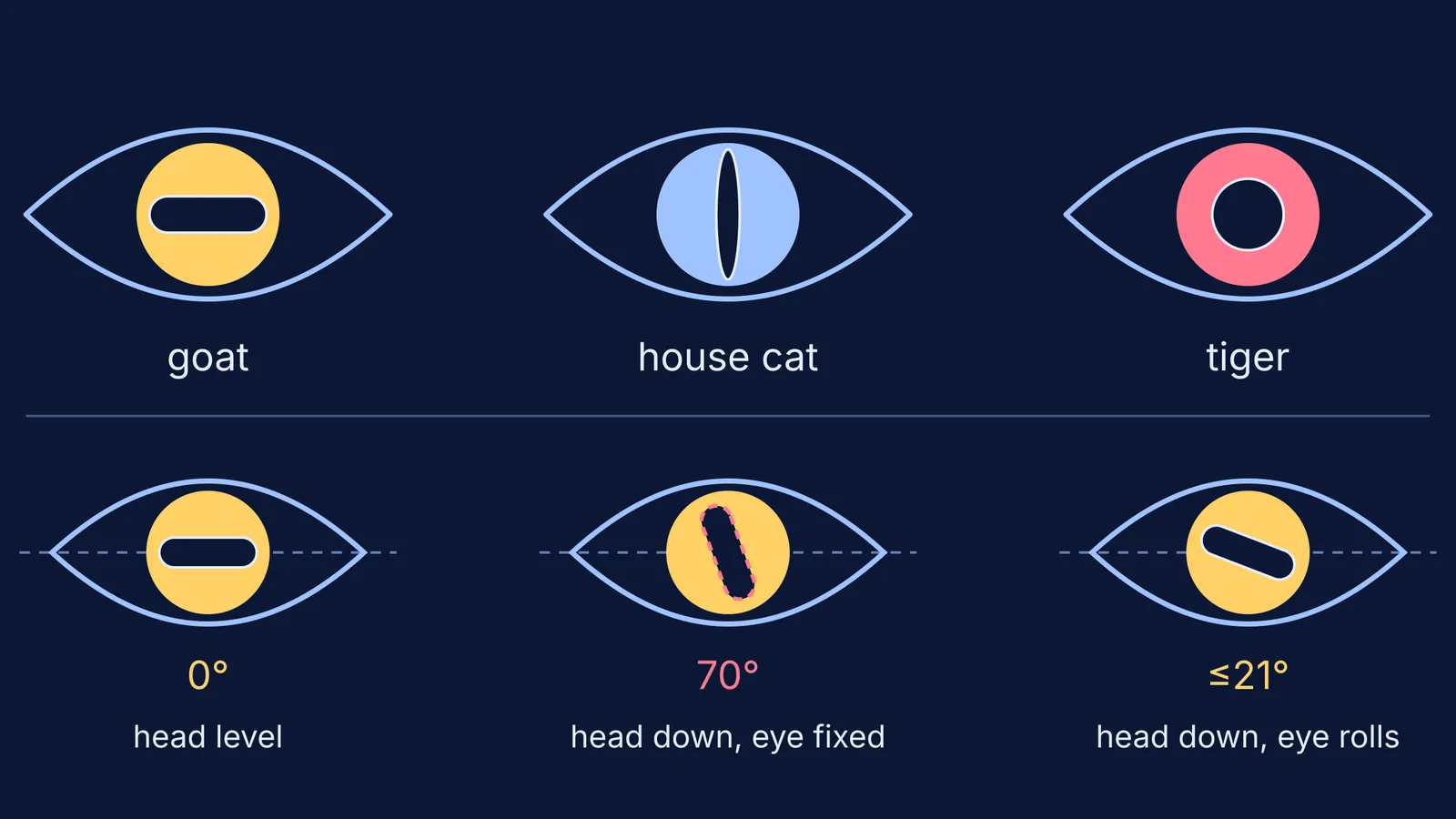
A goat's pupil is a dark rectangle on its side. A house cat's is a thin vertical slit, and a tiger's is round, like yours. In 2015, vision scientist Martin Banks of UC Berkeley and colleagues at Durham University compared 214 species of land animals and found that how an animal lives, and how tall it is, predicts its pupil shape.
Why do goats have rectangular pupils?
Goats, sheep and horses are grazers that must spot a predator coming across open ground.
The study, published in Science Advances, found that species with horizontally elongated pupils are very likely to be prey and to have laterally placed eyes. A wide, flat pupil keeps horizontal edges sharp, which improves the image of the ground ahead of and behind the animal. Squashing the pupil top to bottom also blocks some of the bright overhead sunlight that would otherwise reach the retina, much like the peak of a cap.
But a goat spends hours with its head down. If its eyes were fixed, the rectangles would tip towards vertical. They don't. Grazing animals' eyes can rotate by 50 degrees or more in each eye, a range 10 times greater than human eyes, keeping the pupils roughly level with the ground. In the paper, when sheep, goats, horses, deer and moose tipped their heads by about 70 degrees, their eyes counter-rolled by at least 0.7 of that angle (Banks et al., 2015). That means at least 49 degrees of rotation, leaving the pupil at most about 21 degrees off level.
Why do cats and snakes have vertical slit pupils?
Slits belong to ambush hunters, animals that wait, judge the distance, and pounce. The Science Advances team found that species with vertically elongated pupils are very likely to be ambush predators that are active both day and night (Banks et al., 2015). Snakes make up nearly half of the study's database. An earlier comparison of snake species by Brischoux, Pizzatto and Shine also linked vertical pupils to ambush foraging and to the time of day the snakes are active.
The physics is about depth of field. With a vertical slit, vertical edges stay sharp even when they are nearer or farther than where the eye is focused, while horizontal edges at other distances go blurry. The predator gets two depth cues at once: its two eyes compare the sharp vertical edges, and the amount of blur on horizontal ones helps it judge how far away they are.
A slit also opens and closes over a far bigger range. The vertical-slit pupils of the domestic cat and the gecko change in area by 135-fold and 300-fold, while a human's round pupil changes by about 15-fold (Banks et al., 2015). That helps a cat see at night without being dazzled at noon. Your own pupil does a smaller version, explained in why your pupil gets smaller in bright light.
Why do tigers and lions have round pupils?
Body height is the twist. Of the 65 front-eyed ambush predators in the study, 44 had vertical pupils and 36 of those stood less than 42 centimetres at the shoulder. The paper's analysis shows the blur cue is much stronger for short animals, because with the eyes close to the ground, nearby ground sweeps through a wide range of distances across the retina.
A tiger's eyes are much higher up, so the blur cue is weaker and the slit has less to offer. Domestic cats have vertical slits, but bigger cats such as tigers and lions have round pupils, like humans and dogs (UC Berkeley). The paper also notes that most predators active in the daytime have circular pupils. Where an animal's eyes face matters too, as explained in why cats have front-facing eyes and cows have side eyes.
How can you predict an animal's pupil shape?
These three questions follow the study's findings. They tell you which shape is likely, not which one is certain:
Does it graze, with eyes on the sides of its head, and get hunted? Expect a horizontal pupil (goat, sheep, horse).
Does it lie in wait, hunt by day and by night, and stand lower than about a ruler and a half (42 cm) at the shoulder? Expect a vertical slit (house cat, many snakes).
Is it a predator that stands tall, or one that hunts mainly in daylight? Expect a round pupil (tiger, lion).
Test the slit idea yourself. Cut a narrow vertical slit in a card. Hold a pencil close to your face and focus on something far away, so the pencil blurs. Through the slit, an upright pencil looks sharper than a sideways one. Turn the slit horizontal and the result flips. Never look at the Sun through it.
For the camera version, read how camera aperture size affects brightness and blur. If depth of field makes more sense when you watch it change, the Fermi Simulation Lab has interactive simulations for ideas that are easier to see than to read.


