On this page
A cat stalking a pigeon and a cow chewing grass are solving different problems with the same organ. The cat needs to know exactly how far away its target is. The cow needs to see a threat coming from almost any direction. Where the eyes sit decides which job they do well.
Why do cats have front eyes and cows side eyes?
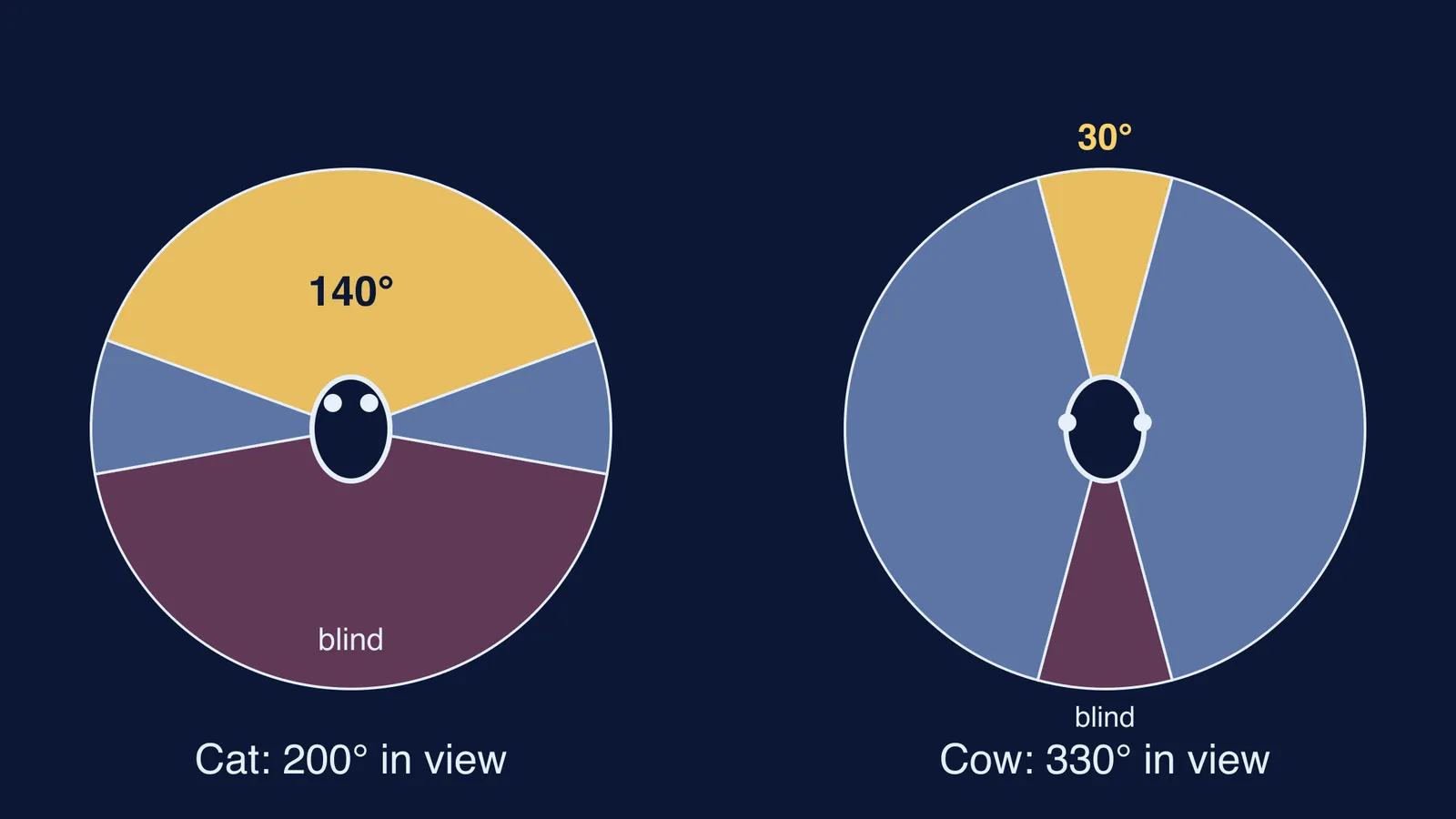
Each eye sees a wide fan of the world. When both eyes point forward, their fans overlap a lot. When they point sideways, the fans barely meet in front, but together they wrap almost all the way round the head.
The numbers show the trade-off. In a 2001 veterinary ophthalmology symposium paper, Paul Miller estimates that cats see about 200° in total and that cats and humans have roughly 140° of binocular overlap. A 2025 review of vision in farmed animals puts the field of view of cattle at around 330°, with a binocular field of only 25–50°. The same review notes that cattle, sheep and goats cannot assess distance accurately, though they are good at detecting motion.
The cat gives up the view behind its head for a wide zone both eyes share. The cow does the opposite.
How do two overlapping eyes judge distance?
Your two eyes sit a few centimetres apart, so each sees a nearby object from a slightly different angle. Your brain compares the two images: the bigger the shift between them, the closer the object. This shift is called binocular disparity, and it only works where the two fields overlap.
It is the same geometry astronomers use to find the distance to the Moon with parallax, just with a much shorter baseline. We explain the human version in why we need two eyes to judge depth.
What does the research say about predators and eye position?
You can read eye position straight off a skull. Christopher Heesy's 2004 study in The Anatomical Record found that orbit convergence (how far forward the eye sockets face) and binocular overlap are significantly correlated across mammals, in a linear relationship.
In a 2007 follow-up covering 321 mammal taxa from 16 orders, Heesy found that placental mammals that eat other animals have more convergent orbits on average than opportunistic feeders or non-meat-eaters. Nocturnal mammals also had more convergent orbits than daytime ones. Heesy reads this as support for the idea that mammal predators evolved forward eyes and stereo vision to spot camouflaged prey at night.
Pupils tell a matching story. A 2015 study of 214 land species by Martin Banks and colleagues found that species with horizontally elongated pupils are very likely to be prey with eyes on the sides of the head. Species with vertically elongated pupils are very likely to be ambush predators, which wait rather than chase, and the authors argue the vertical slit helps these frontal-eyed hunters judge distance.
Worked example: how much does each eye see?
You can work out one eye's field from two published numbers. When you add the two eyes together, the overlap gets counted twice, so: total field = 2 × (one eye's field) − overlap.
Using Miller's cat figures and the farm-animal review's cattle figures:
Cat: total 200°, overlap 140°. One eye = (200 + 140) ÷ 2 = 170°.
Cow: total 330°, overlap taken as 30°, inside the 25–50° range. One eye = (330 + 30) ÷ 2 = 180°.
Blind zone = 360° − total field: about 160° behind the cat, about 30° behind the cow.
Each eye sees a similar amount on both animals, about 170–180°. What changes is where the eyes point: turn two fans slightly outward and most of them overlap; turn them far out and they barely touch in front.
How do you write this as an adaptation answer?
School and entrance-exam biology often asks you to explain an adaptation. Use this five-part checklist:
Structure: where the eyes sit on the skull.
Function: overlap gives depth; side placement gives a wide field.
Lifestyle: hunting needs distance judgement; grazing needs early warning.
Cost: the cat's large blind zone; the cow's poor distance judgement.
Evidence: one example with a number, such as 140° of overlap in cats.
Try the same pattern on how owls are adapted for night hunting, which ties forward eyes to the night-hunting link Heesy found.
Overlapping fields of view are easier to see than to read, which is what the Fermi Simulation Lab is for: interactive simulations for ideas like this one. If parallax or the eye itself still feels shaky, the Fermi Concept Library has a lesson for each concept in physics and biology, with its place in the map.
Next time you see a cat and a cow, sketch their two fans from above: the whole answer fits in one drawing.