

On this page
Smoke from a coal boiler carries a lot of CO₂, but spread thin in nitrogen at about atmospheric pressure, where water barely dissolves it. Capture plants use an aqueous amine instead: it reacts with CO₂ at about 40 °C and gives it back at about 120 °C, so the same liquid goes round and round. Why it grabs, why it lets go, and why primary and tertiary amines hold different amounts all come from the Class 12 amines chapter.
Why can't water absorb CO₂ from flue gas?
Henry's law says the amount of gas that dissolves is proportional to its partial pressure. Coal flue gas is typically around 12% CO₂ at about 1 bar, so p(CO₂) is only about 0.12 bar.
With NCERT's Henry's constant for CO₂ at 298 K, K_H = 1.67 kbar, the mole fraction of dissolved CO₂ is x = 0.12 ÷ 1670 = 7.2 × 10⁻⁵. One kilogram of water is 55.5 mol, so that is about 0.004 mol, or 0.18 g of CO₂ per kg of water. The method is in Henry's law and gas solubility, with worked problems.
Physical absorption in water works only when the CO₂ partial pressure is high. At 0.12 bar you need a liquid that reacts with CO₂, so that dissolved CO₂ is used up and more can enter.
How does an amine capture CO₂?
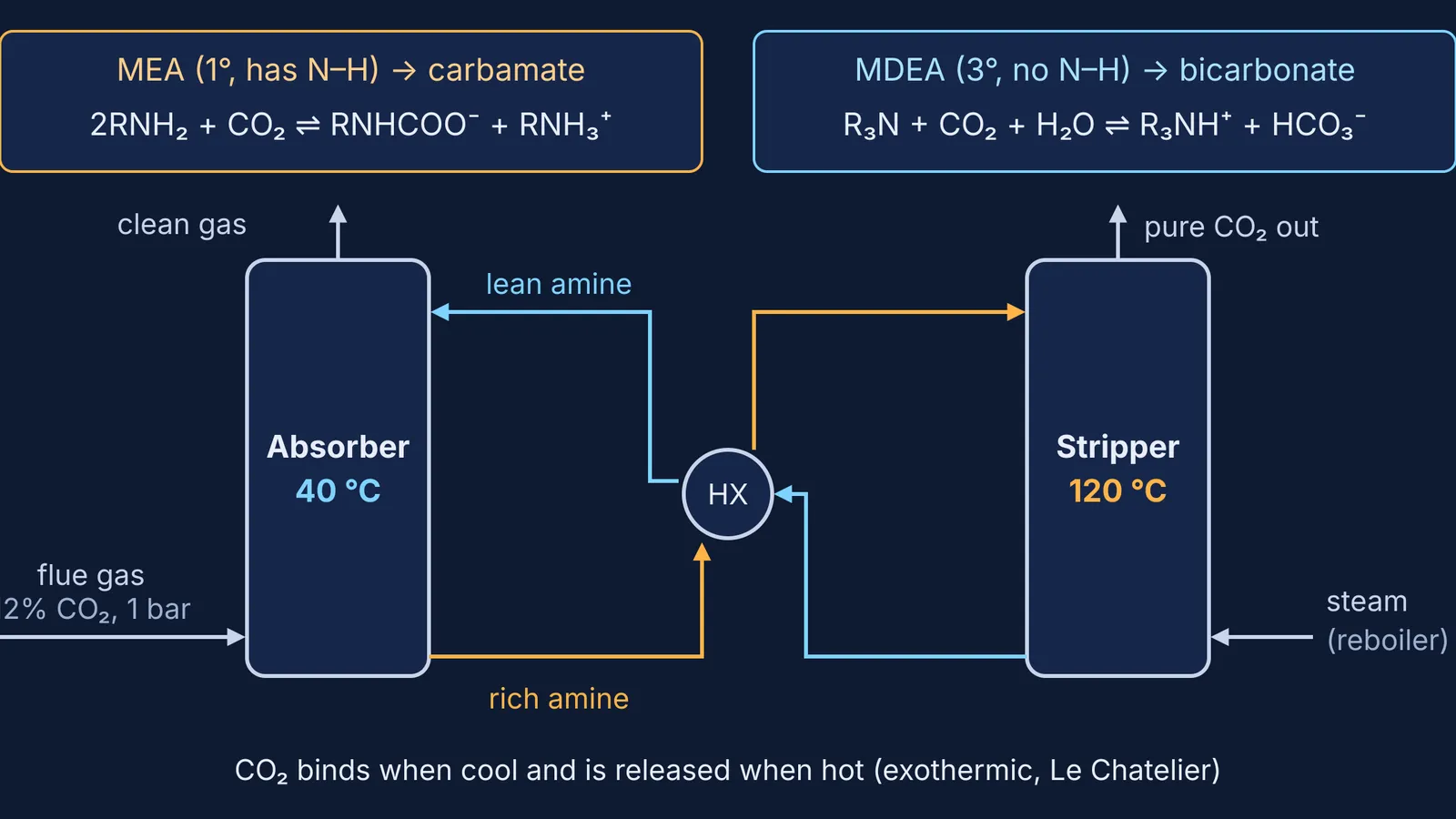
CO₂ is an acidic oxide and amines are bases. A primary amine such as monoethanolamine (MEA, HOCH₂CH₂NH₂) attacks the carbon of CO₂ with its nitrogen lone pair. The overall reaction is:
2RNH₂ + CO₂ ⇌ RNHCOO⁻ + RNH₃⁺
The first amine becomes a carbamate ion, RNH–COO⁻. To do that it must lose the proton from its N–H, and a second amine takes that proton as RNH₃⁺. Check the balance: on the left 2 N, 2 R groups, 4 H on nitrogen, 1 C and 2 O; on the right the same, with charges −1 and +1 summing to zero.
The real mechanism goes through a short-lived zwitterion (RNH₂⁺–COO⁻) that a base then deprotonates. The overall equation is enough for exams.
The key consequence: two amines per CO₂. The carbamate route has a ceiling of 0.5 mol CO₂ per mol amine. Plants report slightly higher loadings because some carbamate slowly hydrolyses to bicarbonate, but 0.5 is the carbamate limit.
Why can a tertiary amine hold more CO₂ but absorb it slowly?
A tertiary amine such as methyldiethanolamine (MDEA) has no N–H. It cannot form a carbamate, because it has no proton to lose. That is the same reason tertiary amines do not undergo acylation.
It can still act as a base. CO₂ first reacts with water to form carbonic acid, and the amine takes the proton:
R₃N + CO₂ + H₂O ⇌ R₃NH⁺ + HCO₃⁻
Now one amine handles one CO₂, so the ceiling is 1 mol CO₂ per mol amine, double the carbamate limit. The catch is speed. The CO₂ + H₂O step is slow, so a tertiary amine on its own absorbs CO₂ slowly. Plants add a small amount of a fast-reacting amine such as piperazine as an "activator". That is the "a" in aMDEA, which ammonia plants use, as mentioned in how ammonia plants remove CO₂ from syngas.
Why does heating release the CO₂ again?
Both capture reactions are exothermic. By Le Chatelier's principle, raising the temperature shifts an exothermic equilibrium to the left. So the plant runs two columns:
Absorber, about 40 °C. Flue gas rises; cool "lean" amine falls. The equilibrium lies to the right and CO₂ is taken up. Clean gas leaves the top.
Stripper, about 100–120 °C. The "rich" amine is heated by steam from a reboiler. The equilibrium shifts left, CO₂ comes off, and the steam also lowers the partial pressure of CO₂ above the liquid, pulling more out.
A heat exchanger lets the hot lean amine warm the incoming rich amine before it returns to the absorber. After the steam is condensed, the CO₂ leaving the stripper is nearly pure.
Worked example: how much solvent and energy per tonne of CO₂?
Take 30% (w/w) MEA. MEA is the long-standing reference solvent for amine scrubbing, which Rochelle's review in Science notes has been used to separate CO₂ from natural gas and hydrogen since 1930. Use MEA = 61.08, MDEA = 119.16 and CO₂ = 44.01 g/mol. Loadings and heats vary with plant and solvent; the values below are typical, not one plant's data.
Amine per kg of solution. 300 g ÷ 61.08 = 4.91 mol MEA.
Working capacity. Suppose lean amine enters at 0.20 mol CO₂ per mol amine and leaves rich at 0.45, close to values used in a modelling study of MEA capture plants. Each kg carries (0.45 − 0.20) × 4.91 = 1.23 mol = 54 g of CO₂ per cycle.
Circulation. 1,000,000 g ÷ 54 g per kg = about 18,500 kg. So roughly 18.5 t of solvent must circulate for every tonne of CO₂ captured.
Compare with water. From the first section, water holds 0.18 g per kg at 0.12 bar, about 300 times less than the amine's 54 g swing.
The ceiling. At 0.5 mol/mol, 4.91 mol MEA holds at most 2.46 mol (108 g) CO₂. The same 300 g of MDEA is 2.52 mol, which at 1 mol/mol could hold 2.52 mol (111 g). Fewer molecules per gram, but each does twice the work.
Energy to break the bond. The heat of absorption of CO₂ in MEA is roughly 80–85 kJ per mol near 40 °C (Kim and Svendsen, 2007). One tonne of CO₂ is 1,000,000 ÷ 44.01 = 22,720 mol. At 85 kJ/mol: 22,720 × 85 = 1.9 GJ just to reverse the reaction.
Total heat. The solvent must also be heated and stripping steam raised, so the reboiler supplies more. The same modelling study reports about 3.5–3.65 GJ per tonne of CO₂ at 95% capture (for gas-turbine flue gas). So roughly half the heat bill is the chemistry itself.
If step 2 or 3 is where you lose the thread, the Fermi Problem Library has a step-by-step solver that explains the reasoning.
Is carbon capture already running in India?
Yes, at small scale. A plant built by Carbon Clean with Tuticorin Alkali Chemicals and Fertilisers in Thoothukudi was reported in 2017 as designed to capture about 60,000 tonnes of CO₂ a year from the company's coal boiler and turn it into soda ash (Na₂CO₃). It uses the company's proprietary solvent, not plain MEA. Soda ash is not permanent storage: when it is used to make glass, Na₂CO₃ + SiO₂ → Na₂SiO₃ + CO₂ releases the CO₂ again.
At NTPC's Vindhyachal power station, a unit designed to capture 20 tonnes of CO₂ per day from the flue gas of a 500 MW coal unit reacts the captured CO₂ with green hydrogen to make methanol; the first methanol was announced in October 2025. That also uses a proprietary solvent. Twenty tonnes a day is a pilot scale, a tiny fraction of what such a unit emits.
Quick checklist
Flue gas: p(CO₂) ≈ 0.12 bar, too low for water by Henry's law.
Primary amine: 2RNH₂ + CO₂ ⇌ RNHCOO⁻ + RNH₃⁺, at most 0.5 CO₂ per amine.
Tertiary amine: R₃N + CO₂ + H₂O ⇌ R₃NH⁺ + HCO₃⁻, up to 1 : 1 but slow; piperazine speeds it up.
Exothermic capture: absorb cool (about 40 °C), release hot (about 120 °C).
30% MEA with a 0.20 → 0.45 swing: about 54 g CO₂ per kg, 18.5 t solvent per tonne CO₂.
Bond energy alone about 1.9 GJ per tonne of CO₂; total reboiler heat is higher.


