

On this page
If you mix a primary amine such as aniline with acetic anhydride in a chemistry laboratory, the test tube warms and glistening crystals of acetanilide precipitate. Aliphatic primary and secondary amines react just as vigorously, warming the tube as they convert into substituted amides. If you repeat the experiment with triethylamine, however, the liquid stays clear, no reaction occurs, and the tertiary amine remains unchanged.
This contrast is a standard diagnostic puzzle in CBSE Class 12 chemistry and competitive examinations such as JEE Main and NEET-UG. Understanding why tertiary amines resist acylation comes down to one structural fact: their nitrogen atom carries no replaceable hydrogen.
Why does acylation require a hydrogen on nitrogen?
In organic chemistry, acylation is a nucleophilic acyl substitution reaction. As described in the NCERT Class 12 Chemistry Amines textbook, primary and secondary amines react with acid chlorides, anhydrides, and esters by replacing an amino hydrogen with an acyl group (R–CO–). With acetic anhydride or acetyl chloride, this transformation is specifically called acetylation.
The reaction proceeds in three steps:
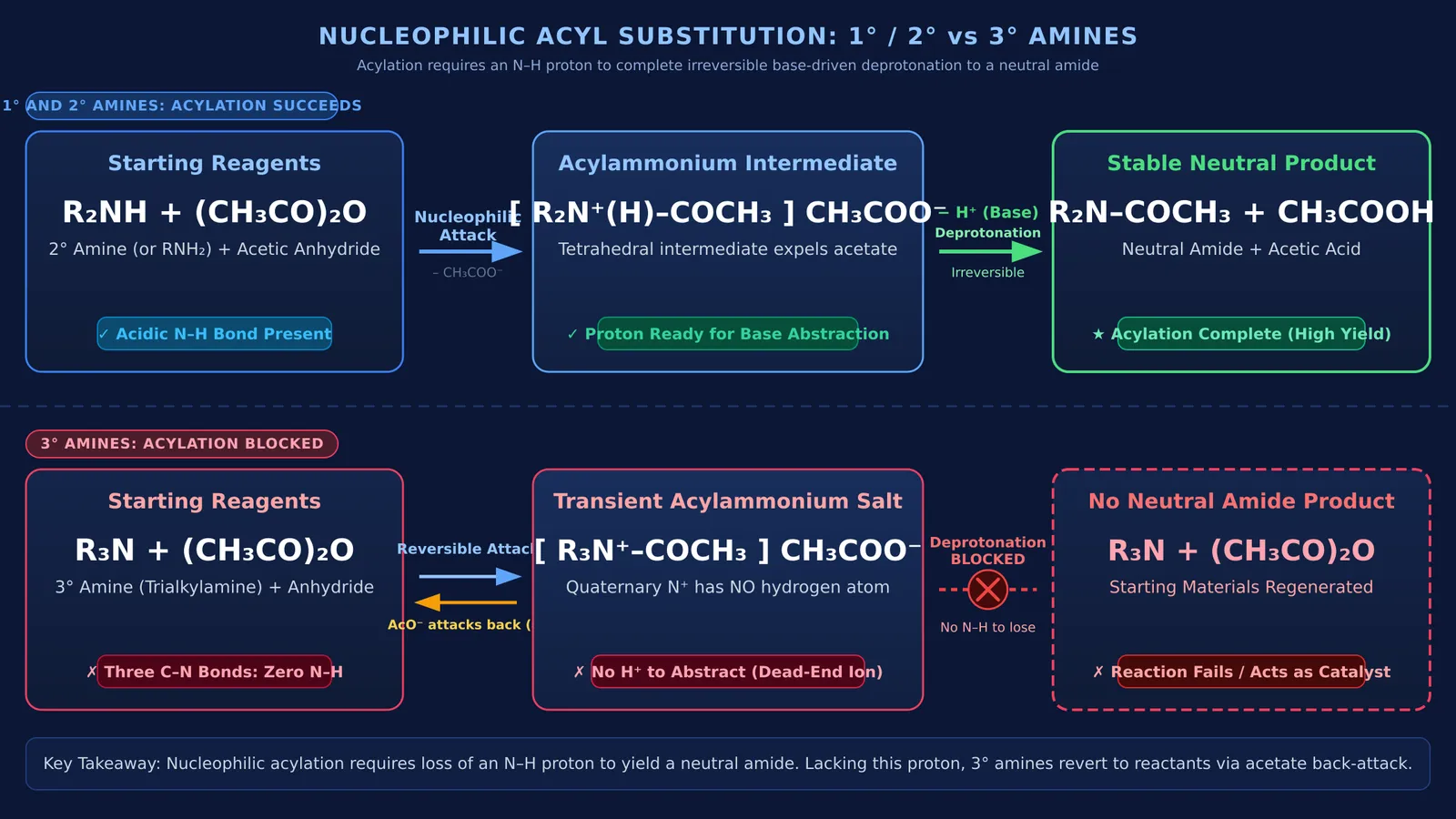
Nucleophilic attack: The amine nitrogen lone pair attacks the carbonyl carbon of the acylating agent, forming a tetrahedral intermediate.
Leaving-group departure: The carbonyl π-bond reforms, expelling chloride or acetate and producing an acylammonium intermediate with a positive formal charge on nitrogen.
Deprotonation: Because primary and secondary amines contain N–H bonds, a base such as pyridine abstracts a proton (H⁺). This neutralizes the nitrogen and yields a stable neutral amide.
As noted in OpenStax Organic Chemistry Section 24.7, primary and secondary amines cleanly form secondary and tertiary amides through this pathway. Without that deprotonation step, however, the process cannot yield a neutral amide.
What happens when a tertiary amine meets acetic anhydride?
A tertiary amine (R₃N) has its nitrogen atom bonded to 3 alkyl or aryl groups. Because all three valencies are bonded to carbon, the molecule contains zero N–H bonds.
When a tertiary amine encounters acetic anhydride, nucleophilic attack still occurs. The nitrogen lone pair attacks the carbonyl carbon to form an acylammonium intermediate:
R₃N + (CH₃CO)₂O ⇌ [R₃N⁺–COCH₃] + CH₃COO⁻
This ionic intermediate cannot move forward. Without a hydrogen atom on nitrogen, no base can deprotonate the cation to form a neutral product. The positive charge stays on nitrogen, keeping the carbonyl carbon highly electrophilic.
Because the tertiary amine is a good neutral leaving group, the displaced acetate counterion quickly attacks the carbonyl carbon, kicking out R₃N and shifting the equilibrium back to starting materials.
This reversibility explains why tertiary amines serve as catalysts rather than substrates. In a review in Angewandte Chemie International Edition in English, Gerhard Höfle, Wolfgang Steglich, and Helmut Vorbrüggen showed that tertiary pyridines form reactive acylpyridinium ion pairs that accelerate acyl transfer to other molecules. In particular, 4-dimethylaminopyridine (DMAP) is roughly 10⁴ times more active than pyridine as an acylation catalyst, transferring acyl groups to alcohols or primary amines while regenerating itself.
For students exploring how reaction mechanisms connect across organic chemistry, the Fermi Concept Library contains every concept in physics, chemistry, biology, mathematics and computing, each with its own lesson and its place in the map.
How do primary, secondary, and tertiary amines compare in the lab?
Because acylation requires a replaceable hydrogen on nitrogen, systematic qualitative analysis schemes such as the NCERT Class 12 Chemistry Laboratory Manual use reactivity toward acylating agents alongside other tests to distinguish amine classes:
Primary amines (RNH₂): Contain two N–H bonds. They react with acetic anhydride to form mono-substituted amides, give an offensive carbylamine odor in the carbylamine test, and react in the Hinsberg's reagent test to yield sulfonamides soluble in aqueous alkali. In synthesis, acetylating aniline before electrophilic aromatic substitution protects the ring from poly-substitution and yields crystalline acetanilide.
Secondary amines (R₂NH): Contain one N–H bond. They react with acetic anhydride to yield disubstituted amides, but their Hinsberg sulfonamides lack an acidic proton and remain insoluble in alkali.
Tertiary amines (R₃N): Contain zero N–H bonds. They do not form neutral amides, release no reaction heat, and leave acetic anhydride chemically unchanged.
To test an unknown amine in a qualitative analysis setting, follow this diagnostic checklist:
Add a small sample of the amine to a dry test tube containing acetic anhydride and 2 drops of pyridine base.
Warm gently in a water bath, then cool and observe the outcome.
Result: heat release or solid amide formation indicates a primary or secondary amine, whereas an unchanged, unreacted solution indicates a tertiary amine.
How can you test amine substitution in exam problems?
Entrance exams frequently test this concept in structural deduction problems involving the molecular formula C₃H₉N:
Count the isomers: C₃H₉N has 4 amine isomers—propan-1-amine (1°), propan-2-amine (1°), N-methylethanamine (2°), and trimethylamine (3°).
Apply the acylation clue: If an unknown isomer fails to react with acetic anhydride, all 1° and 2° isomers are ruled out.
Conclude: The compound must be trimethylamine, which lacks an N–H bond.
When exam questions test multiple functional groups at once, the Fermi Problem Library has worked problems with a step-by-step solver that explains the reasoning rather than printing an answer.


