

On this page
Alligators and crocodiles look alike at first glance. Look at the head, though, and you can usually tell them apart quickly. This guide covers the four clues that matter (snout, teeth, water and range), then shows where both animals sit in class Reptilia and why their heart is a favourite exam trap.
What is the difference between an alligator and a crocodile?
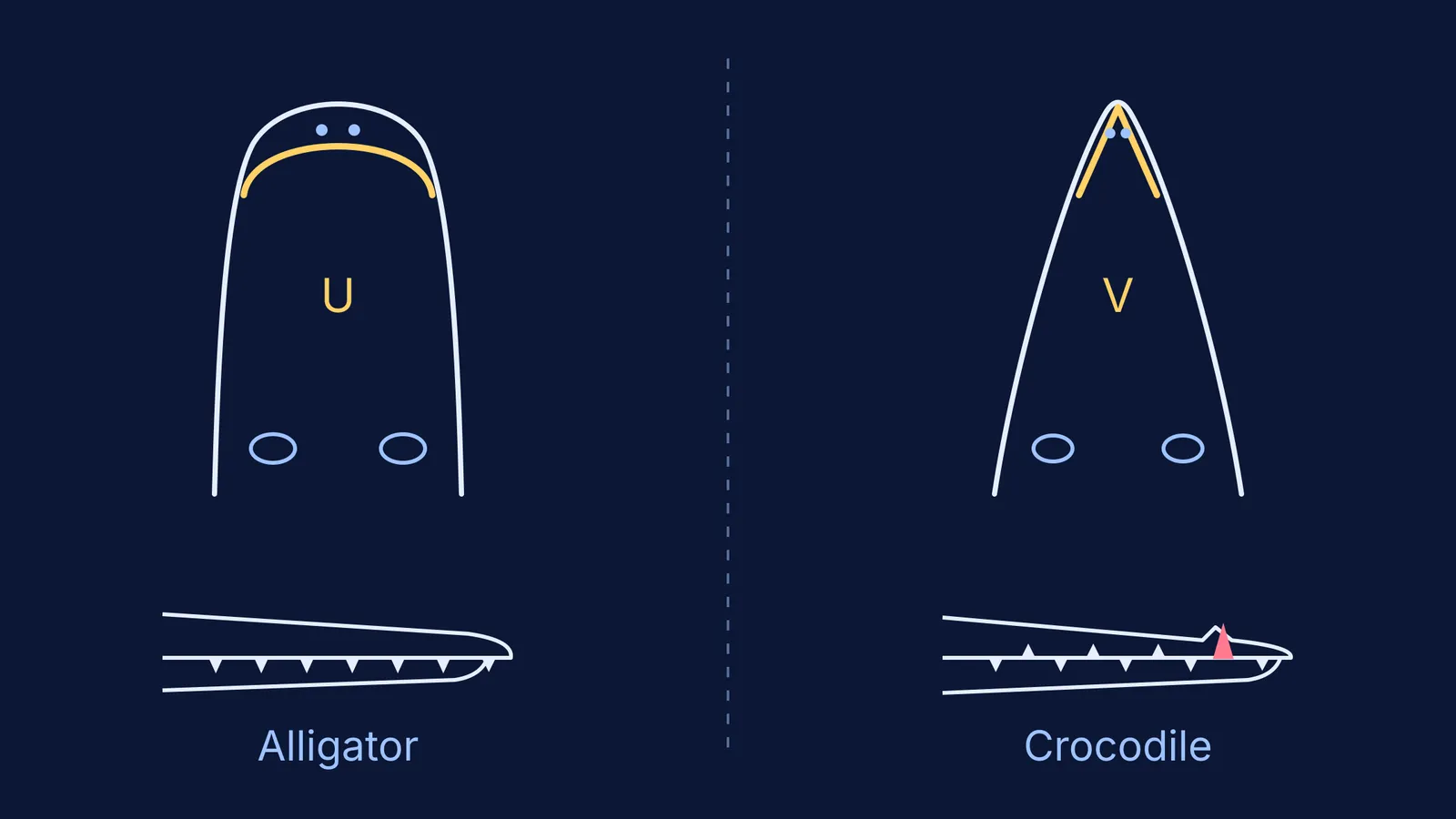
The quickest clue is the snout. According to the Smithsonian's National Zoo, alligators have short, wide snouts with rounded, U-shaped ends, while crocodiles have long, thin snouts with pointy, V-shaped ends. The US National Park Service describes the American crocodile's narrow snout as triangular and the alligator's as broader (NPS, Everglades National Park).
The second clue is which teeth you can see when the mouth is closed:
Alligator: the large fourth tooth in the lower jaw fits into a socket in the upper jaw and is not visible when the mouth is closed (Smithsonian, American alligator). Alligators have a slight overbite, so mostly upper teeth poke out (Smithsonian).
Crocodile: the upper and lower jaws are about the same size, so you see teeth pointing both up and down (Smithsonian). The fourth tooth on each side of the lower jaw stays visible (NPS).
Colour helps a little too. The NPS describes American crocodiles as greyish-green with white to yellowish undersides, and alligators as darker. Mud and light change colour easily, so trust the snout and teeth first.
Where do alligators and crocodiles live?
Water type is the big habitat difference. Crocodiles have salt glands that let them live in brackish and salt water, such as bays and coastal estuaries, as well as fresh water; alligators live in freshwater areas such as ponds, swamps and lakes (Smithsonian). Alligators can tolerate salt water only for brief periods because they do not have salt glands (Smithsonian, American alligator).
Alligators also have a much smaller range. The American alligator lives across the southeastern United States, from the northern coasts of North Carolina to Lake Worth in central Texas (Smithsonian). The Chinese alligator is now limited to the lower Yangtze in eastern China, and it is the only one of the eight species in the alligator family (Alligatoridae) that lives outside the Americas (Smithsonian, Chinese alligator). South Florida is the only place where the American alligator and the American crocodile live together (NPS).
That means India has no wild alligators. Its three crocodilians are the broad-snouted mugger of freshwater rivers, lakes and marshes, the saltwater crocodile of coastal Odisha, West Bengal and the Indian islands, and the narrow-snouted gharial of fast-moving rivers (Wildlife SOS). If you want to know why the gharial's snout is so thin, read our guide to gharial features and its river life.
Are alligators and crocodiles reptiles?
Yes. The NCERT Class 11 chapter Animal Kingdom lists Crocodilus (crocodile) and Alligator as examples of class Reptilia: animals with dry, cornified skin covered in epidermal scales or scutes. The same paragraph gives the exception: the reptile heart is usually three-chambered, but four-chambered in crocodiles.
"Crocodiles" there means the whole crocodilian group. The Smithsonian classifies the American alligator in order Crocodylia (Smithsonian), and a 2017 study in the Journal of Anatomy notes that whereas most reptiles have an undivided ventricle, crocodilians have a fully septated one (Cook et al., 2017). So alligators have the four-chambered heart too. To compare it with fish, amphibians, birds and mammals, see our guide to heart chambers across vertebrate classes.
How can you tell them apart at a glance?
Use this check in order, and stop as soon as one clue is clear:
Snout from above. U-shaped and wide means alligator; V-shaped and narrow means crocodile.
Mouth closed. Mostly upper teeth showing means alligator; teeth pointing up and down, with a big lower fourth tooth visible, means crocodile.
Water and place. Salt or brackish water points to a crocodile. In India, a wild crocodilian is a mugger, a saltwater crocodile or a gharial, never an alligator.
Now a worked exam example. Question: which of these has a four-chambered heart: Calotes, Chelone, Alligator, Naja? All four are reptiles in NCERT's list, so class alone will not decide it. Calotes is a lizard, Chelone a turtle and Naja a snake, all with the usual three-chambered heart. Alligator is a crocodilian, so the answer is Alligator. A statement such as "crocodiles are homoiothermous because their heart has four chambers" is false for the reason in the callout above.
NCERT exceptions like this one are easy to mix up when you revise them as a loose list. The Fermi Concept Library gives every concept in biology its own lesson and its place in the map. For more practice, try our set of Animal Kingdom NCERT exceptions and odd-one-out questions, and check your reasoning on the Fermi Problem Library, where a step-by-step solver explains the reasoning rather than printing an answer.
Next time you see a crocodilian in a zoo or a textbook, check the snout and the teeth first.


