

On this page
At cruising height the air outside a jet is thin, and the air inside is kept much denser so you can breathe. That difference in pressure pushes outward on every window, door and square centimetre of the fuselage skin. The numbers are large. A single cabin window carries a few kilonewtons, and a passenger door carries the weight of a loaded truck. This post works them out from P = F/A, shows why a door cannot be opened in flight, and explains why airlines do not keep the cabin at sea-level pressure.
How much air pressure is inside and outside a plane at cruise?
Airliners do not pressurise the cabin to sea level. The US certification rule for transport aircraft, 14 CFR 25.841, says the cabin must be able to stay at a cabin pressure altitude of not more than 8,000 ft under normal operating conditions. So the air inside feels like the air on a hill station about 2.4 km high. Some newer types aim lower: Boeing lists a maximum cabin altitude of 6,000 ft for its 787 business-jet versions (Boeing BBJ 787 specification).
Pressures at those heights come from the International Standard Atmosphere (ISA): 101,325 Pa and 15 °C at sea level, with temperature falling 6.5 °C per km up to 11 km, where the tabulated pressure is 22,632 Pa. Using the ISA troposphere formula:
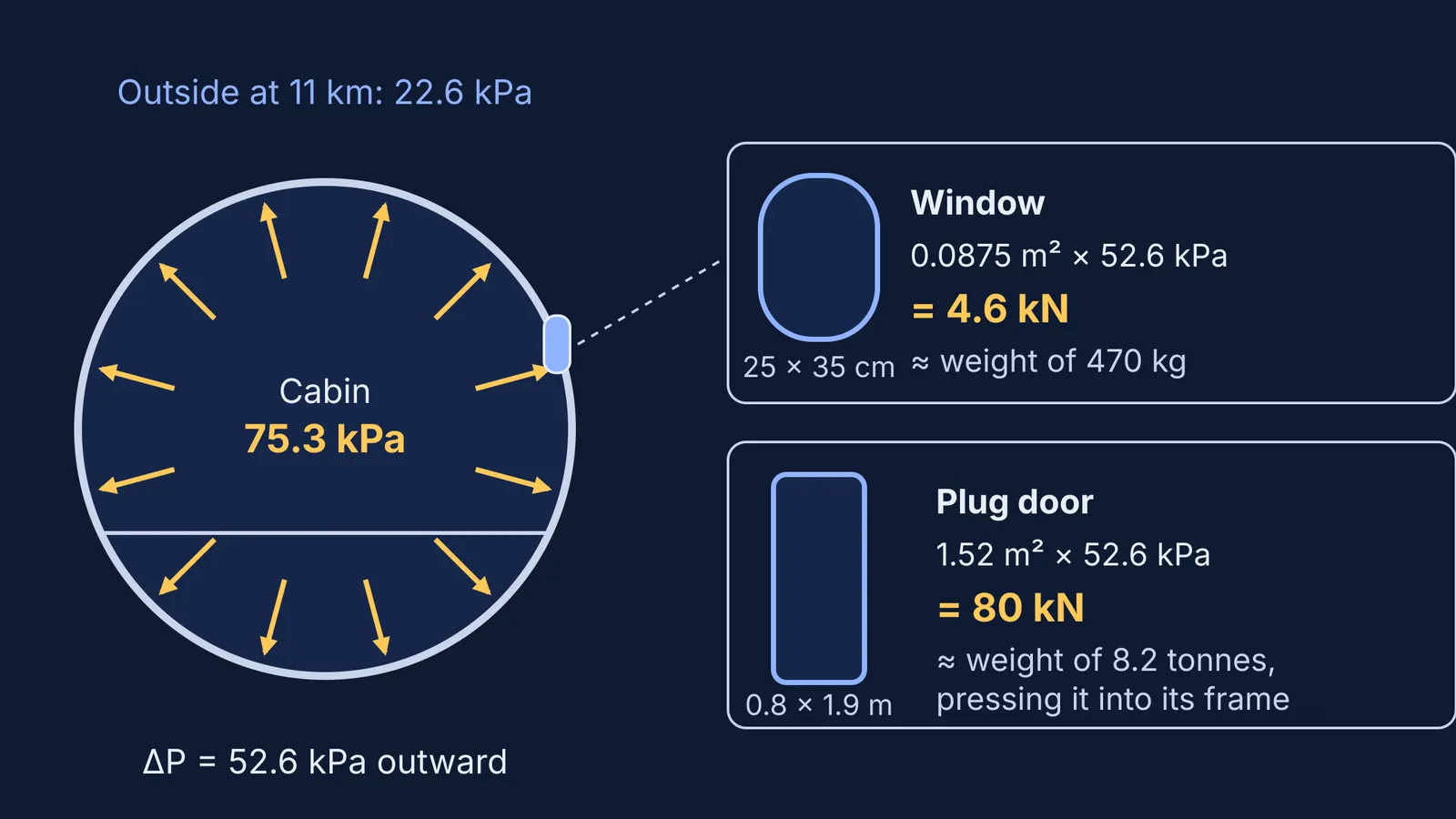
Cabin at 8,000 ft (2,438 m): about 75.3 kPa.
Outside at 11,000 m: 22.6 kPa.
Difference: ΔP = 75.3 − 22.6 = 52.6 kPa, or about 7.6 psi.
Real days are not standard days, so treat these as textbook values, not readings from any particular flight. If you want to see where the 75 kPa cabin figure shows up in another way, see why fountain pens and bottles leak on flights, which uses it for gas expansion rather than force.
What force acts on an aircraft window at 11 km?
Force is pressure difference times area. Only the difference matters, because the outside air pushes in on the outer face while the cabin air pushes out on the inner face.
Area. Take a window opening of 25 cm × 35 cm (an illustrative size, not a specific aircraft). A = 0.25 × 0.35 = 0.0875 m².
Pressure difference. ΔP = 75,262 − 22,632 = 52,630 Pa.
Force. F = ΔP × A = 52,630 × 0.0875 = 4,605 N, about 4.6 kN.
Compare with a weight. m = F/g = 4,605 / 9.81 ≈ 470 kg.
Check units. Pa × m² = (N/m²) × m² = N. Good.
So a window a little larger than a sheet of A4 paper holds back the equivalent of about 470 kg pressing outward, on every flight. Another way to feel it: 52.6 kPa is 5.3 N on every square centimetre, roughly a 540 g mass on each fingertip-sized patch.
The shape of the window is a separate story. Corners concentrate stress, which is why windows are rounded; that is covered in why aeroplane windows are round and not square. Here we only care about the total force.
Why can't anyone open a plane door in flight?
Do the same sum for a passenger door. Take 0.8 m × 1.9 m (again illustrative).
A = 0.8 × 1.9 = 1.52 m².
F = 52,630 × 1.52 ≈ 80,000 N = 80 kN.
m = 80,000 / 9.81 ≈ 8,200 kg, about 8.2 tonnes.
No person can pull against 80 kN. And many airliner doors are plug doors: the door is larger than the opening on the inside, so it must first move inward before it can swing out. Cabin pressure presses it outward into its frame, like a cork pushed into a bottle neck from inside. The higher the pressure difference, the tighter it seals. On the ground, with ΔP close to zero, the same door opens easily.
Why don't airlines keep the cabin at sea-level pressure?
Because the force grows with the pressure difference. If the cabin were held at 101.3 kPa:
ΔP = 101,325 − 22,632 = 78,693 Pa.
Window force = 78,693 × 0.0875 ≈ 6.9 kN.
That is 1.5 times the 4.6 kN at an 8,000 ft cabin.
Every window, door, frame and panel of skin would need to be built for 50% more load, which adds weight and fuel burn. A 6,000 ft cabin (81.2 kPa in the ISA) is a middle path: ΔP = 58.6 kPa, about 11% more than at 8,000 ft. That is the trade designers make for passenger comfort. How the lower cabin pressure affects your ears is in why your ears pop on a flight.
How much stress does cabin pressure put in the fuselage skin?
Treat the fuselage as a thin-walled cylinder of radius r and wall thickness t. Two stresses result:
Hoop stress (around the circumference): σ_h = ΔP·r / t.
Longitudinal stress (along the length): σ_l = ΔP·r / 2t.
Hoop stress is twice the longitudinal stress. That is why a sausage splits along its length when it bursts: the larger stress acts around it.
With illustrative values r = 1.95 m and skin t = 1.6 mm:
σ_h = 52,630 × 1.95 / 0.0016 ≈ 64 × 10⁶ Pa = 64 MPa.
σ_l = 64 / 2 ≈ 32 MPa.
The thin-wall formula needs t much smaller than r, which holds here (1.6 mm against 1,950 mm). A real fuselage shares the load with frames and stringers, so the skin alone carries less than this. But the point stands: every flight pressurises and depressurises the cabin once. That is one load cycle, repeated on every flight for the aircraft's whole working life, which is why engineers worry about metal fatigue and not just a single overload.
What does this teach for JEE and NEET?
This is a straight P = F/A problem with one trap and one extension. The trap is using absolute pressure instead of the difference. The extension is the thin cylinder, which turns up in JEE as a soap bubble, a gas cylinder or a boiler. If you want more fluid-pressure problems worked step by step, the Fermi Problem Library has a step-by-step solver that explains the reasoning at each stage.
Quick checklist
Net force = (P_inside − P_outside) × area. Never use one pressure alone.
Cabin at 8,000 ft is about 75.3 kPa; outside at 11 km is 22.6 kPa (ISA).
A 0.0875 m² window carries 4.6 kN; a 1.52 m² door carries 80 kN.
Plug doors are pressed into their frames, so they cannot open while pressurised.
A sea-level cabin would raise every load by 50%.
Thin cylinder: hoop stress ΔP·r/t is twice longitudinal stress ΔP·r/2t.
One flight is one fatigue cycle.


