

On this page
When you board a commercial flight, you share an experience with millions of other passengers: as the aircraft climbs or descends, your ears feel full, muffled, and eventually, they "pop". This is a common form of ear discomfort resulting directly from fundamental gas laws and changing air pressure meeting the delicate anatomy of the human head.
What is the "pop"?
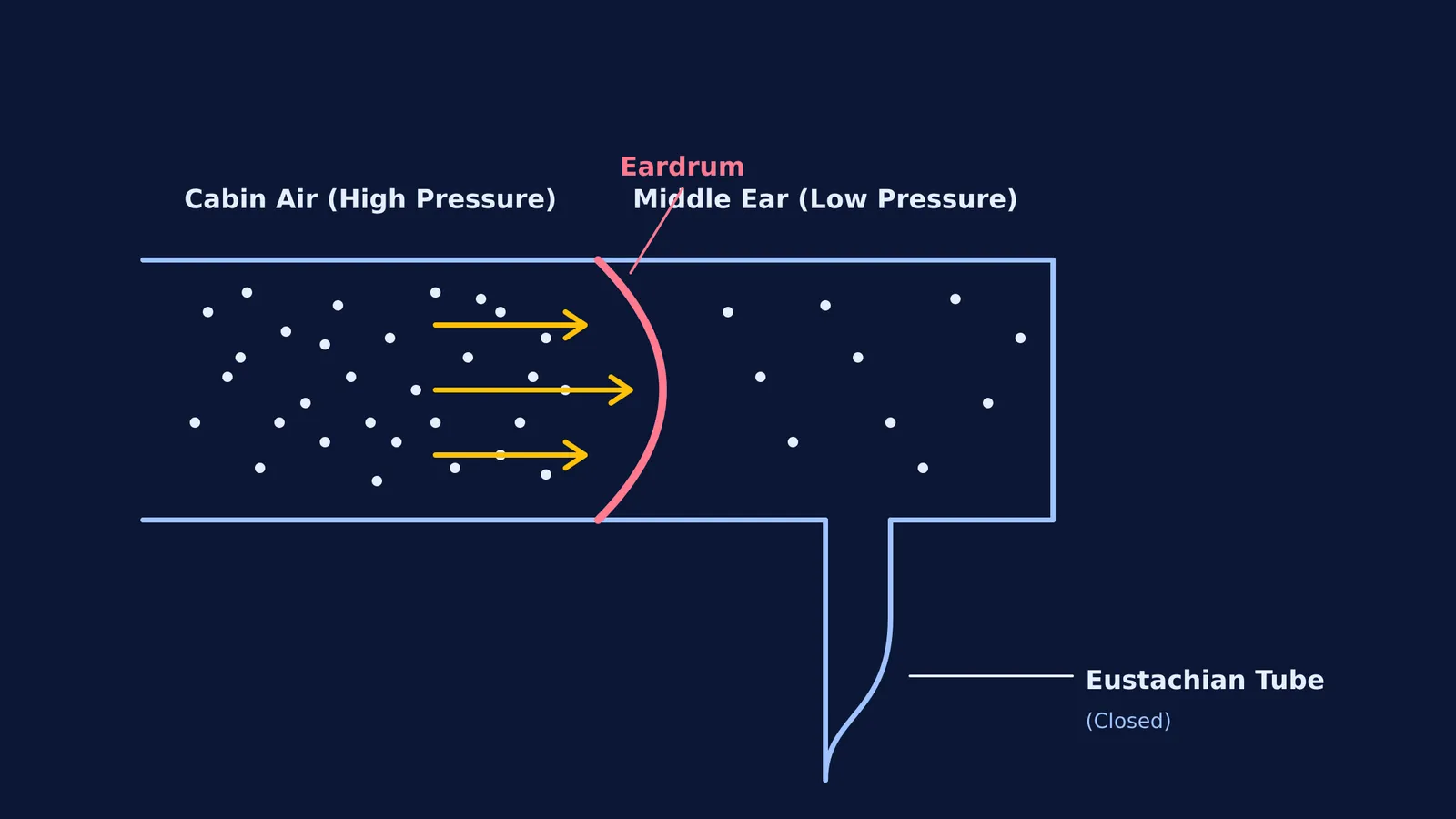
Your eardrum, or tympanic membrane, is a thin, airtight barrier separating your outer ear canal from your middle ear. For your eardrum to vibrate freely and let you hear clearly, the air pressure on both sides must be equal.
When an airplane takes off, it rapidly climbs to altitudes where the outside air is extremely thin. To keep passengers conscious and comfortable, the aircraft pumps compressed air into the cabin. Federal Aviation Administration (FAA) regulations require commercial aircraft to maintain a cabin pressure altitude of no more than 8,000 feet. This means the air inside the cabin feels like the air on a high mountain—lower pressure than at sea level, but still safe to breathe.
Because the cabin pressure changes faster than your body can adjust, an imbalance occurs. The air in your middle ear remains at the pressure of your departure city, while the cabin air pressure drops.
Your body has a built-in release valve called the Eustachian tube, a narrow channel connecting the middle ear to the back of your nose and throat. Most of the time, this tube stays closed. When the pressure difference becomes large enough, the tube opens. The trapped air rushes in or out, and the eardrum snaps rapidly back to its neutral, flat position. That mechanical snap is the "pop" you hear. It is a sudden release of energy, much like the relationship between displacement and pressure waves when sound travels through the air.
If you are studying gas laws, you can explore exactly how gases expand and contract under different pressures. The Fermi Simulation Lab lets you adjust variables and visualise particle behaviour interactively, making the physics much easier to grasp than static diagrams.
Why does descent hurt more than ascent?
Many passengers notice that taking off is relatively painless, while landing can cause significant ear pain. This comes down to the difference between positive and negative pressure, and how gases behave as described by Boyle's Law. Boyle's Law states that the volume of a gas is inversely proportional to its pressure.
During the ascent, cabin pressure decreases. According to Boyle's Law, the volume of the trapped air in your middle ear attempts to expand as the surrounding pressure drops. This means the trapped air is at a higher pressure than the cabin. This positive pressure naturally pushes outward against the soft tissues of the Eustachian tube, gently forcing it open and making it relatively easy for the air to escape—a principle related to the free expansion of an ideal gas. The expanding air quietly vents into the back of your throat, often without you even noticing.
During the descent, the opposite happens. The cabin pressure increases as the aircraft approaches the ground, simulating a return to sea level. The air in your middle ear, which had previously equalised to the lower cruising pressure, is now at a lower pressure than the dense cabin air pushing against it. This negative pressure differential pulls the eardrum inward and acts like a vacuum, sucking the soft walls of the Eustachian tube tightly shut. Overcoming this vacuum requires much more mechanical effort from the muscles in your throat, which is why your ears feel blocked, muffled, and painful as the plane comes in to land.
How can you equalise the pressure?
To relieve the discomfort, you have to force the Eustachian tube open. This is called equalising the pressure.
Swallow or yawn: These actions engage the tensor veli palatini and levator veli palatini muscles in your throat, which mechanically pull the Eustachian tube open.
Chew gum: The repetitive jaw motion encourages swallowing and muscle movement.
Use the Valsalva maneuver: If your ears are stubbornly blocked, pinch your nose, close your mouth, and gently blow air out of your nose. This forces air up the Eustachian tube.
If you are flying with a head cold or allergies, the tissues around your Eustachian tube may be inflamed. In these cases, the tube struggles to open at all, which is why flying with a cold can be particularly painful.
By understanding the physics of your flight and the biology of your ears, you can take simple steps to ensure your next journey ends with a gentle pop rather than a painful landing.


