

On this page
Why do fountain pens leak when a plane ascends?
When you board an aircraft at sea level, ambient air exerts standard atmospheric pressure of roughly 101.3 kilopascals (kPa). As the plane climbs to a cruising altitude of 35,000 feet, cabin compressors maintain air pressure. Under Federal Aviation Administration regulations in 14 CFR § 25.841, passenger cabins must maintain a pressure altitude not exceeding 8,000 feet during normal operations. According to the NASA Earth Atmosphere Model, ambient pressure at 8,000 feet falls to approximately 75.3 kPa (10.9 pounds per square inch), a drop of nearly 26%.
That drop disrupts the balance inside a fountain pen. In 1884, inventor Lewis E. Waterman patented the capillary feed in US Patent 293,545, using narrow fissures to balance liquid adhesion and surface tension. These channels draw ink downward while admitting air bubbles upward to replace spent ink—a process that assumes steady ambient pressure.
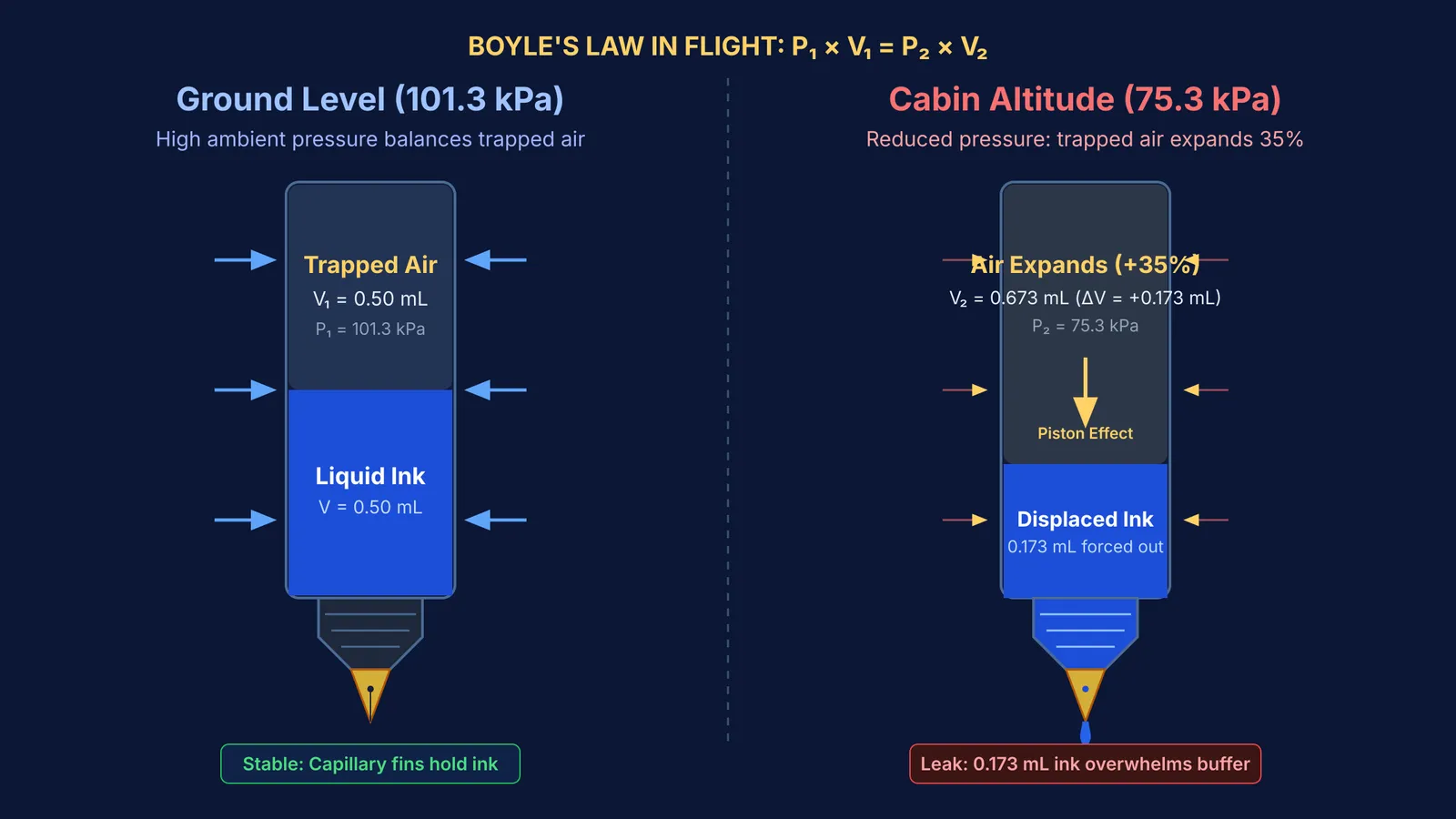
When cabin pressure drops, any trapped air pocket inside the reservoir expands to equalize with the cabin. Because liquid ink cannot easily compress, the expanding gas acts like a piston. If the pen rests horizontally or points downward, the air pocket sits behind the ink, driving liquid through the feed channels and breather hole until it pools inside the cap.
What happens to the air inside water and toiletry bottles?
The same fluid mechanics cause travel shampoo bottles, sunscreen tubes, and plastic water bottles to bulge, hiss, or spray. As documented in the CDC Yellow Book air travel guidance, aircraft cabins maintain pressure equivalent to 6,000 to 8,000 feet, causing confined gases to expand by 25% to 30%. When you seal a toiletry container on the ground at 101.3 kPa, that trapped ground-level air retains its pressure until the plane ascends.
Flexible silicone or polyethylene bottles deform as the air expands, bulging until container elasticity balances the outward push. In rigid containers made of heavy plastic or glass, the volume cannot change, generating an internal gauge pressure of roughly 26.0 kPa behind the closure. Across a flip-top lid orifice of 0.5 square centimetres, this pressure difference produces an outward force of approximately 1.3 newtons—comparable to the weight of a 130-gram mass pressing against the latch. Unclipping the latch at cruising altitude allows this pressurized air pocket to propel lotion or liquid through the opening.
This balance between altitude and air pressure illustrates Blaise Pascal's barometer experiments, which proved how atmospheric weight decreases as you climb above sea level.
How much does air expand under Boyle's law?
The quantitative basis of this expansion is Boyle's law. In 1662, Robert Boyle published experiments on the spring of air in the second edition of *New Experiments Physico-Mechanicall*, recorded by the Science History Institute, establishing that gas volume varies inversely with absolute pressure at constant temperature:
P₁ × V₁ = P₂ × V₂
Consider a standard fountain pen converter with a capacity of 1.0 millilitre (mL), half filled with ink:
Initial trapped air volume at sea level (P₁ = 101.3 kPa): V₁ = 0.50 mL
Cabin pressure at cruising altitude: P₂ = 75.3 kPa
At constant cabin temperature, the expanded gas volume V₂ becomes:
V₂ = (P₁ / P₂) × V₁ = (101.3 / 75.3) × 0.50 mL ≈ 0.673 mL
The air pocket expands by ΔV = 0.673 mL − 0.50 mL = 0.173 mL. Because ink is incompressible, this expanding gas displaces 0.173 mL of liquid. A standard ink drop is roughly 0.05 mL, meaning the gas expels about 3.5 drops. Typical feed fins buffer only 0.05 mL to 0.10 mL of overflow, so 0.173 mL floods the feed and leaks into the cap.
You can trace how pressure and volume shift across varied conditions when solving ideal gas law problems or reviewing Robert Boyle's experiments with trapped gases.
How can you prevent leaks when flying with pens and liquids?
Understanding pressure differentials makes leak prevention simple. You can protect stationery and clothing with four habits:
Keep pens completely full or completely empty. A full reservoir contains almost no air to expand, while an empty pen carries no ink to spill.
Store pens nib-up during takeoff and climb. Keeping the nib pointed upward ensures the air pocket rests against the feed, allowing expanding gas to vent harmlessly.
Squeeze flexible bottles before capping. Squeeze out excess air until liquid reaches the neck before sealing. Expanding gas will simply restore the bottle's shape.
Open containers upright and slowly. Vent excess pressure while holding bottles vertical before tilting to pour.
Visualizing pressure and volume changes makes abstract fluid statics intuitive. The Fermi Simulation Lab provides interactive simulations for ideas that are easier to see than to read, letting you adjust pressure boundaries and observe fluid displacement directly. If you are working through fluid problems, the Fermi Problem Library offers worked problems with a step-by-step solver that explains the reasoning rather than printing an answer.


