

On this page
In 1952, the de Havilland Comet entered service as the world's first commercial jet airliner. It flew higher and faster than propeller planes, bringing a new era of quiet and comfortable travel. But within two years, two Comets were lost in mid-air due to a phenomenon engineers did not fully appreciate at the time: metal fatigue (Source).
The cause was traced back to the Comet's design: its square passenger windows and other sharp rectangular cutouts in the fuselage.
Why do aeroplanes have pressurised cabins?
To fly efficiently and avoid bad weather, modern passenger jets cruise at high altitudes. At these heights, the outside air is too thin and cold for humans to breathe. Aircraft must pump air into the cabin to maintain a comfortable pressure.
Because the pressure inside the cabin is much higher than the pressure outside, the aeroplane's fuselage expands slightly like a balloon. Every time the plane takes off, it inflates; every time it lands, it shrinks. This continuous cycle places the metal structure under immense tensile stress. Understanding this expansion is similar to studying the free expansion of an ideal gas, where pressure and volume dictate the behaviour of the system.
Why are aeroplane windows round and not square?
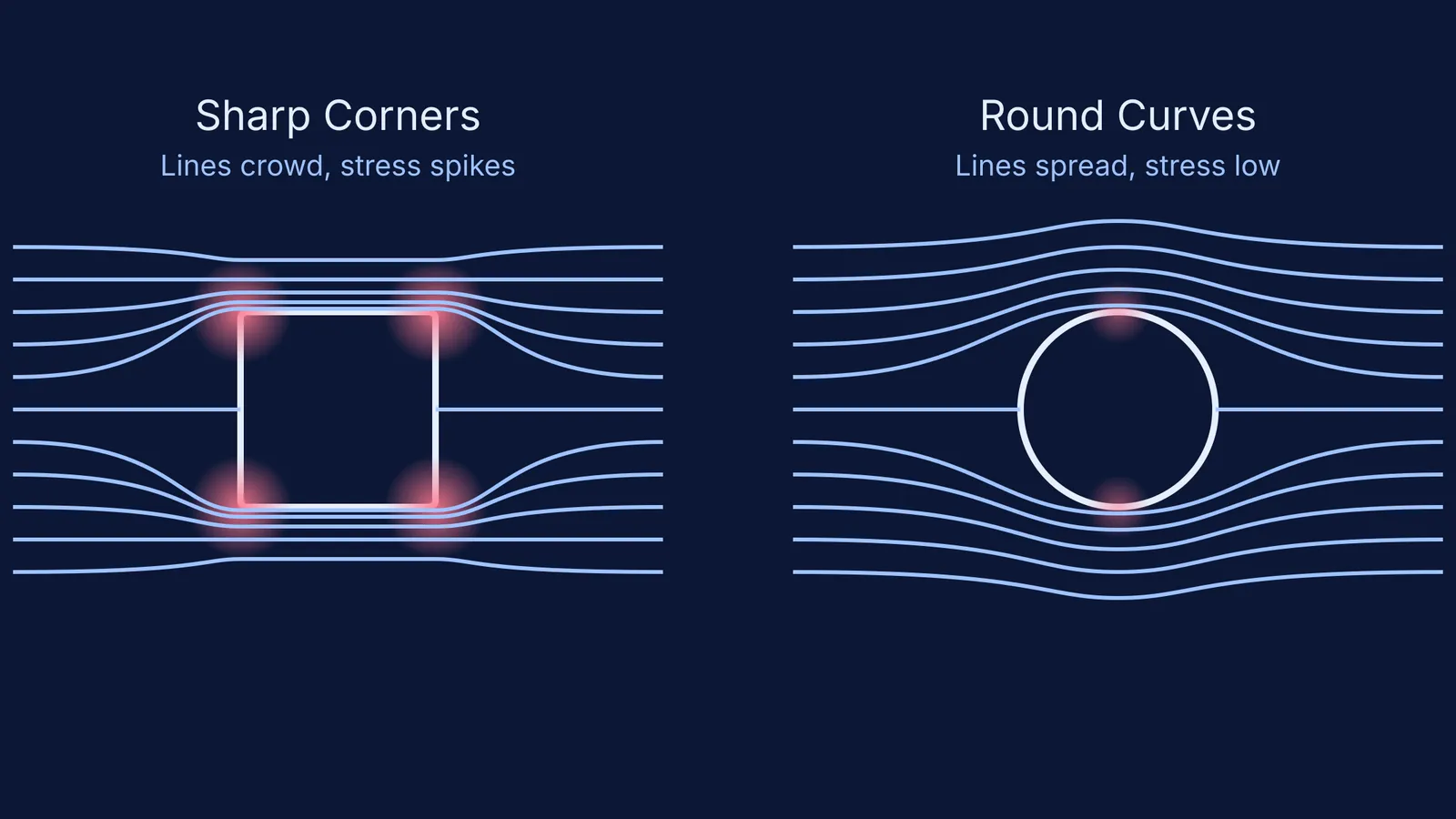
When you cut a hole in a metal plate and pull on it, the stress does not stay uniform. The force has to detour around the hole, causing lines of tension to bunch up at the edges. This effect is called stress concentration.
If the hole is square, the force lines are forced to make an abrupt turn. They crowd tightly at the sharp corners, creating a massive spike in stress. The de Havilland Comet first flew in 1949 with square windows. The stress at these corners was so high that microscopic cracks formed and grew with every flight, eventually tearing the metal apart.
Round or oval windows solve this by allowing the stress lines to curve smoothly. With a continuous curve, the tension is distributed evenly around the entire edge, preventing any single point from bearing too much force.
How did engineers find the cause?
When the Comet crashes occurred, the concept of metal fatigue in aircraft fuselages was not well understood. Investigators at the Royal Aircraft Establishment (RAE) in Farnborough had to devise a completely new way to test the plane. They built a massive tank, submerged a complete Comet fuselage inside it, and repeatedly pumped water in and out to simulate the pressurisation cycles of flight.
Because water is practically incompressible, it was much safer to use than air. If the fuselage failed under air pressure, the compressed air would expand violently, destroying the evidence. With water, a failure would simply result in a sudden leak, preserving the exact origin of the crack for investigators to study.
After running the equivalent of 3,057 flight cycles in the water tank, the fuselage finally split open (Source). The tear began at a bolt hole near the sharp corner of a forward escape hatch. An examination of the actual wreckage from one of the crashed Comets revealed a similar fatigue crack that had started near the corner of a square antenna window on the roof. The stress concentration at these sharp corners had caused tiny fatigue cracks to form, which then spread rapidly through the metal skin.
How do you calculate stress concentration?
Engineers use a specific value, the stress concentration factor, to measure how much a shape amplifies stress. The stress concentration factor for a small circular hole under tension is exactly 3 (Source). This means the peak stress at the edge of the circle is three times higher than the stress in the bulk of the material.
For an elliptical hole, the factor depends on its length and width. The formula is K = 1 + 2(a/b).
Here, 'a' is the half-length of the hole perpendicular to the stretch, and 'b' is the half-width parallel to it.
If 'b' becomes very small — like in a sharp square corner or a tiny crack — the term (a/b) becomes huge. The stress concentration shoots up to infinity, meaning the material will inevitably yield and crack further. This mathematical principle is just as critical in civil engineering when calculating the elastic potential energy in a stretched wire to ensure bridges and cables do not snap under tension.
Seeing invisible forces
Understanding forces that you cannot see — like stress lines, electric fields, and magnetic flux — is notoriously difficult. Reading the formula for tensile stress is helpful, but picturing how those forces actually flow around an obstacle requires a strong physical intuition.
This is where the Simulation Lab comes in. It provides interactive simulations for the ideas that are easier to see than to read. By experimenting with shapes and loads on screen, you can watch how stress lines bunch up at sharp corners or spread out across smooth curves, helping you build a deep, intuitive grasp of the mechanics.


