

On this page
On a small commuter aircraft, the crew sometimes asks a few passengers to move seats before take-off, even when the cabin is half empty. It is not about comfort. Every passenger is a mass at some distance from the nose, and together those masses decide where the aircraft's centre of gravity sits. That point has to stay inside a narrow band set by the maker.
How do you find an aircraft's centre of gravity?
Treat the loaded aircraft as point masses along one line, the length of the fuselage. Pick a reference point called the datum; here it is the nose. The distance of each mass from the datum is its arm, and mass × arm is its moment.
The centre of gravity is the point where the whole mass can be taken to act:
x_cg = Σ(m × x) / Σm
Loaders fill in a table of masses, arms and moments for the empty aircraft, crew, fuel, bags and each passenger row, then divide total moment by total mass. The FAA's Aircraft Weight and Balance Handbook (FAA-H-8083-1B) sets out this method. For the lab version of the same idea, see finding the centre of gravity of an irregular lamina with a plumb line.
What does "percent MAC" mean?
On larger aircraft the centre of gravity is quoted as a percentage of the wing's mean aerodynamic chord (MAC). The chord is the front-to-back width of the wing. On a tapered wing it changes along the span, so designers use one reference chord that stands for the whole wing.
If the front edge of the MAC (called LEMAC) is at arm x_LE and the MAC has length c, then
CG in % MAC = (x_cg − x_LE) / c × 100
0% is the front edge of that reference chord and 100% its rear edge. The FAA handbook notes that an aircraft normally handles acceptably with its centre of gravity somewhere near 25% of the chord, ahead of the point where the wing's lift effectively acts. The MAC is a reference length for calculation, not the real chord at any one spot on the wing.
Why can't the centre of gravity be too far forward or too far back?
Think of the aircraft as a beam in rotational equilibrium. The wing's lift acts a little behind the centre of gravity, so weight and lift together make a nose-down torque. The horizontal tail balances it with a small downward force, and in steady flight the net torque is zero.
Too far forward. The nose-down torque grows, so the tail must push down harder. The handbook explains that at low take-off speed the elevator may not make enough nose-up torque to raise the nose, and on landing there may not be enough to flare.
Too far back. The centre of gravity gets close to the centre of lift, so the restoring torque after a gust is small and the aircraft is less stable in pitch. The handbook warns that an aircraft loaded aft of its limit is unstable and hard to recover from a stall.
The forward and aft limits are found during flight testing for type certification and printed in each type's flight manual. The numbers below are illustrative, not limits for any real aircraft.
How far does the centre of gravity move when six passengers change rows?
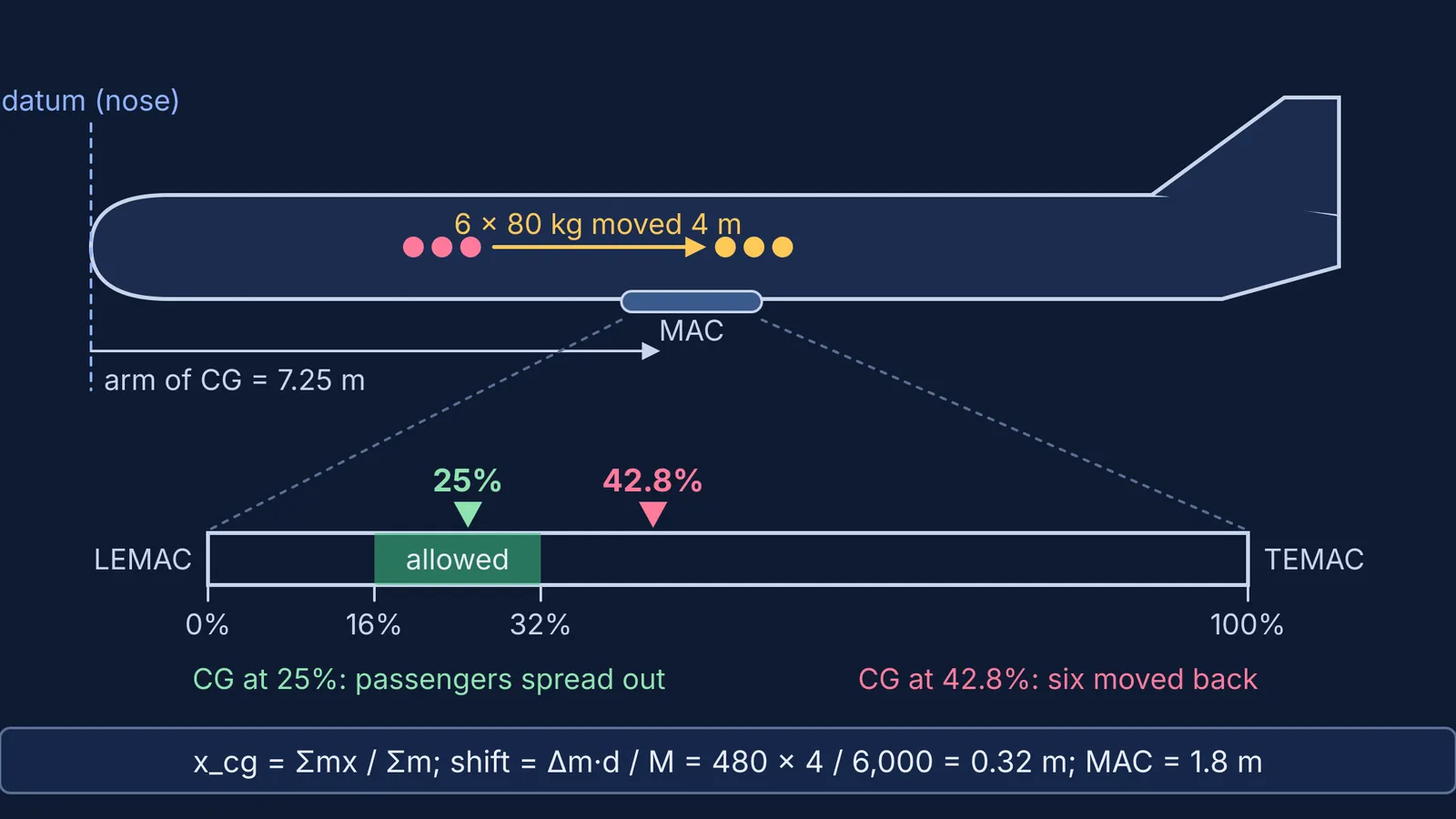
Take an illustrative 19-seat commuter aircraft with round numbers: total mass 6,000 kg, LEMAC 6.80 m behind the nose, MAC 1.8 m, allowed band 16% to 32% MAC, and an assumed 80 kg per passenger.
List the loads and arms (from the nose). Empty aircraft 3,980 kg at 7.50 m. Two crew, 160 kg at 2.00 m. Fuel 700 kg at 7.40 m. Bags 200 kg at 10.75 m. Six front passengers, 480 kg at 4.50 m. Six rear passengers, 480 kg at 8.00 m.
Moments. 29,850 + 320 + 5,180 + 2,150 + 2,160 + 3,840 = 43,500 kg·m.
Total mass. 6,000 kg.
Centre of gravity. x_cg = 43,500 / 6,000 = 7.25 m from the nose.
Convert to % MAC. (7.25 − 6.80) / 1.8 × 100 = 25.0%. Inside the band.
The six front passengers move 4 m back, to rows at 8.50 m. The total mass is unchanged and only one moment changes, so Δx = Δm × d / M = 480 × 4 / 6,000 = 0.32 m.
New position. 7.25 + 0.32 = 7.57 m, which is (7.57 − 6.80) / 1.8 × 100 = 42.8% MAC, 10.8 points past the illustrative 32% aft limit.
Each 80 kg passenger moving 4 m shifts the centre of gravity by 80 × 4 / 6,000 = 0.053 m, about 3.0% of the chord. Two passengers moving back give 30.9% MAC, still inside. A third gives 33.9%, outside. On a large aircraft the same move hardly matters, because Δx = Δm × d / M shrinks as M grows.
Why move passengers instead of bags?
The handbook puts the fix plainly: if the centre of gravity is too far forward, a heavy passenger can be moved to a rear seat or bags shifted to a rear hold; if it is too far aft, passenger or bag weight can be shifted forward. Which load helps depends on how much moment it can change.
Rearrange the equation for the distance a mass must travel: d = M × Δx / Δm. To undo the 0.32 m shift with 150 kg of bags alone, d = 6,000 × 0.32 / 150 = 12.8 m, longer than this aircraft's cabin. Six passengers moved 4 m change the moment by 1,920 kg·m, the same as 150 kg moved 12.8 m. On a small aircraft, people are the largest movable masses.
As fuel burns, both Σm and Σ(m × x) change, so the centre of gravity also drifts in flight. Who sits where is always the crew's decision, made from the type's own manual.
For more centre-of-mass problems with each step explained, try the Fermi Problem Library. If you are preparing for JEE, Fermi Test Prep offers personalised preparation for JEE Main & Advanced with an AI tutor, live classes, adaptive mocks, mentorship and a study plan that updates based on mastery. For an aircraft where software helps manage pitch, read Kota Harinarayana and how fly-by-wire flies the Tejas.
Which mistakes cost marks on centre of gravity shift problems?
Dividing by the moved mass instead of the total mass.
Adding the moved mass to the total. Moving a passenger does not change the total.
Mixing datums. Every arm must be measured from the same point.
Forgetting to subtract LEMAC before dividing by the MAC.
Quick checklist
x_cg = Σ(m × x) / Σm, with every arm from one datum.
% MAC = (x_cg − LEMAC) / MAC × 100.
One mass moved: Δx_cg = Δm × d / M; total mass stays the same.
Too far forward: not enough elevator to raise the nose. Too far aft: less pitch stability.
Six 80 kg passengers moved 4 m in a 6,000 kg aircraft: 0.32 m, or 17.8% of a 1.8 m chord.
Real limits come from each type's flight manual; seat changes are the crew's call.


