

On this page
On 4 January 2001, India's first Light Combat Aircraft technology demonstrator, TD1, made its first flight, according to the Aeronautical Development Agency's milestone list. Kota Harinarayana had been appointed director and chief designer of the programme, as the HAL Tejas article on Wikipedia notes. The aircraft became the Tejas, and the idea at its heart is one you can test with a ruler on your palm: a jet that is slightly unstable on purpose, kept steady by computers.
Who is Kota Harinarayana?
Harinarayana was born in 1943 in Berhampur, Odisha, studied mechanical engineering at Banaras Hindu University and aerospace engineering at IISc Bengaluru, and received the Padma Shri in 2002, as The Better India's profile records. Before the Tejas he worked at Hindustan Aeronautics Limited (HAL), including at Nashik, where MiG aircraft were made, and did his PhD at IIT Bombay.
In a long interview with The Interview Portal, he explained the problem. India's previous fighter, the HF-24, had flown in 1961, and by 1985 no new fighter project had been started for about two and a half decades. He began with almost 300 people from HAL, the National Aerospace Laboratories (NAL) and DRDO. In his words: "we were 5000 engineers working with 300 industries, about 40 laboratories and 20 academic institutions."
Why was the Tejas designed to be unstable?
The U.S. Centennial of Flight Commission's essay on stability gives the definition: an aeroplane is statically stable if, after a disturbance, it produces forces and moments that tend to bring it back to straight and level flight. It depends on the centre of gravity: far enough forward, the aircraft is stable; at the neutral point, neutrally stable; further back, unstable.
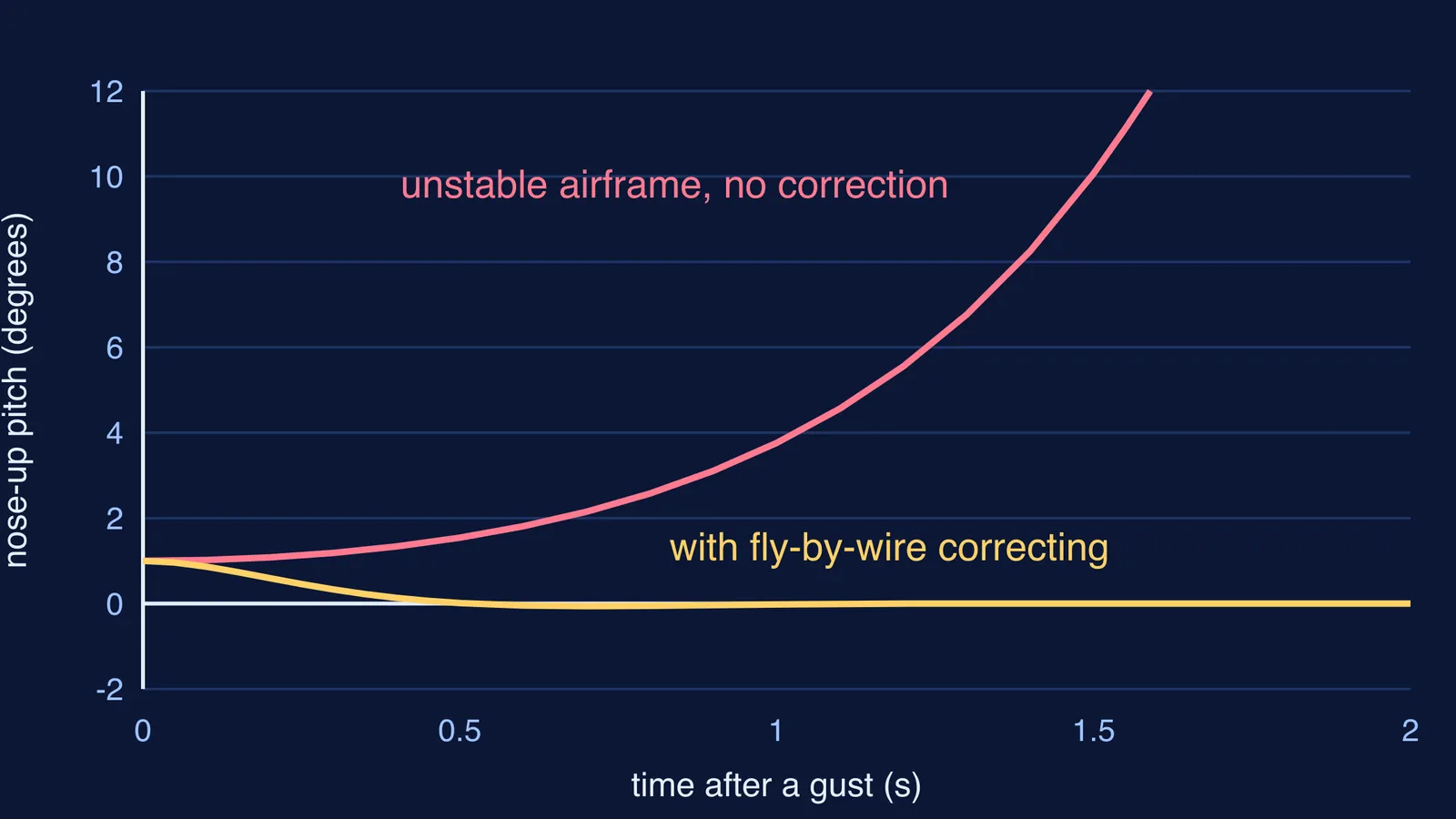
The ADA page on the Tejas Mk1 describes a single-engine, compound-delta-wing, tailless aircraft built with relaxed static stability, fly-by-wire control and composite materials. The Wikipedia article says the fly-by-wire design was chosen "to provide enhanced manoeuvrability". A strongly stable aircraft keeps pushing its nose back, so it also resists the pilot who wants to turn. Relax that stability and it responds faster, but relax it far enough and a human hand alone can no longer keep it steady.
How does fly-by-wire keep the Tejas in the air?
In a fly-by-wire aircraft the stick has no mechanical link to the control surfaces. It sends an electrical signal to flight control computers, which read the sensors and decide how far to move each surface.
The ADA page on integrated flight control describes the Tejas system as a full-authority quadruplex digital fly-by-wire system with a fault-tolerant flight control computer and "Robust Control Laws for Stability and command Augmentation, Carefree Maneuvering". Quadruplex means four channels, so the system can carry on if one fails; ADA calls the design fail-operational and fail-safe. The fly-by-wire control laws, the rules the computer follows, were developed by CSIR-NAL, as this 2016 report on CSIR-NAL's role notes.
Digital fly-by-wire had been tested in flight decades earlier. NASA's F-8 Digital Fly-By-Wire aircraft first flew on 25 May 1972, and NASA says the project validated the principal concepts of the all-electric flight controls now used on nearly all modern high-performance aircraft.
Harinarayana told The Interview Portal that the test pilot, Wing Commander Kothiyal, had never flown a prototype in his life. "That too an unstable aircraft," he added. The team tested the control laws on a modified F-16 in the USA. "I never wanted to side step any testing," he said, and the whole testing process went on for a year. After the first flight, the pilot reported zero snags.
Try the control loop on your own palm
Balance a ruler upright on your palm. It is unstable: any tilt grows.
Sense: your eyes see the top start to lean.
Compare: your brain notes the gap from upright.
Act: your hand moves under the lean.
Repeat: stop for a moment and the ruler falls.
That is a feedback loop. The Tejas flight computer runs the same steps with sensors, control laws and actuators. Now try a broom: it is easier, because a longer stick tips more slowly and gives your loop more time. A more unstable aircraft needs faster correction for the same reason.
What can students take from the Tejas story?
The physics is in your syllabus: centre of gravity, torque and feedback sit behind a fighter jet.
Test until the airworthiness team and the pilots trust it, as Harinarayana insisted.
Big projects are team projects: his biggest challenge, he said, was knitting people from different organisations into one team, which took almost two years.
The Tejas entered service with No. 45 Squadron of the Indian Air Force on 1 July 2016, as reported at the time.
If the gap between stable and unstable is hard to picture, the Fermi Simulation Lab has interactive simulations for ideas that are easier to see than to read, and the Fermi Concept Library gives torque and centre of gravity each their own lesson.
Next, read our guide to aerospace engineering careers in India, the route to becoming a scientist at ISRO or DRDO, and how Norbert Wiener's cybernetics explained feedback.


