

On this page
For a science or engineering student in India, few careers command as much respect as becoming a research scientist at the Indian Space Research Organisation (ISRO) or the Defence Research and Development Organisation (DRDO). These institutions design satellites, build defense systems, and drive the nation's technical sovereignty.
If you are charting a path from your undergraduate studies to a laboratory at ISRO or DRDO, the route requires academic rigor and strategic exam preparation.
What degrees do you need for ISRO and DRDO?
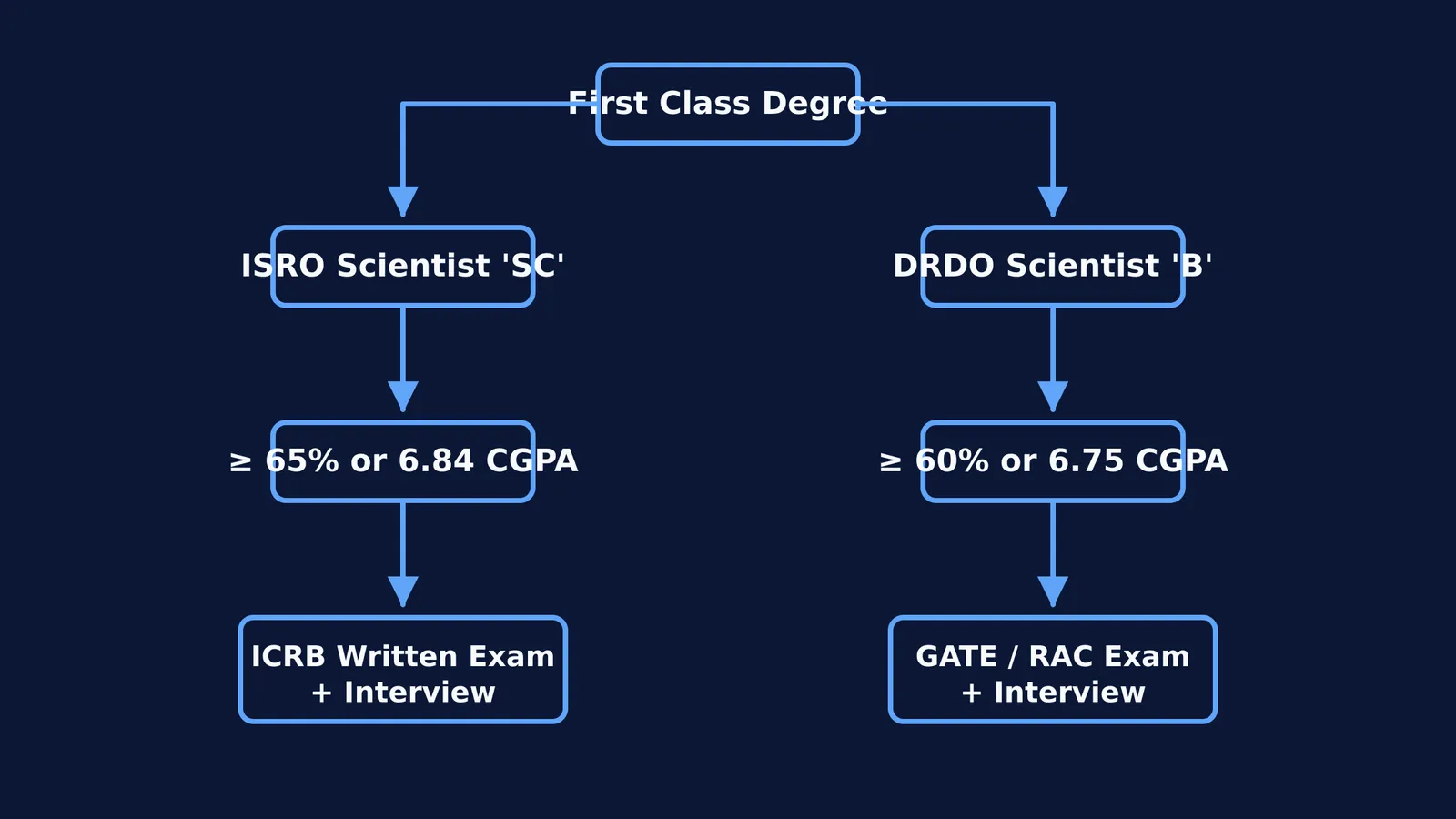
Both organizations primarily recruit at the entry-level for the roles of Scientist 'SC' (ISRO) and Scientist 'B' (DRDO). The fundamental requirement is a First Class degree. For ISRO, this means a minimum of 65% marks or a 6.84 CGPA (ISRO Careers). For DRDO, a First Class degree is typically defined as at least 60% marks or a 6.75 CGPA (DRDO RAC).
For students in the engineering stream, a Bachelor of Engineering (B.E.) or Bachelor of Technology (B.Tech) in core disciplines like mechanical, electronics, computer science, or aerospace engineering is required. As we discuss in our guide to talking about STEM careers beyond engineering and medicine, pure sciences are equally valuable. Students with a Master of Science (M.Sc.) in physics, mathematics, chemistry, or atmospheric science are also eligible to apply.
While a bachelor's degree is the baseline for engineers, a master's degree is typically required for science graduates.
How does ISRO recruit Scientist 'SC' candidates?
ISRO manages its recruitment through the ISRO Centralised Recruitment Board (ICRB). The standard process is a two-step evaluation. First, candidates take a written exam consisting of objective-type questions that test their grasp of core technical subjects. Those who clear the written test are called for a technical interview, which ultimately decides the selection.
In some recruitment cycles, ISRO allows candidates to bypass the ICRB written test if they have a strong score in the Graduate Aptitude Test in Engineering (GATE).
Preparing for these exams requires a deep understanding of core concepts rather than surface-level memorization. When you are reviewing difficult physics topics like the displacement and pressure waves in sound or chemical processes like the contact process for sulphuric acid, the Fermi Problem Library has worked problems with a step-by-step solver that explains the reasoning rather than just printing an answer.
How does DRDO recruit Scientist 'B' candidates?
DRDO conducts its hiring through the Recruitment and Assessment Centre (RAC). The standard pathway leans heavily on the GATE exam. For most Scientist 'B' positions, a valid GATE score is the mandatory first filter used to shortlist candidates for the next stage.
The next stage is typically a descriptive written examination, modeled similarly to the UPSC Engineering Services Examination, followed by a personal interview. DRDO does offer an exception to the GATE requirement for exceptional students: graduates from IITs and NITs with an aggregate of 80% or above can sometimes be shortlisted directly for the interview stage (DRDO RAC), although taking the GATE is still highly recommended to ensure eligibility across all roles.
A plan for your final years in college
If your goal is to work at ISRO or DRDO, your preparation should begin in the third year of your B.E./B.Tech or the first year of your M.Sc.
Maintain your GPA: Ensure your aggregate score never drops below the 65% or 6.84 CGPA threshold for ISRO, or the 60% or 6.75 CGPA threshold for DRDO (ISRO Careers, DRDO RAC). A single dip can disqualify you from the application process.
Target the GATE: Because both organizations rely heavily on GATE scores—DRDO as a primary filter and ISRO as an alternate entry—preparing for GATE should be your top priority.
Master the fundamentals: In technical interviews for both ISRO and DRDO, interviewers test first principles. They will often ask you to derive a formula or explain the physical meaning behind an equation on a whiteboard.
Choosing a career in space or defense research means committing to continuous learning. By focusing on your core engineering or science subjects and preparing strategically for the national recruitment exams, you can position yourself for a role at the forefront of Indian science.


