

On this page
In 1948, American mathematician Norbert Wiener published *Cybernetics: Or Control and Communication in the Animal and the Machine* with MIT Technology Press and Hermann in Paris. Wiener, a former child prodigy who earned his doctorate from Harvard at age 18 and taught at the Massachusetts Institute of Technology, coined the term from the ancient Greek *kybernetes*, meaning steersman or pilot.
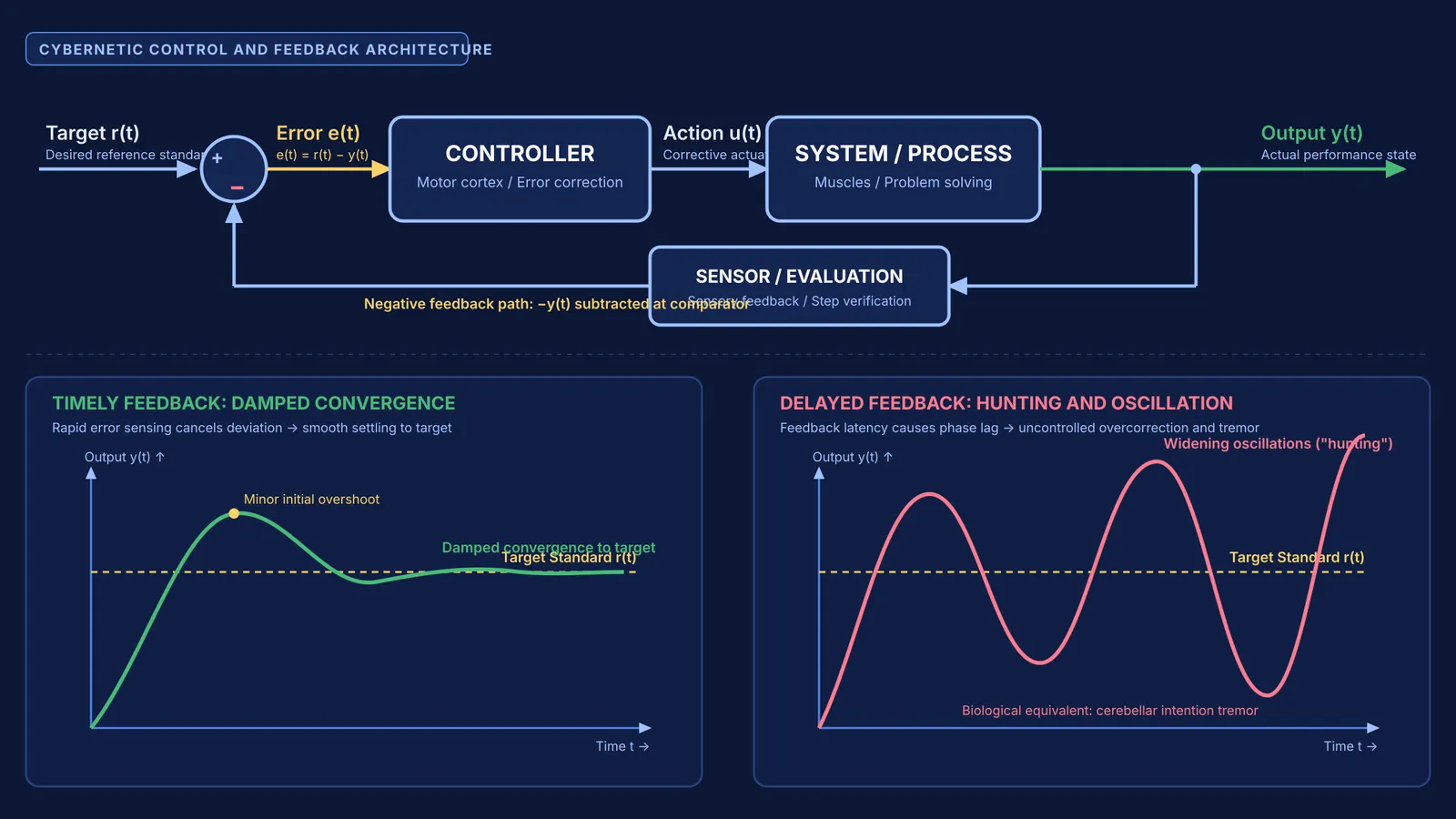
Wiener recognized that whether a system is a steam engine governor, an automated radar gun, or a living nervous system, purposeful behavior does not emerge from rigid, predetermined scripts. Instead, it relies on the circular transmission of information. A ship's helmsman does not lock the rudder in one fixed position; when a sudden gust or wave pushes the vessel off course, the steersman observes the error angle, compares it to the desired heading, and applies an opposing corrective turn.
This insight bridged mechanical engineering and physiology. Cybernetics showed that machines and living organisms both maintain direction through negative feedback—a loop where an observed error feeds back into the controller to cancel the deviation. Alongside Claude Shannon's mathematical theory of information, Wiener's framework laid the foundation for modern control systems, robotics, and computing.
How did anti-aircraft guns and muscle tremors reveal feedback?
During the Second World War, Wiener and engineer Julian Bigelow tackled anti-aircraft fire control. An automated gun could not simply shoot where a bomber was located; it had to calculate where the aircraft would be seconds into the future, anticipating evasive maneuvers. Servomechanisms monitored the difference between the gun barrel's orientation and the radar's predicted coordinates.
When Wiener and Bigelow tested their predictive apparatus, they encountered a dangerous instability known as "hunting." If the corrective feedback signal was delayed or amplified too aggressively, the gun barrel violently overshot the target. Instead of settling smoothly onto the airplane, the mechanism began swinging back and forth in widening, erratic oscillations.
Wiener suspected that biological motor control suffered from the exact same mathematical vulnerability. He consulted Mexican physiologist Arturo Rosenblueth, a close collaborator of Walter Cannon—the Harvard physiologist who had formalized bodily equilibrium in his 1929 paper *Organization for Physiological Homeostasis*, which we also explore in our guide on Walter Cannon's discovery of homeostasis.
Wiener asked Rosenblueth whether human patients ever exhibited a similar oscillation during purposeful movements. Rosenblueth confirmed the phenomenon immediately: intention tremor, a hallmark of cerebellar injury. When a patient with cerebellar ataxia rests their hand on a table, the limb is calm. But when reaching out to grasp a pencil, their hand overshoots, oscillating back and forth with increasing amplitude as the fingers approach the target.
In their 1943 paper *Behavior, Purpose and Teleology*, published in *Philosophy of Science*, Rosenblueth, Wiener, and Bigelow demonstrated that mechanical hunting and cerebellar tremor share the same underlying mechanism. The brain does not navigate the physical world through blind, open-loop motor commands. It acts through continuous sensory feedback, measuring the instantaneous error between limb and target to modulate muscle contractions. When feedback is delayed, the loop destabilizes, and purposeful coordination collapses.
Why is negative feedback the engine of human learning?
Wiener's cybernetic loop applies directly to cognitive skill acquisition. In 1983, systems researcher Arkalgud Ramaprasad provided the classic cybernetic definition of educational feedback in *Behavioral Science*: feedback is information about the gap between actual performance and a reference standard, used specifically to alter the gap.
When students struggle with difficult STEM subjects, the breakdown is almost always a failure of the feedback loop:
Open-loop practice: Solving problems in large batches without verifying intermediate steps leaves errors undetected, allowing faulty conceptual models to harden into habits.
High-latency feedback: Receiving test results weeks later creates dangerous latency. By the time the corrections arrive, the precise reasoning chain that produced each miscalculation has faded from memory.
Hunting and panic: Experiencing a setback on a single test often leads to erratic overcorrection. Students impulsively change books, abandon schedules, or switch resources, oscillating wildly without diagnosing the specific misconception.
As highlighted in Black and Wiliam's research on formative assessment, drawn from their 1998 review in *Assessment in Education*, feedback that diagnoses learning gaps yields substantial academic gains across more than 200 empirical studies. Timely feedback stabilizes the learner, damping erratic swings and guiding performance toward the target standard.
How can students build an active cybernetic study loop?
To learn like a self-regulating cybernetic system, you must organize revision around rapid, closed-loop error reduction rather than passive study hours.
Here is a 4-step Cybernetic Problem-Solving Protocol for daily practice:
Define the reference standard: Identify the fundamental law or conservation theorem before writing equations. If you cannot explain why an equation applies, pause before calculating.
Sense intermediate output: Break problems into checkpoints. After sketching a free-body diagram or setting up an equilibrium expression, check coordinate signs and dimensional consistency before proceeding.
Compare against the benchmark: When an answer is incorrect, do not erase your work and start fresh. Inspect your written steps to locate the exact mathematical junction where your reasoning diverged from the correct path.
Recalibrate deliberately: Categorize the error. If it was an algebraic slip, refine your calculation cadence; if it was a conceptual flaw, revisit the core definition before attempting an analogous question.
Isolating that precise point of divergence in advanced derivations is often the hardest part of self-study. In the Fermi Problem Library, worked problems provide a step-by-step solver that explains the reasoning rather than printing an answer. For interactive doubt resolution, Fermi's AI tutor notices where a student is stuck, decides whether to explain, ask or show, and checks understanding as it goes. This immediate, calibrated interaction closes the loop before errors compound.


