

On this page
Every vertebrate you will meet in the NEET-UG syllabus falls into one of two divisions, and the dividing line is a single feature: the jaw. Get that split right and the rest of the vertebrate tree, from lampreys to peacocks, follows in a fixed order. Below are the definitions, where each group sits, one point where research adds detail to the textbook, and a flowchart you can run on any example.
What is the difference between Agnatha and Gnathostomata?
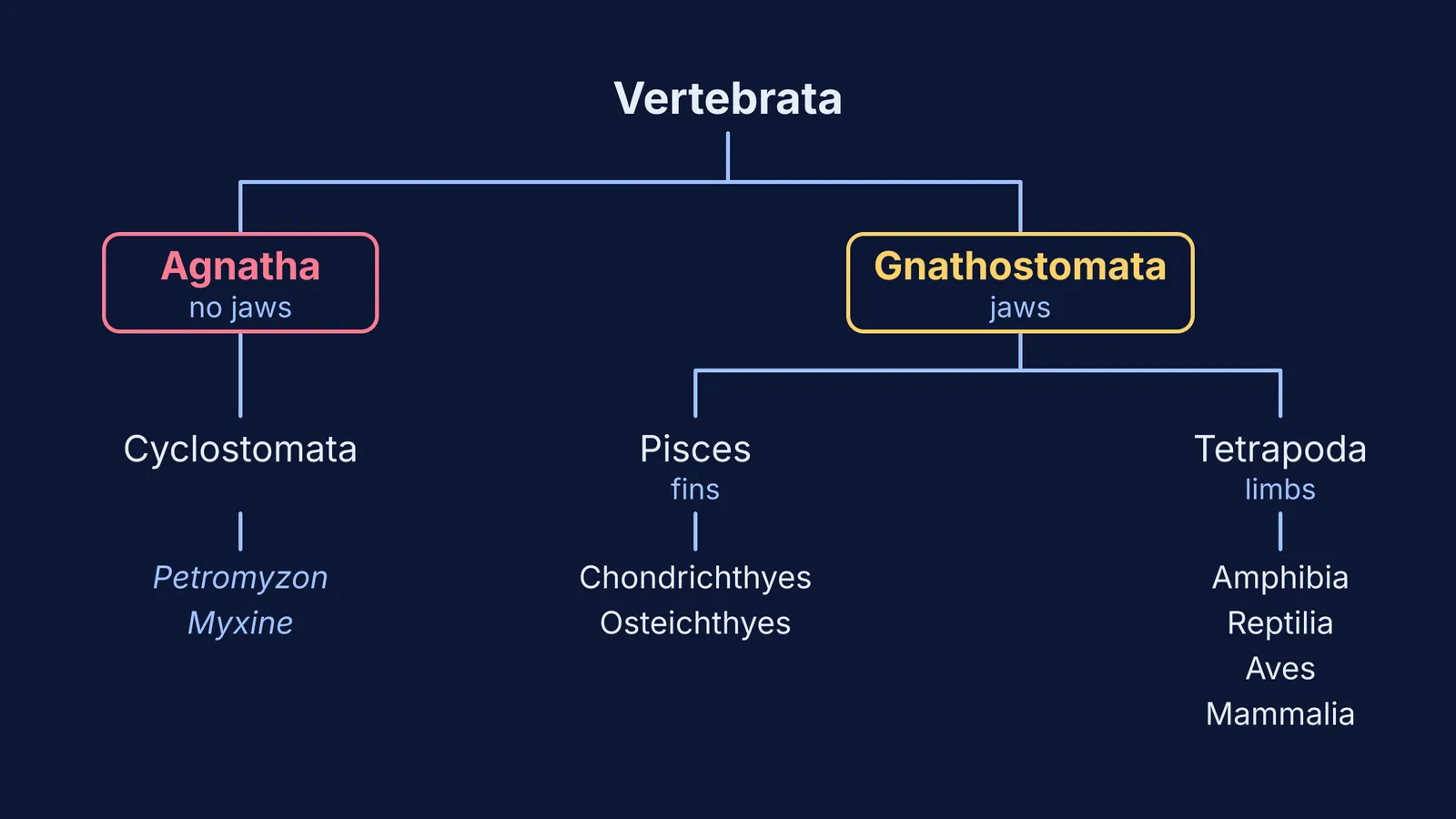
The NCERT Class 11 Biology chapter Animal Kingdom divides subphylum Vertebrata into two divisions: Agnatha, labelled "lacks jaw", and Gnathostomata, labelled "bears jaw".
Agnatha means jawless vertebrates, and in NCERT it contains only one class, Cyclostomata, with examples *Petromyzon* (lamprey) and *Myxine* (hagfish) (NCERT, Animal Kingdom).
Gnathostomata means jawed vertebrates, and it holds every other vertebrate class: all fishes with jaws, amphibians, reptiles, birds and mammals.
The same chapter lists these features of cyclostomes, which set them apart from jawed fishes:
Mouth: sucking and circular, without jaws.
Gills: 6-15 pairs of gill slits.
Body: no scales and no paired fins.
Skeleton: cranium and vertebral column are cartilaginous.
Jawed fishes, by contrast, have paired fins, and NCERT describes the jaws of cartilaginous fishes such as sharks as "very powerful". All vertebrates, jawed or not, share the features NCERT lists for the subphylum: a ventral muscular heart, kidneys for excretion and osmoregulation, and a notochord replaced by a cartilaginous or bony vertebral column in the adult.
Where do Cyclostomata, Pisces and Tetrapoda sit?
They sit at different levels, which is the usual source of confusion. Cyclostomata is a class. Pisces and Tetrapoda are superclasses, and both sit inside Gnathostomata. The NCERT scheme reads:
Agnatha (division) → Class Cyclostomata
Gnathostomata (division) → Superclass Pisces (bear fins) → Classes Chondrichthyes and Osteichthyes
Gnathostomata (division) → Superclass Tetrapoda (bear limbs) → Classes Amphibia, Reptilia, Aves and Mammalia
So "fish" is not one group in this tree. A lamprey looks like a fish but is in Agnatha; a shark and a rohu are both in Pisces, but in different classes.
Are hagfish and lampreys really one group?
For a long time scientists disagreed. A 2010 study in PNAS by Heimberg and colleagues found that hagfish and lampreys share 4 microRNA families unique to the pair, and concluded that Cyclostomata is a natural (monophyletic) group (Heimberg et al., 2010). Their abstract calls hagfish and lampreys "the only living representatives of the jawless vertebrates", which matches the single class NCERT puts in Agnatha.
One textbook line is a simplification. NCERT says all living cyclostomes are ectoparasites on some fishes, but the Natural History Museum, London describes hagfish as "known foremost as scavengers" that feed on dead and dying animals on the ocean floor. In an exam, write the NCERT statement; just know that it fits lampreys better than hagfish.
How do you place any vertebrate in one glance?
Run these questions in order. Every feature comes from the NCERT chapter.
Does it have jaws? No: Agnatha, Class Cyclostomata. Stop. Yes: Gnathostomata, go on.
Does it bear fins or limbs? Fins: Pisces, go to step 3. Limbs: Tetrapoda, go to step 4. NCERT also places limbless animals such as *Ichthyophis* and snakes in tetrapod classes, so check the class features too.
Cartilage skeleton, no operculum, placoid scales: Chondrichthyes. Bony skeleton, operculum, air bladder: Osteichthyes.
Moist skin without scales: Amphibia. Dry skin with scales or scutes: Reptilia. Feathers: Aves. Mammary glands: Mammalia.
Here is the flowchart run on five NCERT examples:
*Petromyzon* (lamprey): no jaws → Agnatha → Cyclostomata.
*Scoliodon* (dogfish): jaws, fins, cartilage, no operculum → Gnathostomata → Pisces → Chondrichthyes.
*Hippocampus* (sea horse): jaws, fins, bony skeleton → Pisces → Osteichthyes, even though it looks nothing like a typical fish.
*Ichthyophis*: jaws, no limbs, but NCERT lists it as a limbless amphibian → Tetrapoda → Amphibia.
*Pavo* (peacock): jaws, limbs, feathers → Tetrapoda → Aves.
If a step stalls on a word you can't define, such as operculum or placoid scale, the Fermi Concept Library covers every concept in biology, each with its own lesson and its place in the map, so you can see where a term like Chondrichthyes connects to the rest of the chapter.
What should you revise next?
Test yourself on the rest of the chapter with these sets:
Try the flowchart on *Torpedo*, *Hyla* and *Pteropus* before you open them.


