

On this page
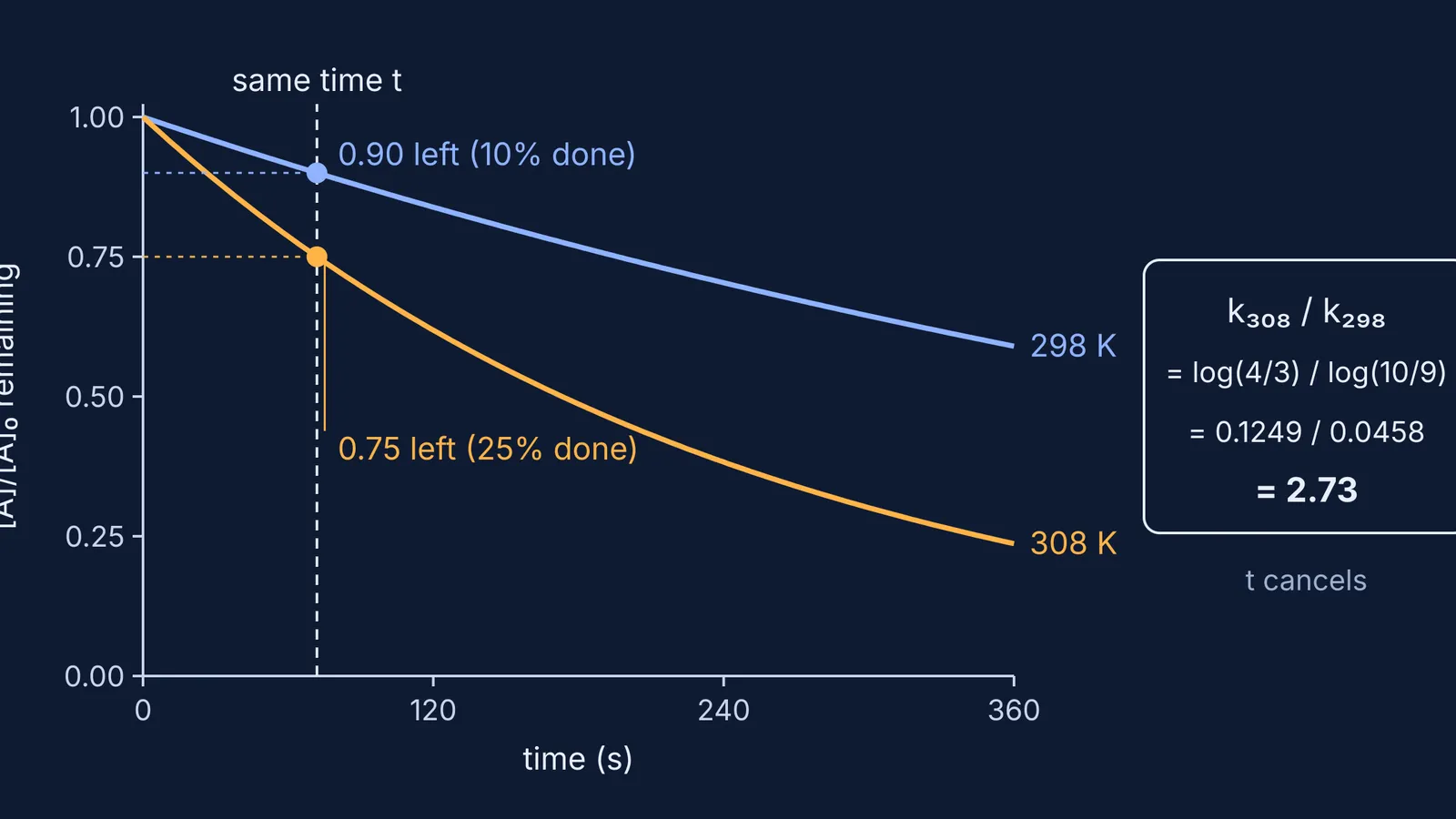
One NCERT Class 12 kinetics exercise reads: "The time required for 10% completion of a first order reaction at 298 K is equal to that required for its 25% completion at 308 K. If the value of A is 4 × 10¹⁰ s⁻¹, calculate k at 318 K and Ea." Many students stall because no rate constant and no time is given. You do not need either. The time is the same at both temperatures, so it cancels, and what is left is a ratio of two log terms. That ratio is k₃₀₈/k₂₉₈, and the Arrhenius equation does the rest.
Why does the same time at two temperatures give the ratio of k?
For a first-order reaction, the integrated rate law is:
k = (2.303/t) log([A]₀/[A])
Write it once for each temperature, using the same t:
k₂₉₈ = (2.303/t) log(first fraction term)
k₃₀₈ = (2.303/t) log(second fraction term)
Divide the second by the first. The 2.303 and the t both cancel:
k₃₀₈/k₂₉₈ = log(term at 308 K) / log(term at 298 K)
So the question has already handed you the rate-constant ratio. You only have to read the percentages correctly.
This is the mirror image of the half-life version, where the fraction is the same (one half) and the times differ. That case is covered in activation energy from half-lives at two temperatures. Here the time is fixed and the fractions differ.
How do you turn "10% complete" into the right log term?
The log term is always log([A]₀/[A]): starting amount over amount left, not amount used.
10% complete at 298 K. 90% is left, so [A]₀/[A] = 100/90 = 10/9. The term is log(10/9) = 0.0458.
25% complete at 308 K. 75% is left, so [A]₀/[A] = 100/75 = 4/3. The term is log(4/3) = 0.1249.
Both terms are small, positive numbers, because only a small part of the reaction has happened. If you ever get log 10 = 1 here, you have used the fraction used instead of the fraction left. The same "10% lost → log(10/9)" step appears at a single temperature in the chemical kinetics case study questions for Class 12.
Worked example: find Ea from 10% at 298 K and 25% at 308 K
Ratio of rate constants. k₃₀₈/k₂₉₈ = log(4/3) / log(10/9) = 0.1249 / 0.0458 = 2.73. The reaction is about 2.7 times faster at 308 K, which is reasonable for a 10 K rise.
Write the two-temperature Arrhenius equation. log(k₂/k₁) = (Ea / 2.303R) × (T₂ − T₁)/(T₁T₂).
Rearrange for Ea. Ea = 2.303R × log(k₂/k₁) × T₁T₂/(T₂ − T₁).
Put in the numbers. log 2.73 = 0.4362. 2.303 × 8.314 = 19.147 J mol⁻¹ K⁻¹. T₁T₂/(T₂ − T₁) = (298 × 308)/10 = 9178 K.
Multiply. Ea = 19.147 × 0.4362 × 9178 ≈ 76,660 J mol⁻¹ ≈ 76.7 kJ mol⁻¹.
NCERT's printed answer is about 76.6 kJ mol⁻¹. The small difference comes only from how many digits you keep in the logs, so either value earns the marks.
Watch the temperature factor. T₂ − T₁ = 10 K goes in the denominator and T₁T₂ = 91,784 K² goes in the numerator. Flip them and you get an answer that is wrong by a factor of about 8 × 10⁷.
How do you find k at 318 K from A and Ea?
Now use the Arrhenius equation directly, k = A e^(−Ea/RT), with A = 4 × 10¹⁰ s⁻¹.
Exponent. Ea/RT = 76,660 / (8.314 × 318) = 29.0.
Exponential. e^(−29.0) ≈ 2.54 × 10⁻¹³.
Rate constant. k₃₁₈ = 4 × 10¹⁰ × 2.54 × 10⁻¹³ ≈ 1.0 × 10⁻² s⁻¹.
This matches NCERT's answer of about 1 × 10⁻² s⁻¹. If you prefer base-10 logs, log k = log A − Ea/(2.303RT) = 10.602 − 12.59 = −1.99, which gives the same k.
You can check the whole chain. The same A and Ea give k₂₉₈ ≈ 1.47 × 10⁻³ s⁻¹ and k₃₀₈ ≈ 4.00 × 10⁻³ s⁻¹. Their ratio is 2.73, as step 1 said. The common time is t = 2.303 log(10/9) / k₂₉₈ ≈ 72 s. In those 72 s at 308 K, exactly 75% is left. A is treated as constant over 298 to 318 K, which is the standard assumption; what A actually means is explained in the pre-exponential factor A in the Arrhenius equation.
What is the general rule for "equal times" questions?
The pattern works for any pair of percentages, as long as the reaction is first order and the time is the same:
k₂/k₁ = log([A]₀/[A] at T₂) / log([A]₀/[A] at T₁)
The opposite pattern, "equal fractions in different times", turns into a ratio of times instead:
k₂/k₁ = t₁/t₂
Half-life questions are the special case where the fraction is one half. In both versions, the quantity that is the same at both temperatures cancels. Spotting which one it is takes most of the work out of the problem.
A related JEE Advanced style question runs the other way: you are given Ea and asked for the temperature at which a set percentage is reached in a set time. You use the same log terms, but solve the Arrhenius equation for T₂ instead of Ea.
If you want to practise more of these, the Fermi Problem Library has a step-by-step solver that explains the reasoning, so you can see where a "fraction used" slip enters.
Which mistakes cost marks here?
Writing log 10 or log 4 instead of log(10/9) and log(4/3). That treats the fraction used as the fraction left.
Putting the 298 K term on top. The faster reaction (higher temperature) has the bigger k, so its log term goes on top and the ratio is above 1.
Using 2.303R in one step and R in another. Stay in base-10 logs with 2.303R, or in ln with R, but not a mix.
Swapping T₁T₂ and T₂ − T₁ in the Ea formula.
Forgetting to convert J mol⁻¹ to kJ mol⁻¹ at the end, or using R = 0.0821 (the L atm value) in an energy formula.
Quick checklist
Same time at two temperatures: t cancels, leaving a ratio of log terms.
10% complete gives log(10/9) = 0.0458; 25% complete gives log(4/3) = 0.1249.
k₃₀₈/k₂₉₈ = 2.73.
Ea = 2.303R × log 2.73 × (298 × 308)/10 ≈ 76.7 kJ mol⁻¹.
k₃₁₈ = 4 × 10¹⁰ × e^(−29.0) ≈ 1.0 × 10⁻² s⁻¹.
Check: the ratio of k values from A and Ea should come back to 2.73.


