On this page
If you have ever stared at W on the periodic table and wondered where the letter came from, the answer starts in the Basque Country in 1783. Two Spanish brothers took a heavy mineral, pulled an acid out of it, and heated that acid with charcoal until a new metal was left behind. For much of the twentieth century, that metal was the glowing wire inside light bulbs.
Who discovered tungsten?
Juan José and Fausto Elhuyar isolated tungsten in 1783 from the mineral wolframite, according to the Los Alamos National Laboratory periodic table. They were not the first to suspect a new element in these heavy ores. The Royal Society of Chemistry notes that Peter Woulfe examined the mineral in 1779 and concluded it held a new metal, and that Carl Wilhelm Scheele isolated its acidic oxide in 1781. Neither turned it into the metal.
The brothers' step was the reduction. WebElements records that they identified an acid present in wolframite in 1783 and then reduced it to the metal using charcoal. They did this work for the Royal Basque Society in Bergara, Spain, as described in the Wikipedia article on tungsten.
Their training explains why they could do it. Fausto Elhuyar studied chemistry in Paris with his brother between 1773 and 1777 and collaborated with Torbern Bergman at Uppsala, according to his Wikipedia biography. In 1786 he was appointed General Director of Mines in Mexico, and in 1792 he became the first director of its new School of Mines.
Why is tungsten's symbol W?
The symbol W comes from wolfram, the metal's older name, which was taken from the mineral wolframite, as the Los Alamos periodic table explains. Most European languages still say wolfram, while English and French use tungsten.
The two names have different roots. Tungsten comes from the Swedish ‘tung sten’, meaning heavy stone, according to the Royal Society of Chemistry. Wolfram is older and stranger: WebElements says it comes from ‘wolf rahm’, because the ore interfered with the smelting of tin and was thought to devour the tin.
W belongs to a short list of symbols that do not match the English name. WebElements traces the others you meet most often in Class 9 and 10:
Fe for iron, from the Latin ferrum
Na for sodium, from the Latin natrium
K for potassium, from the Latin kalium
W for tungsten, from wolfram
If symbols like these keep slipping, the Fermi Concept Library has a lesson for every concept in chemistry, each with its place in the map, so you can see where the element sits instead of memorising a bare list.
Why was tungsten used for bulb filaments?
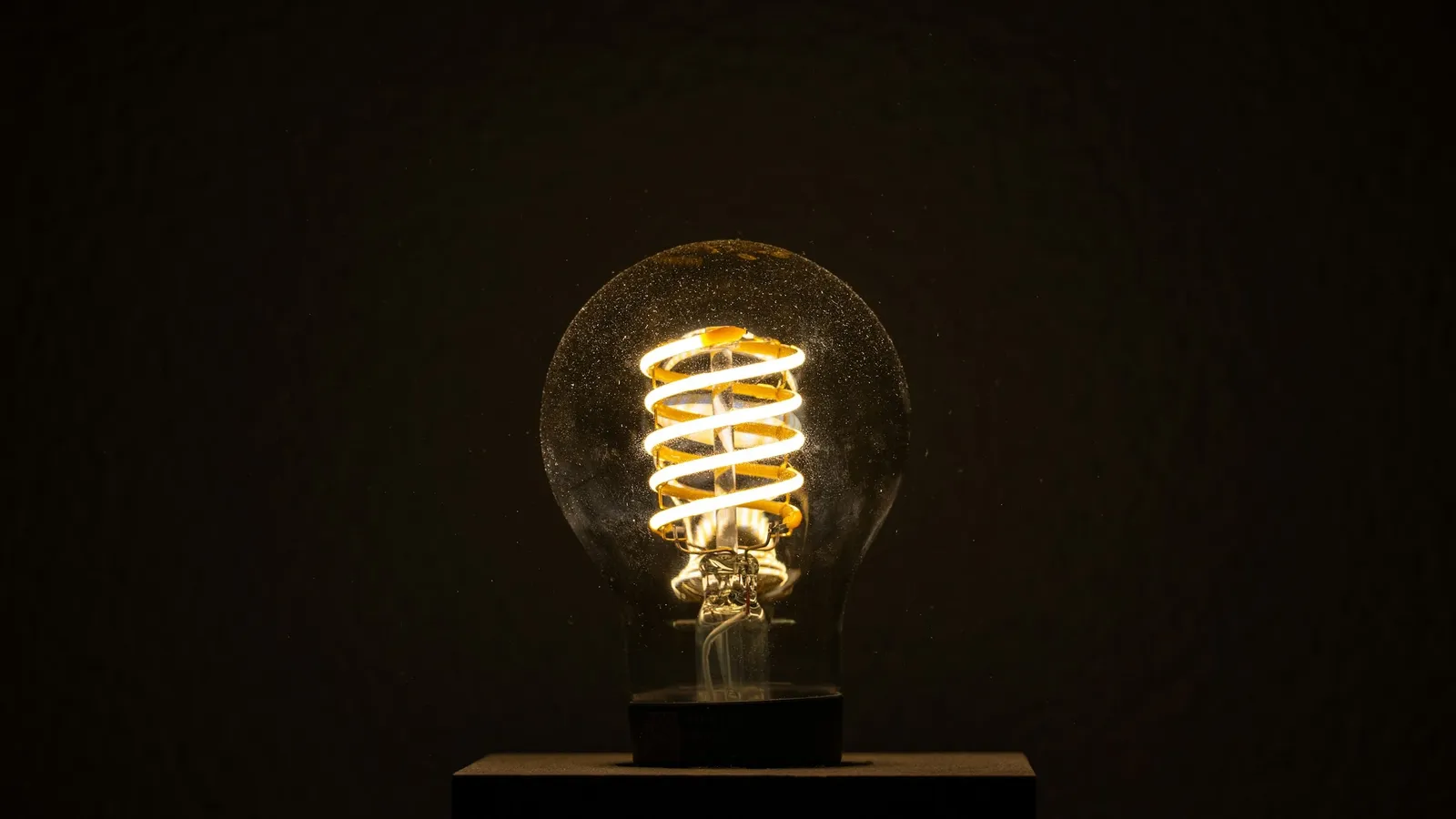
A filament makes light by getting very hot, so it must stay solid at temperatures that melt other metals. Tungsten melts at 3695 K, the highest melting point of all metals, according to the Los Alamos periodic table.
Filaments in incandescent bulbs are typically heated to 2000 to 3300 K, as the Wikipedia article on incandescent bulbs describes. The same article explains why earlier choices fell short: carbon tended to turn to vapour and blacken the bulb, and tantalum filaments had to be very long, with several internal supports.
The catch, the same article notes, was that tungsten is brittle. By 1910 William Coolidge at General Electric had a process for making ductile tungsten, and that year he published a paper titled Ductile Tungsten in the Transactions of the American Institute of Electrical Engineers. For the circuit side of the story, see our explainer on how an incandescent bulb works and why it fuses.
How to check a filament metal yourself
You can test any metal with three numbers. Use the 3300 K top of the filament range from the incandescent bulb article, the tungsten melting point above, and melting points from Los Alamos for copper (1358 K) and iron (1811 K).
Write the hottest temperature the job needs: 3300 K.
Subtract it from the metal's melting point. Tungsten: 3695 − 3300 = 395 K of margin.
Copper: 1358 − 3300 = −1942 K. A negative answer means the wire melts before it reaches filament temperatures.
Iron: 1811 − 3300 = −1489 K. Also out.
Only a positive margin passes. Then ask the next question: can it be made into a thin wire? That is the problem Coolidge solved.
If you get stuck balancing reductions like this, the Fermi Problem Library has worked problems with a step-by-step solver that explains the reasoning rather than printing an answer.
The same margin logic decides why heaters use a different alloy; our post on why tungsten goes in bulbs and nichrome in heaters works through that choice. For how people extracted metals from ores long before 1783, read about Agricola's De re metallica.