

On this page
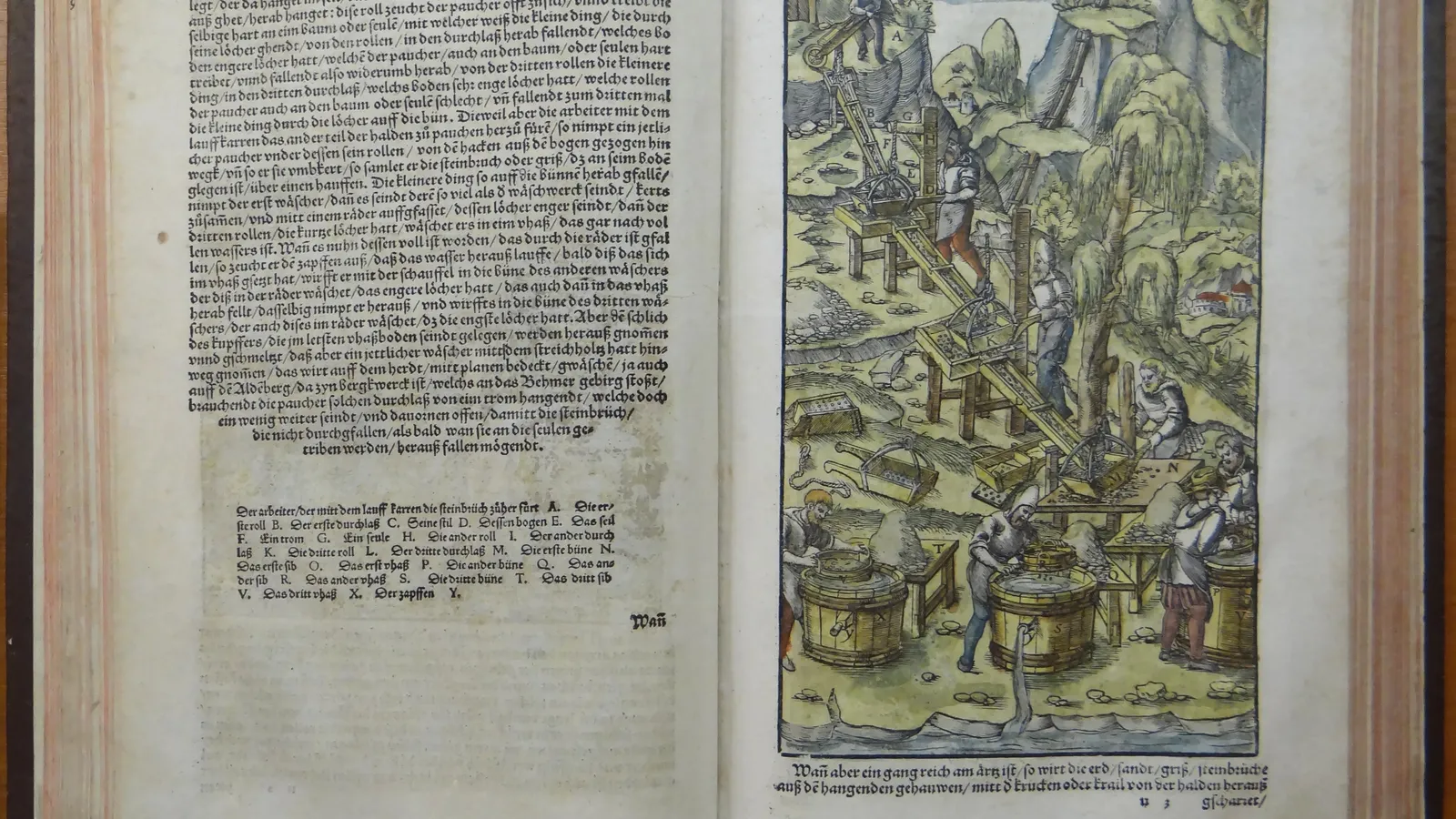
About 470 years ago, a German town doctor wrote a book about getting metal out of rock. You still study its core steps in Class 10, as enrichment, roasting and reduction, and his pictures show each step as a real job.
What is De re metallica?
According to the introduction to the 1912 English translation by Herbert and Lou Henry Hoover, Georgius Agricola was born at Glauchau in Saxony on 24 March 1494. He became town physician at Joachimsthal in 1527 and city physician of Chemnitz around 1533, where he lived until his death in 1555. The Hoovers write that he completed De re metallica in 1550 and sent it to the printer in 1553, and it appeared from Froben in Basel in 1556, a year after he died.
Joachimsthal is now Jáchymov in the Czech Republic. De re metallica is a twelve-book manual on mining and metallurgy illustrated with 292 woodcuts, and it remained the authoritative text on mining for 180 years.
He explained in his preface why the pictures mattered. In the Hoovers' translation, he says he hired illustrators "lest descriptions which are conveyed by words should either not be understood by men of our own times, or should cause difficulty to posterity" (Project Gutenberg text). Good advice for any student: if words are not enough, draw it.
How did Agricola keep mines from flooding?
Deep mines fill with groundwater, so Book VI spends many pages on pumps. Agricola lists buckets, water-bags, chains of dippers, suction pumps and "rag and chain" pumps, which pull balls on a chain up a pipe (Hoover translation, Book VI).
One horse-driven machine drew water from a shaft 240 feet deep and was worked by 32 horses, eight at a time for four hours each. At Schemnitz, three pumps in a chain were turned by 96 horses, and the lowest machine sat 660 feet below the surface. A pump turned by men, he wrote, could lift water only from 48 feet, because "such very heavy labour exhausts not only men, but even horses" (Book VI).
A quick worked example from Class 9 physics: 240 feet is about 73.2 metres, so lifting 1 litre of water (1 kg) that far takes W = mgh = 1 × 9.8 × 73.2, about 717 joules. A thousand litres needs about 717 kJ, before friction. No wonder Agricola wrote that only water-power could drive such a pump continuously.
What did Agricola say about roasting and smelting?
In Book VIII, Agricola gives the reason for roasting. "Ore is burned for two reasons," he writes: to make hard ore soft enough to crush, or to burn off "sulphur, bitumen, orpiment, or realgar". He adds that sulphur does more harm to the metals, except gold, than the other impurities, and is "most harmful of all to iron". Ore may be roasted once, twice or three times depending on how hard it is (Hoover translation, Book VIII).
Roasting is heating an ore under flowing air), and for zinc blende it is 2ZnS + 3O2 → 2ZnO + 2SO2. The sulphur leaves as sulphur dioxide. Calcination heats a solid compound with a restricted supply of oxygen, the usual treatment for carbonate ores.
Book IX covers smelting. Smelting applies heat and a reducing agent, in earlier times charcoal, to an ore, and a flux helps remove the rocky waste, or gangue, as slag.
How does De re metallica map to Class 10 metallurgy?
The CBSE Class 10 Science syllabus for 2025-26 lists "Basic metallurgical processes" under Metals and Non-metals. Agricola's preface lists what each book covers, and it lines up closely with the steps in your chapter:
Books II to V, finding veins and digging ore, match the occurrence of metals: minerals, ores and gangue.
Book VIII, crushing and washing ore, matches enrichment (concentration) of the ore.
Book VIII, roasting, matches roasting and calcination.
Book IX, smelting, matches reduction of the oxide to metal, usually with carbon.
Books X and XI, parting gold, silver, lead and copper from each other, match refining.
Metals high in the reactivity series need electricity, which Agricola lacked. See why aluminium is extracted by electrolysis and not in a charcoal furnace.
How can you revise metallurgy with Agricola in 20 minutes?
Minutes 0-5: Open the free Project Gutenberg text and look at one roasting woodcut from Book VIII.
Minutes 5-10: From memory, draw five boxes: ore, enrichment, roasting or calcination, reduction, refining. Add an equation under each.
Minutes 10-15: For zinc, write both routes: ZnS by roasting, ZnCO3 by calcination, then ZnO + C → Zn + CO.
Minutes 15-20: Check the order with a quick prediction exercise, such as predicting which metal displaces which, then simulating it.
If a box stays blank, the Fermi Concept Library has a lesson for each chemistry concept, with its place in the map. If your equations keep coming out unbalanced, the Fermi Problem Library has worked problems with a step-by-step solver that explains the reasoning rather than printing an answer.
For another early book that changed how chemists think, read how Robert Boyle doubted the four elements in The Sceptical Chymist.


