On this page
Your chemistry textbook says an element is a substance that cannot be broken down into anything simpler. That idea is often traced back to a book Robert Boyle published in London in 1661, written as a conversation between friends. The real story is a little more tangled.
What did Robert Boyle argue in The Sceptical Chymist?
The full title says what Boyle was after: *The Sceptical Chymist: or Chymico-Physical Doubts and Paradoxes, Touching the Spagyrist's Principles Commonly call'd Hypostatical, As they are wont to be Propos'd and Defended by the Generality of Alchymists* (1661 text, Project Gutenberg).
The book is a dialogue between four characters: Carneades, Themistius, Philoponus and Eleutherius. Carneades plays the sceptic and at one point reminds the others "'tis a Sceptick speaks to you" (Project Gutenberg).
Boyle had two targets. Followers of Aristotle said everything is made of earth, water, air and fire. Followers of Paracelsus said the true ingredients were three principles: salt, sulphur and mercury. According to the Science History Institute, Boyle favoured corpuscularism instead, which explained matter and change in terms of tiny particles and their motion.
How did Boyle define an element?
Boyle wrote that by elements he meant "certain Primitive and Simple, or perfectly unmingled bodies; which not being made of any other bodies, or of one another, are the Ingredients of which all those call'd perfectly mixt Bodies are immediately compounded, and into which they are ultimately resolved" (The Sceptical Chymist, 1661).
But whether any such body is found in every compound "is the thing I now question." Boyle did not hand over a new list of elements. He gave a definition, and he doubted that the old lists passed it.
Why did burning wood not prove the four elements?
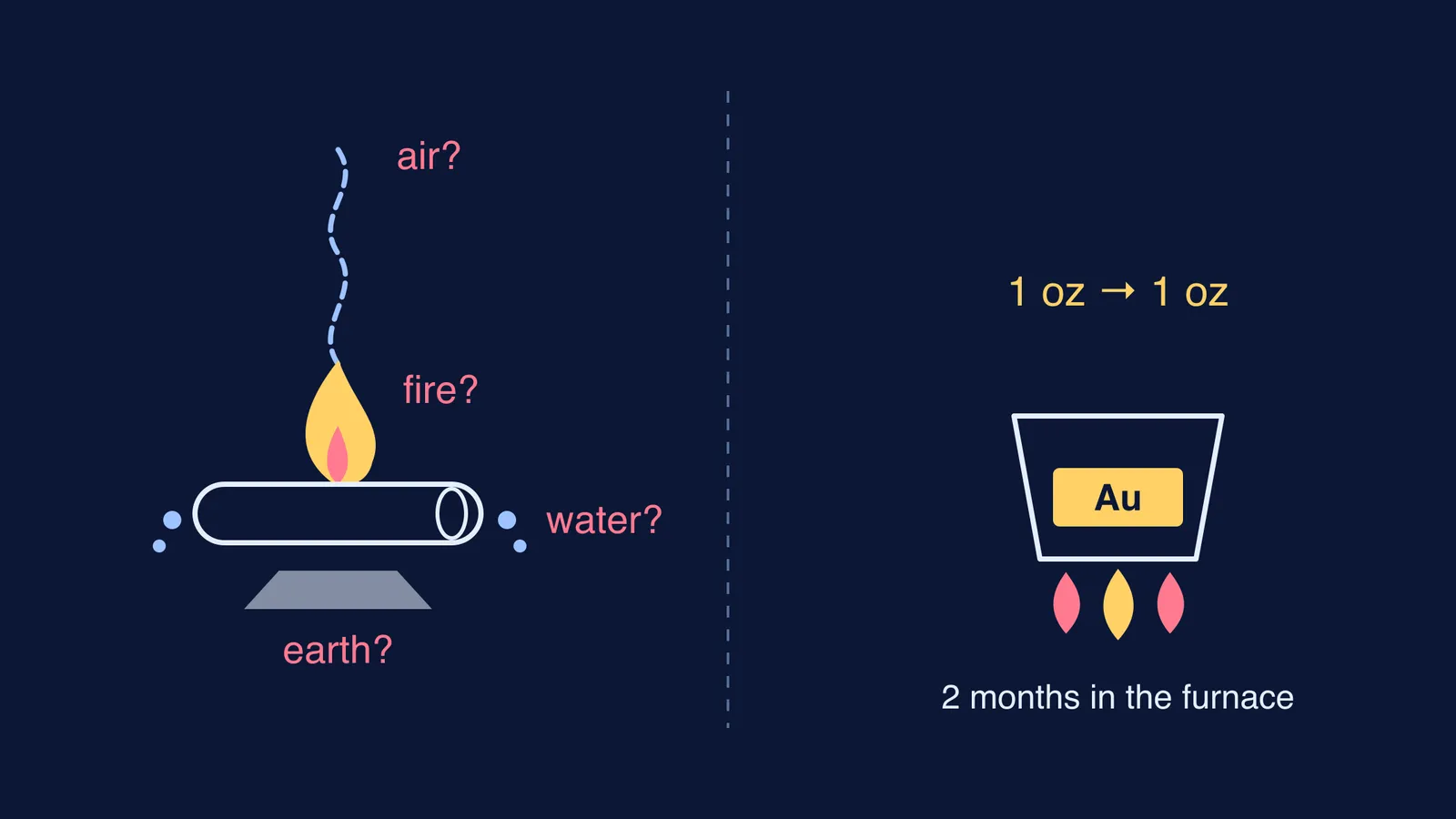
Themistius, who defends Aristotle, offers one experiment that he says makes all others needless. Burn a piece of green wood, he says, and you will "readily discern in the disbanded parts of it the four Elements" (Project Gutenberg). The flame is fire, the smoke rises and vanishes into air, water boils and hisses at the ends of the log, and the heavy, dry ashes are earth.
Carneades' reply runs through the rest of the book: getting four things out of a fire does not show that those four things were inside. Fire might make new substances rather than simply separate old ones. And some bodies do not seem to come apart at all.
Gold is his clearest example. Boyle wrote that in fire, however violent, gold did not noticeably lose its weight, let alone break into salt, sulphur or mercury. He reported an experiment by Gasto Claveus, who kept an ounce of pure gold and an ounce of pure silver melted in a glass-house furnace for two months. The silver lost no more than a twelfth of its weight, and the gold lost nothing (The Sceptical Chymist, 1661).
What happened to Boyle's idea of elements?
According to the Science History Institute, Boyle was probably thinking of tiny, uniform, unobserved particles. He was not using *element* the way Antoine Lavoisier and others did in the 18th century, for substances that chemical methods could not break down further.
That later, practical meaning is the one in your textbook. Lavoisier, whose *Traité élémentaire de chimie* appeared in 1789, considered 33 substances to be elements: substances that chemical analysis had failed to break into anything simpler. His list even included caloric, a weightless principle of heat (Science History Institute).
Water, one of Aristotle's four, turned out not to be an element at all. You can follow that story in how Henry Cavendish showed water is made of hydrogen and oxygen and how Nicholson and Carlisle split water with electricity in 1800. Today IUPAC has approved names for elements up to number 118 (IUPAC periodic table).
How can you test a claim the way Boyle did?
Boyle's sceptical habit still works in a Class 9 or Class 11 chemistry lesson. Run four checks on any claim about what something is made of:
What exactly is the claim? Write it in one sentence, like Boyle's definition.
What experiment is offered? Burning wood was Themistius's one piece of evidence.
Could something else explain the result? Fire might create the smoke and ash rather than release them.
Is there a case that does not fit? Gold in the furnace did not split at all.
Here is a worked example. Claim: "Water is an element because boiling it only gives water vapour." Check 2: the evidence is boiling. Check 3: boiling is a change of state, so it would never break water apart even if water were a compound. Check 4: passing an electric current through water gives two gases, hydrogen and oxygen. So the claim fails. Water is a compound.
If elements, compounds and molecules still feel shaky, the Fermi Concept Library has a lesson for every concept in chemistry, physics and biology, each placed on a map of related ideas.