On this page
The Royal Society of Chemistry's history of hydrogen credits Henry Cavendish with showing that hydrogen forms water when it burns, "thereby ending the belief that water was an element." He made the key experiments in the summer of 1781 and reported them in his paper Experiments on Air, printed in the Royal Society's Philosophical Transactions for 1784. A scan of the original is on the Internet Archive, and the experimental figures below come from it.
Who was Henry Cavendish?
The Dictionary of National Biography) records that Cavendish was born in Nice on 10 October 1731; he died in 1810. In 1766 he collected hydrogen and showed that it was different from other gases, as the RSC page notes. He called it inflammable air. He later weighed the Earth with a torsion balance.
How did Henry Cavendish show water is made of hydrogen?
Here is the experiment in four steps, from his 1784 paper.
A clue from someone else. Joseph Priestley had described an experiment by John Warltire, who fired a mixture of common air and inflammable air with an electric spark in a closed vessel. When the experiment was repeated in glass, the inside of the glass, clean and dry before, became dewy. Cavendish repeated it in a glass globe. The glass always became dewy, and he saw no sooty matter at all.
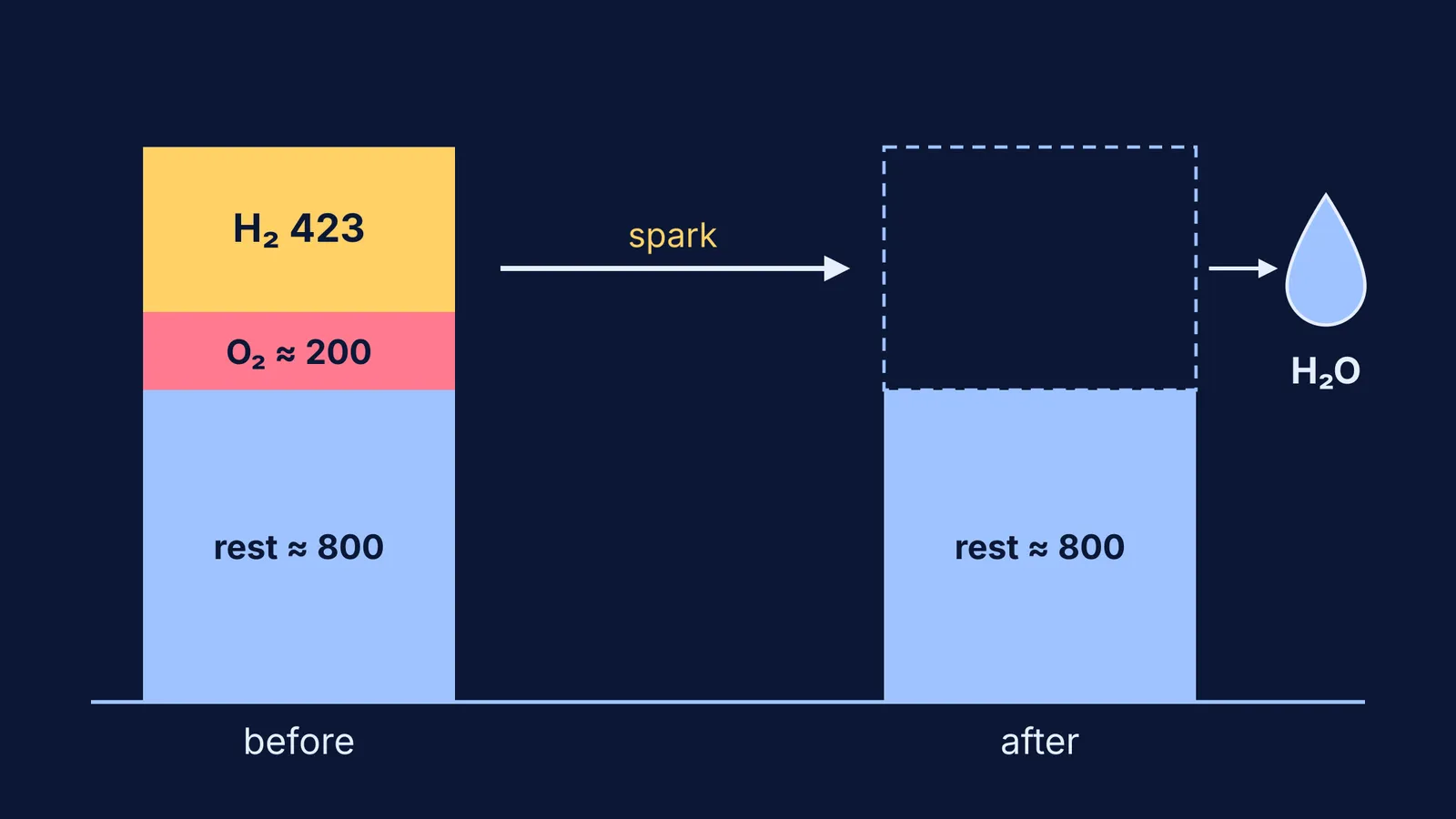
Measuring what disappeared. He found that 423 measures of inflammable air were nearly enough to use up the active part of 1000 measures of common air. When the two were exploded in that proportion, almost all the inflammable air and about one-fifth of the common air lost their springiness ("elasticity") and condensed into dew.
Collecting enough to test. He burned 500,000 grain measures (his unit of gas volume) of inflammable air with about two and a half times as much common air, and passed the burnt air through a glass cylinder eight feet long. More than 135 grains of water collected. It had no taste or smell and left no noticeable sediment when evaporated to dryness. In his words, "it seemed pure water."
Using pure oxygen. Next he fired a mixture of 19,500 grain measures of dephlogisticated air (oxygen) and 37,000 of inflammable air, a little at a time, in a glass globe. Almost all of it lost its springiness. The liquid from that batch was slightly acidic (an acid "of the nitrous kind", he wrote), because some oxygen was left over. When he used enough inflammable air to burn up almost all the oxygen, the liquid was not acid at all and seemed pure water.
The conclusion: two gases go in, and water comes out. Water is made from them, so it cannot be an element.
Who discovered that water is a compound: Cavendish, Watt or Lavoisier?
The credit was later disputed. Cavendish's paper says he told Priestley about the 1781 experiments, and that a friend described them to Lavoisier "during the last summer", that is, the summer before the paper appeared. The Dictionary of National Biography) notes that James Watt wrote to Priestley on 26 April 1783 that water is composed of dephlogisticated and inflammable air, and concludes that Cavendish and Watt worked honestly, without knowing of each other's work. For Lavoisier's side, read Lavoisier and the end of phlogiston; for Priestley's, Joseph Priestley and the air that made a candle blaze.
Do Cavendish's numbers match H₂O?
Today you write the reaction as 2H₂ + O₂ → 2H₂O. At the same temperature and pressure, gas volumes are in the same ratio as molecules, so hydrogen and oxygen should react in a 2:1 volume ratio. Here is a worked check using only the figures from Cavendish's paper:
Common air test. 423 measures of inflammable air used up about one-fifth of 1000 measures of air, which is about 200 measures of oxygen. Ratio: 423 ÷ 200 ≈ 2.1.
Pure oxygen test. 37,000 ÷ 19,500 ≈ 1.9.
Compare. Both are close to 2, from an experiment done before anyone knew about molecules.
Why not exactly 2? His "one-fifth" is a rounded figure, his gases were not perfectly pure, and in the pure oxygen test some oxygen was left unburnt, which fits a ratio a little under 2.
If gas-volume questions like this keep tripping you up, the Fermi Problem Library has worked problems with a step-by-step solver that explains the reasoning rather than printing an answer. And if the mole idea behind the 2:1 ratio still feels shaky, the Fermi Concept Library has a lesson for every concept in chemistry, each with its place in the map.
Next time you balance 2H₂ + O₂ → 2H₂O, remember those 135 grains of tasteless water collected in a glass cylinder eight feet long.