

On this page
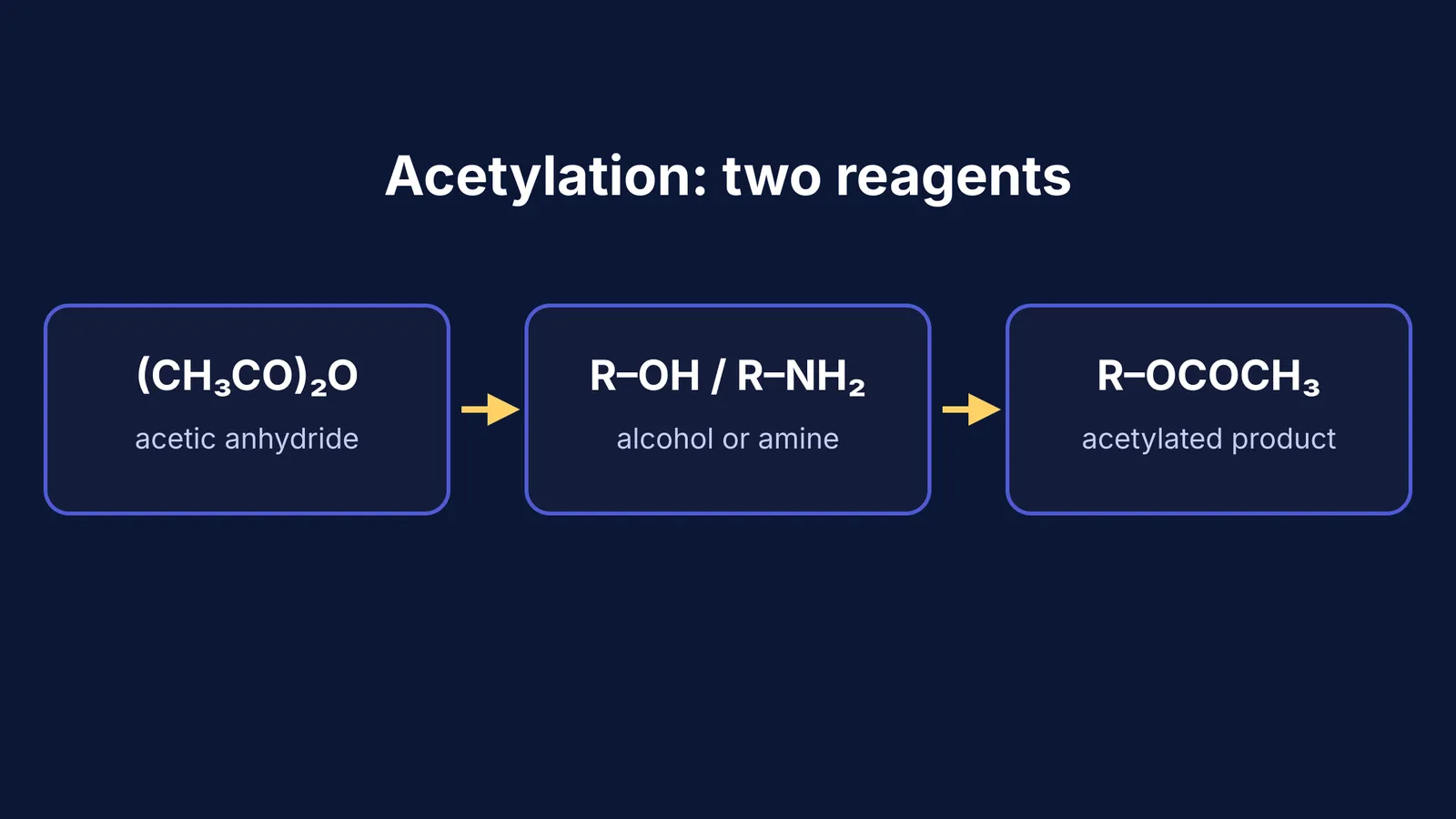
In the acetanilide practical you pour acetic anhydride into the flask, not acetyl chloride. Both attach the same acetyl group (CH3CO–); they differ in how hard they push, what they leave behind and how they behave on the bench.
What actually differs between acetic anhydride and acetyl chloride?
Amines react with both acid chlorides and anhydrides by nucleophilic substitution, as the NCERT Class 12 chapter on amines explains. Here is how the two reagents compare, using NOAA's CAMEO Chemicals hazard sheets for acetyl chloride and acetic anhydride:
Reactivity: acid anhydrides "aren't so violently reactive as acyl chlorides", as chemguide's page on anhydride reactions puts it.
By-product: acetyl chloride gives hydrogen chloride; acetic anhydride gives acetic acid.
Volatility: acetyl chloride boils at 123.6 °F (about 51 °C), while acetic anhydride boils at 283.19 °F (about 140 °C).
Fuming: NOAA describes acetyl chloride as "a colorless, fuming liquid" that "reacts violently with water producing heat and acidic HCl".
Water: NOAA says acetic anhydride also "reacts violently with water", but the product is acetic acid, and chemguide says the anhydride is "not so readily hydrolysed" as the acid chloride.
The anhydride is not harmless: NOAA says it "causes skin and eye burns" and is flammable, so gloves, goggles and a fume cupboard still apply.
Why does the HCl by-product matter?
It fumes. HCl is a corrosive, irritating gas, so you need dry glassware and a fume cupboard.
It ties up your amine. Aniline is a base, so HCl turns some of it into a salt that can no longer attack the acetyl group. That is why a base is added: NCERT notes that acylation is "carried out in the presence of a base stronger than the amine, like pyridine, which removes HCl so formed and shifts the equilibrium to the right hand side" (NCERT Class 12, Amines).
The fix brings its own hazard. NCERT's lab manual asks you to handle pyridine "with extreme caution" in an efficient fume cupboard.
Acetic acid, by contrast, is a weak acid that is washed out of the product with cold water.
Worked example 1: acetylating aniline to acetanilide
Experiment 10.1 in the NCERT Class 12 chemistry lab manual states it plainly: "In the laboratory, acetylation is usually carried out with acetic anhydride. Acetyl chloride may also be used for the purpose of acetylation if acetic anhydride is not available." The main procedure also allows acetyl chloride with dry pyridine. Compare the anhydride route with the manual's alternative method:
Anhydride route: 5 mL aniline with 5 mL acetic anhydride and 5 mL glacial acetic acid, refluxed gently for 10-15 minutes, then poured slowly into 150-200 mL of ice-cold water. C6H5NH2 + (CH3CO)2O → C6H5NHCOCH3 + CH3COOH.
Acetyl chloride route: 1 mL aniline and 1 mL glacial acetic acid, with 1 mL acetyl chloride added in lots of 0.3 mL because "the mixture becomes warm". C6H5NH2 + CH3COCl → C6H5NHCOCH3 + HCl.
The reactivity difference shows up as technique: the anhydride mixture is refluxed from the start, while the chloride goes in small portions, with the tube cooled under the tap if it becomes too hot to touch. The precautions add that "acetyl chloride also strongly fumes in air" and warn: "Do not inhale the vapours coming out during the addition of acetylchloride."
NCERT uses the same anhydride acetylation to tame aniline's -NH2 group; see why aniline is acetylated before nitration.
Worked example 2: making aspirin from salicylic acid
Aspirin forms when the -OH group of salicylic acid (2-hydroxybenzoic acid) is acetylated. The Royal Society of Chemistry's microscale aspirin practical uses 0.23 g of salicylic acid, 25 drops of ethanoic (acetic) anhydride and one drop of 85% phosphoric acid, warmed in a 70-80 °C water bath for 15 minutes. It labels ethanoic anhydride "CORROSIVE, HARMFUL if swallowed or inhaled and FLAMMABLE".
C7H6O3 + (CH3CO)2O → C9H8O4 + CH3COOH
Industry makes the same choice: chemguide says aspirin is manufactured with ethanoic anhydride at 90 °C, because the anhydride is cheaper, it is "less corrosive and not so readily hydrolysed", and it "doesn't produce dangerous (corrosive and poisonous) fumes of hydrogen chloride". For the full practical, read our guide to preparing aspirin from salicylic acid.
How do you answer this in a viva or board exam?
"We use acetic anhydride because it is less reactive and easier to control, and its by-product is acetic acid instead of HCl gas. Acetyl chloride fumes in air and reacts violently with water, so it needs perfectly dry apparatus and a base such as pyridine to remove the HCl, which would otherwise turn some of the aniline into its salt."
Before the practical:
Dry all glassware, because both reagents react with water.
Wear gloves and goggles; open reagent bottles only in the fume cupboard.
Write the right by-product: CH3COOH for the anhydride, HCl for the chloride.
Our chemistry lab safety rules for school practicals cover the rest of the bench routine.
To practise reagent and product questions, the Fermi Problem Library has worked problems with a step-by-step solver that explains the reasoning rather than printing an answer.


