

On this page
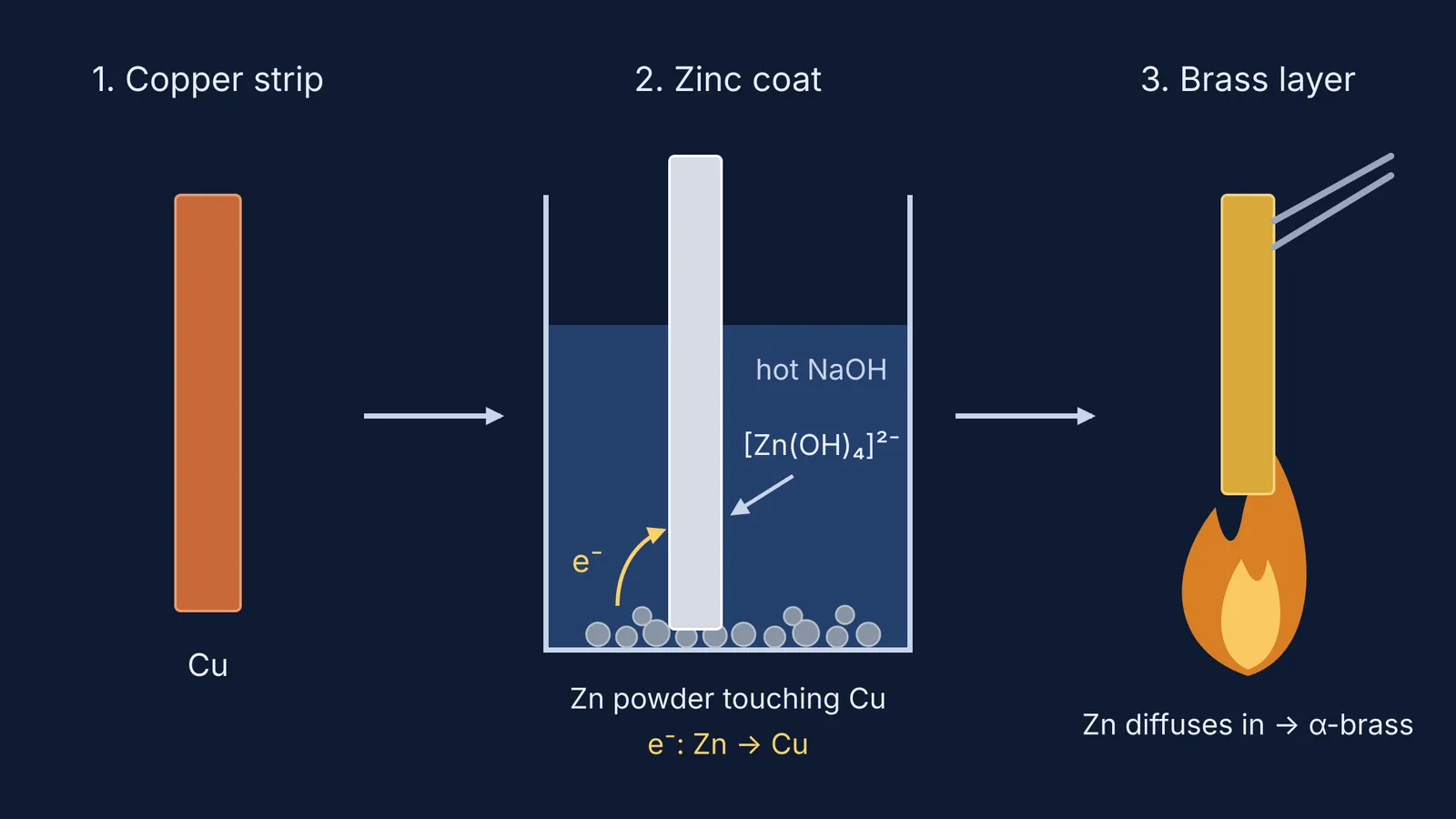
A copper strip goes into hot sodium hydroxide with zinc powder and comes out silvery. A few seconds in a flame, and it turns gold. Nothing has been turned into silver or gold. The silver colour is a thin coat of zinc, and the gold colour is a thin layer of brass, an alloy of copper and zinc. The interesting part is the first step, because a quick look at E° values says it should not happen at all.
What happens in the zinc-on-copper demonstration?
Zinc dissolves in hot alkali. Zinc is amphoteric, so it reacts with hydroxide to give the zincate ion and hydrogen: Zn + 2OH⁻ + 2H₂O → [Zn(OH)₄]²⁻ + H₂. Check it: one Zn, four O, six H and a charge of −2 on each side. Why zinc does this and iron does not is explained in why zinc and aluminium react with NaOH.
Zinc deposits on the copper. A clean copper strip that touches the zinc powder at the bottom of the beaker gets a grey-silver coat of zinc metal within a minute or two.
Heating makes brass. In the flame, zinc atoms diffuse into the copper surface and form brass, which is golden.
Recipes vary. Some use about 3 M NaOH (120 g per litre), and the Royal Society of Chemistry's school version uses a much weaker 0.4 M solution near boiling (RSC Education). Use copper sheet or thick wire, not coins: Indian coins today are not copper, and defacing currency is an offence.
Why can't E° alone explain zinc depositing on copper?
Look at the obvious redox pair. E°(Zn²⁺/Zn) is −0.76 V and E°(Cu²⁺/Cu) is +0.34 V. In alkali the zinc couple is even more negative: [Zn(OH)₄]²⁻ + 2e⁻ → Zn + 4OH⁻ has E° of about −1.2 V (tables differ slightly). For copper to reduce zincate, copper would have to be oxidised and push electrons onto zinc. That is the familiar zinc-displaces-copper reaction run backwards, and it is strongly uphill.
So copper is not the reducing agent. A careful study of this demonstration, Szczepankiewicz, Bieron and Kozik's "Golden Penny" paper in the Journal of Chemical Education (1995), came to the same conclusion, using electrochemical measurements to rule out copper, water and hydrogen as the source of the electrons.
Why must the copper touch the zinc?
The electrons come from the zinc powder. When the copper touches the zinc, the two metals form a short-circuited galvanic cell:
At the zinc (anode): Zn + 4OH⁻ → [Zn(OH)₄]²⁻ + 2e⁻
At the copper (cathode): [Zn(OH)₄]²⁻ + 2e⁻ → Zn (on the copper) + 4OH⁻
Electrons flow through the metal contact; zincate ions carry zinc through the solution. The RSC notes that plating happens only when the copper and zinc are in contact, directly or through a wire. If the strip hangs in the solution without touching the zinc, it stays copper-coloured.
No power supply is needed. In ordinary electroplating, a battery forces a non-spontaneous change. Here the cell drives itself.
But add the two half-equations and you get Zn → Zn. If zinc simply moved from one lump of pure zinc to a layer of pure zinc, ΔG would be zero and nothing would drive the transfer. Something else must make it downhill.
Where does the driving force come from? A worked example
The answer is alloying. The first zinc atoms to land do not sit on the copper as pure zinc. They dissolve into the copper surface and form a solid solution. Zinc in that alloy has an activity, a(Zn), below 1. So the cell is really a concentration cell:
Zn (pure, a = 1) → Zn (dissolved in Cu, a < 1)
Question: Zinc in the copper surface has an activity of 0.01. Find the EMF of the cell and ΔG for moving one mole of zinc. Take 0.059 V for 2.303RT/F at 25 °C.
Step 1: write the Nernst equation. The reaction transfers 2 electrons, E° = 0 (same substance on both sides), and Q = a(Zn in Cu)/a(Zn pure) = 0.01/1. So E = 0 − (0.059/2) log Q.
Step 2: put in the number. log 0.01 = −2, so E = −(0.0295) × (−2) = +0.059 V.
Step 3: find ΔG. ΔG = −nFE = −2 × 96 485 × 0.059 ≈ −11.4 kJ per mole of zinc. The same answer comes from ΔG = RT ln a = 8.314 × 298 × ln 0.01 ≈ −11.4 kJ.
Positive E, negative ΔG: the transfer is spontaneous. The lower the zinc activity at the surface, the larger the push. The same logic is behind concentration cells.
Why does heating turn the zinc coat into brass?
Brass is a substitutional alloy: zinc atoms take the place of copper atoms in copper's face-centred cubic lattice. This works because the atoms are similar in size (metallic radii in NCERT are 128 pm for Cu and 137 pm for Zn, a difference of about 7%) and both are metals with similar bonding. Up to roughly a third zinc, the alloy keeps the copper structure and is called α-brass. It is golden yellow. Commercial brasses usually contain about 60 to 70% copper. The same size-and-bonding match is why transition metals form alloys so easily.
At room temperature atoms diffuse through a solid very slowly. A few seconds in a hot flame speeds diffusion enough for zinc from the surface coat to mix into the top layer of copper. Nothing melts (copper melts at 1085 °C). The colour change happens at the surface only, which is why a scratch shows red copper underneath.
Heat it too long and the zinc oxidises to white ZnO and the surface tarnishes, so the gold turns dull and patchy.
How should this demonstration be run safely?
Treat it as a teacher-led demonstration, not a home experiment.
Hot NaOH is the main hazard. Hot, concentrated alkali causes severe skin burns and serious eye damage, and it can spit when heated. Wear splash goggles, with a face shield for anyone near the beaker, plus gloves and a lab coat. Heat gently on a hot plate and keep onlookers back.
Hydrogen is given off. Zinc reacting with alkali releases H₂, which is flammable. Work in a fume hood or a well-ventilated space, and keep the beaker well away from the burner. The flame step should be done at a separate bench.
Zinc powder is flammable. Do not leave wet zinc residue to dry in the bin, because it can ignite; follow your school's disposal procedure.
The flame step. Rinse the plated strip in water first, hold it with metal tongs in the hot part of the flame for a few seconds only, and let it cool before anyone touches it.
To practise the Nernst step without a beaker of hot alkali, the Fermi Problem Library has a step-by-step solver that explains the reasoning, which helps with sign errors in concentration-cell questions.
Quick checklist
Silver = zinc coat; gold = brass layer. No transmutation.
Copper must touch zinc: it is a short-circuited galvanic cell, with no power supply.
E° alone does not predict the deposit; zinc's activity below 1 in copper gives the driving force.
For a(Zn) = 0.01, E = +0.059 V and ΔG ≈ −11.4 kJ per mole.
Heating gives substitutional α-brass; overheating tarnishes it.
Goggles and face shield, ventilation, and a teacher in charge.


