

On this page
Electroplating is the process of depositing a thin layer of one metal over another by passing an electric current. In the ICSE Class 10 chemistry syllabus, questions often ask you to set up a cell for electroplating a base metal with silver or nickel. Getting the setup right is about controlling how fast the metal ions move so that the final coat is smooth, firm and uniform.
Whether you are plating a brass spoon with silver or a steel car part with nickel, the core rules of the electrolytic cell are exactly the same. If you are preparing for your board exams, learning why these rules exist is much better than simply memorising a list of conditions. You can explore the exact chemical reactions behind them in the Fermi Concept Library, which gives every concept its own lesson and its place in the map.
What are the conditions for electroplating?
The standard conditions for an electroplating cell Source: LibreTexts/Electrochemistry/Electrolytic_Cells/Electroplating) are designed to build the metal layer slowly and steadily:
The article is the cathode. The object you want to plate (like a metal spoon or a cup) is always connected to the negative terminal of your battery. Positive metal ions in the solution will travel here to gain electrons and form a solid metal coat.
The pure metal is the anode. A block of the metal you want to deposit (like pure silver or pure nickel) is connected to the positive terminal. As the current flows, this block dissolves into the solution to replace the metal ions that are lost to the cathode.
The electrolyte is a salt of the plating metal. The liquid bath must contain ions of the metal you are depositing. For copper, you use copper sulphate; for silver, you use a silver salt.
The current is low and steady. Only a direct current (DC) is used. Alternating current (AC) cannot be used because it changes direction constantly, which would cause the metal to deposit and then strip away repeatedly. Furthermore, a low current passed for a longer time ensures the metal atoms arrange themselves tightly, creating a smooth and uniform finish rather than a brittle or powdery one.
The surface is completely clean. Before anything goes into the tank, the article must be degreased with a base and washed with an acid. If there is grease or rust on the surface, the plating metal will not adhere properly and the coating will eventually peel off.
You will see similar rules applied when purifying metals on an industrial scale, as explained in our guide to the electrolytic refining of copper.
What are the conditions for electroplating silver?
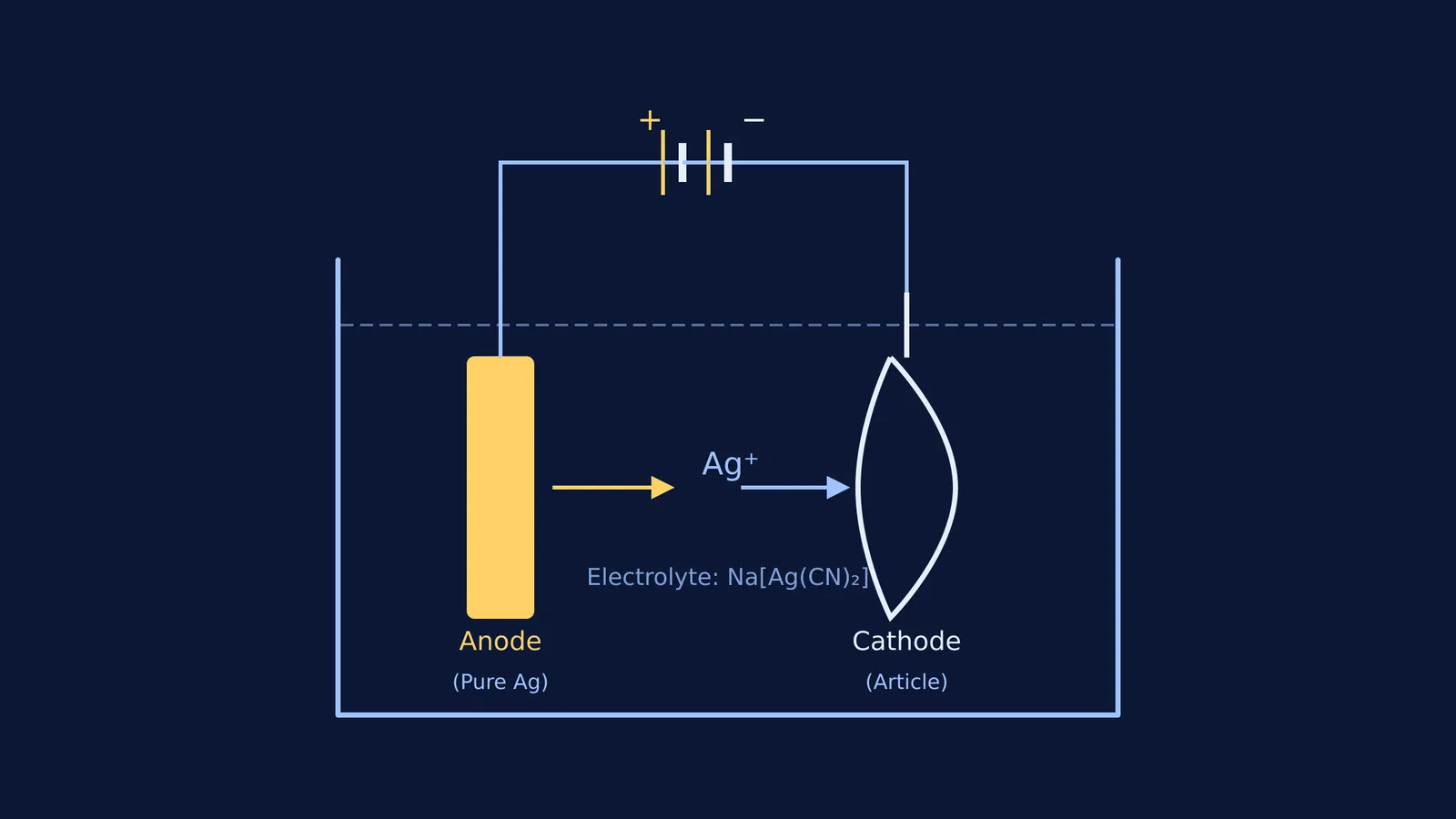
When the exam asks you to plate an article with silver, you must apply the general rules to a specific silver setup. You use a block or rod of pure silver as the anode, and the article itself acts as the cathode.
The most frequently tested fact in this topic is your choice of electrolyte. You must use an aqueous solution of sodium argentocyanide (Na[Ag(CN)₂]) or potassium argentocyanide (K[Ag(CN)₂]) as the electrolyte.
As silver atoms are stripped of electrons at the anode, they become Ag⁺ ions and float into the electrolyte. At the same time, Ag⁺ ions already in the electrolyte arrive at the cathode, grab an electron, and become solid silver atoms on the surface of your article.
Why is silver nitrate not used for electroplating?
A very common board question asks why silver nitrate (AgNO₃) is not used as the electrolyte, even though it is a highly soluble silver salt and seems like an obvious choice.
The answer lies in the speed of the reaction. Silver nitrate dissociates very rapidly in water. This floods the solution with a high concentration of Ag⁺ ions, which all rush to the cathode and deposit onto the article at once. The result is a fast, uneven and non-adherent coating that easily rubs off.
Sodium argentocyanide, on the other hand, is a complex salt that dissociates slowly. It releases a steady, controlled trickle of Ag⁺ ions into the bath. This slow migration gives the silver atoms time to pack closely together and build a smooth, firm layer. If you are stuck on understanding how complex ions dissociate or why concentration affects the rate of a reaction, Fermi's AI tutor can teach through it, drawing the figure on a board and checking understanding as it goes.
What are the conditions for nickel plating?
If an exam asks you to plate an article with nickel instead of silver, the underlying logic holds exactly the same. You just swap out the metals and the salts:
Cathode: The article to be plated (for example, a steel tap).
Anode: A block of pure nickel.
Electrolyte: An aqueous solution of nickel sulphate (NiSO₄).
Sometimes, if you need to plate a highly reactive base metal like iron or steel with a precious metal like silver, it is first plated with a thin layer of copper or nickel. This intermediate base layer stops the steel from reacting directly with the silver solution and helps the final silver coat stick securely to the article.
If you want to practice setting up more electrochemical cells or calculating oxidation numbers, try the worked problems in the Fermi Problem Library, which features a step-by-step solver that explains the reasoning. You can also look up the electrode potentials of 3d metals for more context on why some metals are easier to reduce than others.


