

On this page
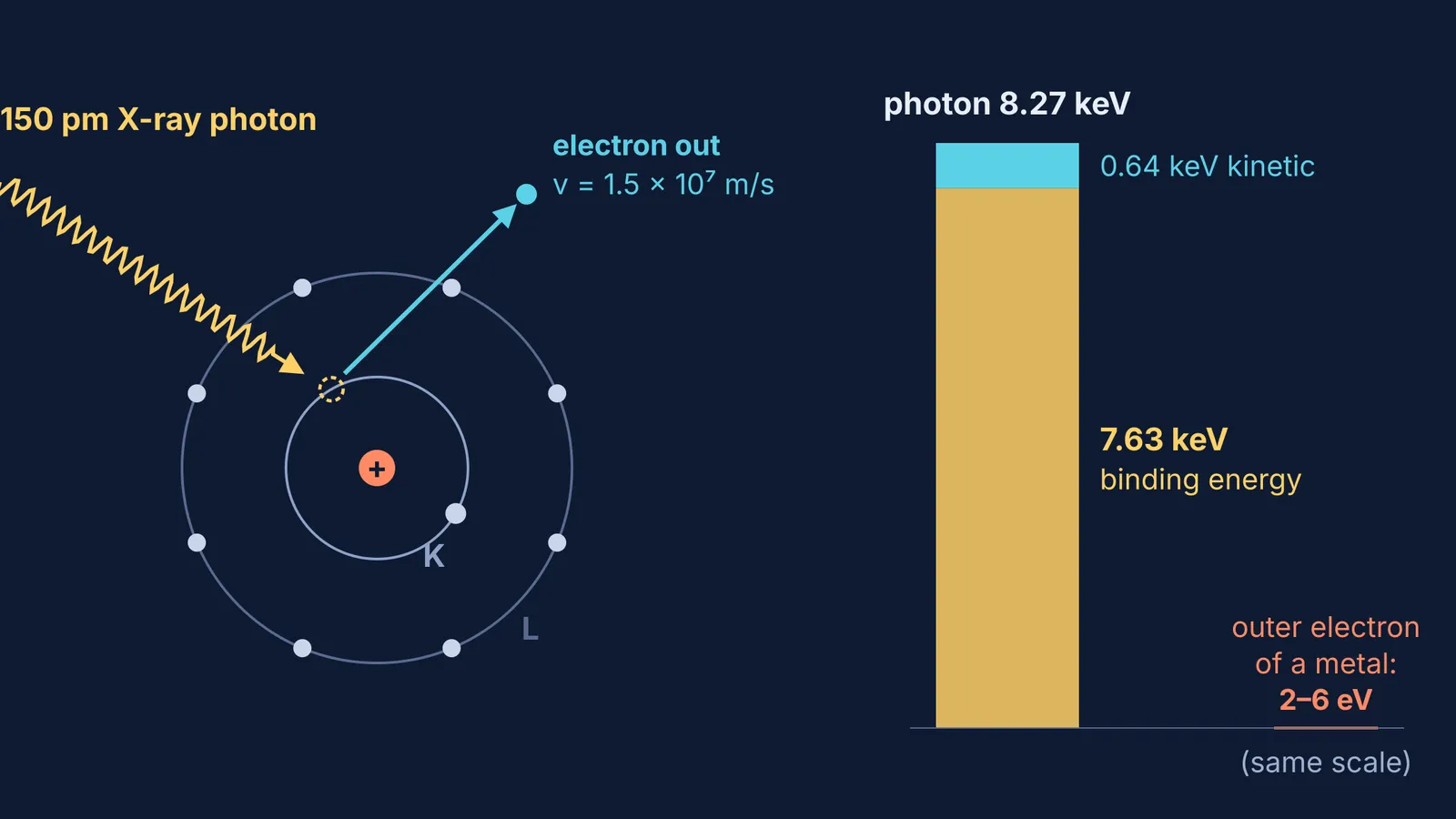
An NCERT Class 11 atomic-structure exercise has an X-ray photon of wavelength 150 pm knock an electron out of an inner shell of an atom. The electron leaves at 1.5 × 10⁷ m s⁻¹, and you are asked for the energy that held it to the nucleus. It is the photoelectric equation again, used on an electron deep inside the atom instead of one at the surface of a metal. The answer, about 7.6 keV, is over a thousand times the energy needed to pull an outer electron off a metal, and that is the point of the question.
What equation finds the binding energy of an inner electron?
Energy is conserved when the photon is absorbed. Part of its energy pulls the electron free, and the rest becomes the electron's kinetic energy:
E(photon) = binding energy + kinetic energy
So binding energy = hc/λ − ½mv².
This is Einstein's photoelectric equation with the work function replaced by the binding energy of one particular shell. For a metal surface the work function is the smallest energy that frees the most loosely held electron. For an inner shell the binding energy is the energy needed to remove an electron from that shell, and it is far larger.
Worked example: a 150 pm photon and a 1.5 × 10⁷ m s⁻¹ electron
Use h = 6.626 × 10⁻³⁴ J s, c = 3.0 × 10⁸ m s⁻¹, mₑ = 9.11 × 10⁻³¹ kg and 1 eV = 1.602 × 10⁻¹⁹ J. Stay in joules until the end.
Convert the wavelength. 150 pm = 150 × 10⁻¹² m = 1.50 × 10⁻¹⁰ m.
Photon energy. E = hc/λ = (6.626 × 10⁻³⁴ × 3.0 × 10⁸) ÷ 1.50 × 10⁻¹⁰ = 1.325 × 10⁻¹⁵ J.
Kinetic energy of the electron. KE = ½ × 9.11 × 10⁻³¹ × (1.5 × 10⁷)² = ½ × 9.11 × 10⁻³¹ × 2.25 × 10¹⁴ = 1.025 × 10⁻¹⁶ J.
Subtract. Binding energy = 1.325 × 10⁻¹⁵ − 0.1025 × 10⁻¹⁵ = 1.223 × 10⁻¹⁵ J.
Convert to electron volts. 1.223 × 10⁻¹⁵ ÷ 1.602 × 10⁻¹⁹ = 7.63 × 10³ eV, about 7.63 keV.
In electron volts the split is easy to see: the photon brings 8.27 keV, 7.63 keV goes into freeing the electron, and 0.64 keV is left as kinetic energy. NCERT's answer is about 1.22 × 10⁻¹⁵ J, or 7.63 × 10³ eV. Notice that the kinetic energy is less than a tenth of the photon energy, so you cannot drop it, but it does not dominate either.
The question does not name the element, so do not guess one. Many elements have an inner shell bound by a few keV.
Is ½mv² good enough at 1.5 × 10⁷ m s⁻¹?
Yes. 1.5 × 10⁷ m s⁻¹ is 5% of the speed of light. The relativistic kinetic energy at that speed is only about 0.2% larger than ½mv², about 641 eV instead of 640 eV. That shifts the binding energy by roughly 1 eV out of 7630, which is far smaller than the rounding in the data. A rough rule: below about a tenth of c, the classical formula is fine for JEE and NEET work. Say this in one line if a long answer asks you to justify your method.
Why is an inner electron bound so much more tightly than an outer one?
Compare the two numbers. Work functions of common metals are roughly 2 to 6 eV: the HyperPhysics table of work functions lists about 2.1 eV for cesium, 4.3 eV for zinc and 6.35 eV for platinum. Our post on which metals show the photoelectric effect with visible light works through those values. The inner electron here needs 7630 eV, more than a thousand times as much.
The reason is position and shielding.
It is close to the nucleus. An inner-shell electron sits much nearer the nucleus than a valence electron, and the attraction grows as the distance shrinks.
Almost nothing shields it. A K-shell electron has no electrons closer to the nucleus than itself. Only the other K electron screens it, and only slightly, so it feels nearly the full nuclear charge Z. A valence electron is screened by every inner electron. Our post on effective nuclear charge with Slater's rules shows how to estimate that screening.
The energy grows roughly as Z². In the Bohr picture of a one-electron ion, the energy of the first orbit is −13.6 Z² eV. Real K-shell binding energies of heavier atoms are smaller than this because of some screening, but they still rise steeply across the periodic table.
For scale, the X-Ray Data Booklet table of electron binding energies from Lawrence Berkeley National Laboratory lists the K-shell binding energy of iron at 7112 eV. That is the same order as our answer, and it shows that "thousands of eV" is normal for the innermost shell of a transition metal.
Why can only X-rays knock out an inner electron?
Turn the binding energy into a threshold wavelength, just as you would for a metal: λ₀ = hc/BE = 1.988 × 10⁻²⁵ J m ÷ 1.223 × 10⁻¹⁵ J = 1.63 × 10⁻¹⁰ m, or about 163 pm. Any photon with a wavelength longer than 163 pm cannot remove this electron, however intense the beam. Ultraviolet light, at tens to hundreds of nanometres, is nowhere near. Only short-wavelength X-rays carry that much energy in a single photon.
The 150 pm photon is just short enough. That is why the electron leaves with a modest 0.64 keV.
What happens to the atom after the electron leaves?
The atom now has a hole in an inner shell. An electron from a higher shell drops into it, and the atom emits a photon whose energy equals the difference between the two shells. When the hole is in the K shell and the electron comes from the L shell, this is the Kα line. Its energy is less than the K binding energy, because the L electron was itself bound. For iron, the Kα line is near 6.4 keV, below the 7.1 keV K binding energy.
These lines are unique to each element. Henry Moseley used them to show that atomic number, not atomic mass, orders the periodic table, a story told in Henry Moseley, X-rays and fixing the periodic table. So this one NCERT problem links the photoelectric effect at a metal surface to the inner shells that X-ray spectra map.
If you lose marks on unit conversions in problems like this, the Fermi Problem Library has a step-by-step solver that explains the reasoning, so you can see where each power of ten goes.
Quick checklist
Binding energy = hc/λ − ½mv².
150 pm photon: 1.325 × 10⁻¹⁵ J (8.27 keV).
Electron at 1.5 × 10⁷ m s⁻¹: 1.025 × 10⁻¹⁶ J (0.64 keV).
Binding energy: 1.22 × 10⁻¹⁵ J, about 7.63 × 10³ eV.
At 5% of c, ½mv² is accurate enough.
Inner electrons need keV, outer electrons of metals need a few eV.
Threshold for this electron is about 163 pm, so only X-rays work.


