

On this page
An outer electron does not feel the whole charge of the nucleus. The electrons between it and the nucleus cancel part of that pull, and the charge left over is the effective nuclear charge, Zeff. In 1930 the physicist J. C. Slater published a set of quick rules for estimating it, in a Physical Review paper called Atomic Shielding Constants. They remain a quick way to estimate it by hand.
What are Slater's rules for shielding?
The definition is short: Zeff = Z − S, where Z is the atomic number and S is the shielding (screening) constant, as set out in this LibreTexts summary of Slater's rules. The same page gives the values below.
First, write the configuration in Slater's groups, in this order: (1s) (2s, 2p) (3s, 3p) (3d) (4s, 4p) (4d) (4f) (5s, 5p). The s and p of a shell share a group, but d and f each get their own.
Then pick the electron you care about and add up S from every other electron:
Electrons to the right of its group: 0.
Each other electron in the same group: 0.35 (but 0.30 inside the 1s group).
For an s or p electron, each electron in the shell n − 1: 0.85.
For an s or p electron, each electron in shell n − 2 or lower: 1.00.
For a d or f electron, every electron in all groups to its left: 1.00.
How do you calculate Zeff step by step?
The nitrogen numbers match the worked example on the LibreTexts page, and the iron values match the iron table in the Wikipedia entry on Slater's rules.
Nitrogen, a 2p electron (Z = 7). Groups: (1s²)(2s² 2p³). Same group: 4 × 0.35 = 1.40. Shell below: 2 × 0.85 = 1.70. S = 3.10, so Zeff = 7 − 3.10 = 3.90.
Sodium, the 3s electron (Z = 11). Groups: (1s²)(2s² 2p⁶)(3s¹). Same group: none. Shell n − 1: 8 × 0.85 = 6.80. Shell n − 2: 2 × 1.00 = 2.00. S = 8.80, so Zeff = 2.20.
Potassium, the 4s electron (Z = 19). Groups: (1s²)(2s² 2p⁶)(3s² 3p⁶)(4s¹). Shell n − 1: 8 × 0.85 = 6.80. Deeper: 10 × 1.00 = 10.00. S = 16.80, so Zeff = 2.20, the same as sodium.
Iron, 4s versus 3d (Z = 26). Groups: (1s²)(2s² 2p⁶)(3s² 3p⁶)(3d⁶)(4s²). For a 4s electron: 1 × 0.35 + 14 × 0.85 + 10 × 1.00 = 22.25, so Zeff = 3.75. For a 3d electron: 5 × 0.35 + 18 × 1.00 = 19.75, so Zeff = 6.25.
In iron, the 4s electrons feel a much smaller pull than the 3d ones, which fits transition metals losing 4s electrons first. Our post on electron configurations of ions like Fe³⁺ and Cu⁺ takes that idea further.
How does Zeff explain atomic size and ionisation energy?
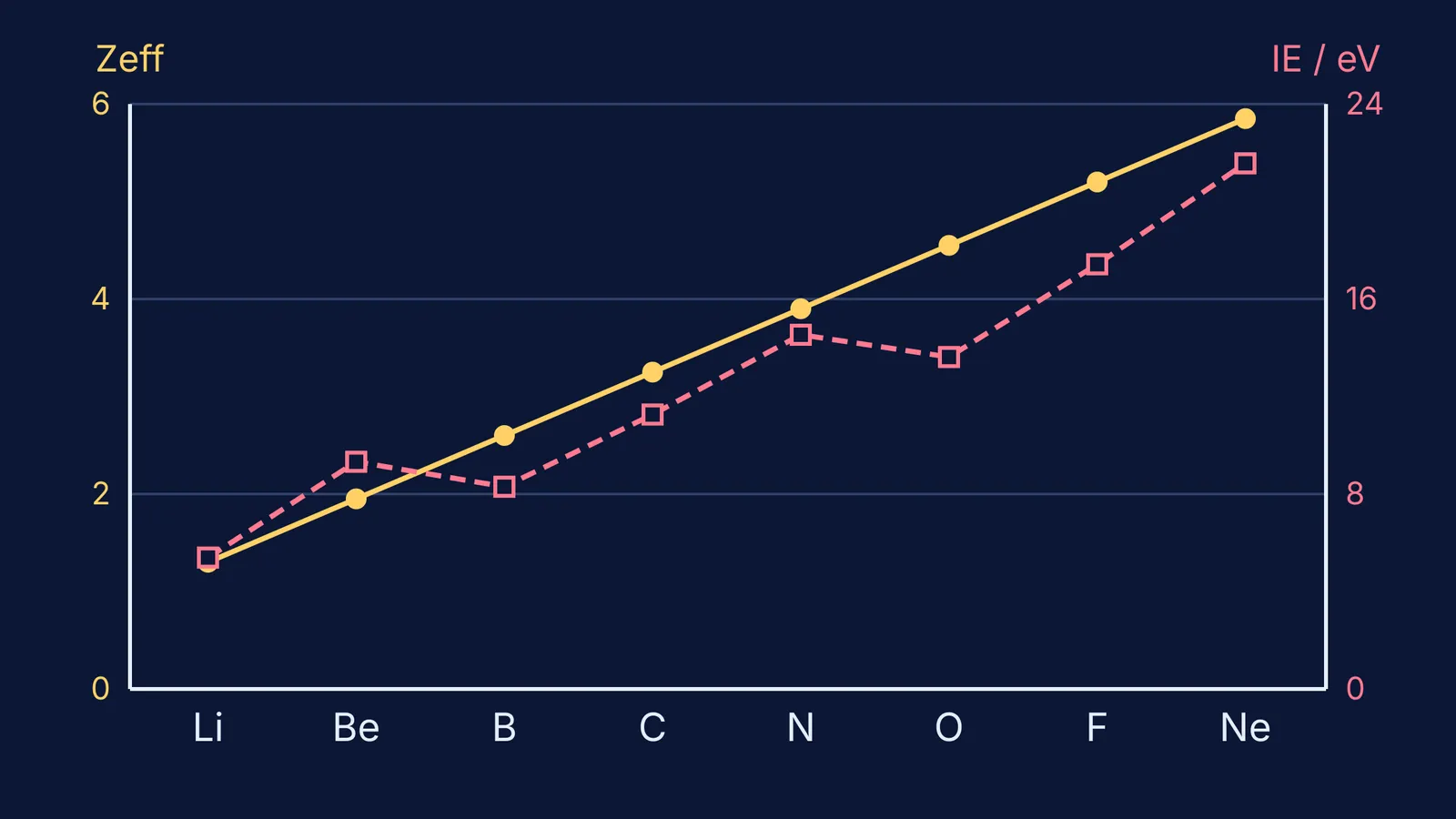
Across period 2, each step adds one proton (+1) and one electron in the same group (+0.35 shielding), so Slater's Zeff rises by 0.65 every time: from 1.30 for lithium to 5.85 for neon. A bigger pull on the same shell shrinks the atom and makes its electrons harder to remove. The measured first ionisation energies in the NIST Atomic Spectra Database follow the same rise: 5.39 eV for lithium and 21.56 eV for neon.
Down a group, sodium and potassium show Zeff staying the same. What changes is n: potassium's outer electron sits in a larger shell, farther from the nucleus, so it is easier to remove. NIST lists 5.14 eV for sodium and 4.34 eV for potassium. In an exam answer, give both reasons: Zeff for trends across a period, and shell number for trends down a group.
Our guide to periodic trends and their exceptions explains both dips. Slater's numbers were later refined: in 1963, E. Clementi and D. L. Raimondi used self-consistent-field calculations for atoms with 2 to 36 electrons to derive improved screening constants. For school-level problems, Slater's original values are the ones usually taught.
A two-minute check before you move on
Did you write the groups in Slater's order, with 3d separate from 3s, 3p?
Did you leave out the electron you picked?
Did you use 0.85 only for an s or p electron, and 1.00 for everything below a d or f electron?
Is a valence Zeff far less than Z, and does it rise across a period?
To practise, try chlorine's 3p electron (answer 6.10) and zinc's 4s electron (answer 4.35). If yours differs, the Fermi Problem Library has a step-by-step solver that explains the reasoning, so you can see which group you miscounted. If shielding still feels abstract, the Fermi Concept Library gives each concept its own lesson and its place in the map.


