

On this page
Eight original numerical-value questions, easy to hard. Take g = 10 m/s² throughout.
How does the JEE Main numerical section work?
The JEE (Main) 2027 information bulletin gives Paper 1 physics 20 MCQs in Section A and 5 numerical-value questions in Section B. A correct Section B answer earns +4 and a wrong one −1. You type an integer, rounded off to the nearest integer, and the bulletin advises calculating with the constants given in the question, if any.
Every question sits inside Unit 4 of the NTA Syllabus for JEE (Main) 2027 and follows NCERT Class 11 Physics, Chapter 5 (Reprint 2026-27). New to the chapter? Start with our guide on how to prepare Work, Energy and Power for JEE Main.
Easy questions (Q1 to Q3)
Q1 (easy). A 0.5 kg particle moves along the x-axis with x = (t³ − 3t) m, t in seconds. Find the work done on it by the net force from t = 0 to t = 2 s, in joules.
Answer: 18. v = 3t² − 3 is −3 m/s at t = 0 and 9 m/s at t = 2 s. By the work-energy theorem, W = ½ × 0.5 × (81 − 9) = 18 J.
Trap: 20 (from 20.25 J), assuming it starts from rest.
Q2 (easy). A 0.1 kg block on a smooth floor compresses a light spring (k = 250 N/m) by 8 cm and is released. Find its kinetic energy, in millijoules, when the compression has fallen to 4 cm.
Answer: 600. Stored energy falls from ½ × 250 × 0.08² = 0.8 J to ½ × 250 × 0.04² = 0.2 J. The block gains the difference, 0.6 J = 600 mJ.
Trap: 400. Spring energy goes as x², so half the compression is not half the energy.
Q3 (easy). A 30 kg child slides from rest down a playground slide 2.5 m high and reaches the bottom at 4 m/s. Find the magnitude of the work done by friction, in joules.
Answer: 510. Gravity does 750 J; the child keeps ½ × 30 × 4² = 240 J. Friction took 750 − 240 = 510 J.
Trap: 240, the kinetic energy, typed in place of the energy lost.
Medium questions (Q4 to Q6)
Q4 (medium). A 20 g bullet moving at 300 m/s passes straight through a 1 kg wooden block at rest on a smooth floor and comes out at 100 m/s. Find the kinetic energy lost in the process, in joules.
Answer: 792. Momentum gives 6 = 2 + 1 × V, so V = 4 m/s. Loss = ½ × 0.02 × (300² − 100²) − ½ × 1 × 4² = 800 − 8 = 792 J.
Trap: 800, forgetting the block's 8 J.
Q5 (medium). A loaded 800 kg hoist cage hangs from a cable running over a motor-driven pulley to a 600 kg counterweight. Ignore friction and the cable and pulley masses. Find the motor's power, in watts, when the cage moves up at 2 m/s while speeding up at 1 m/s².
Answer: 6800. The motor balances the unequal weights and accelerates both masses: F = (800 − 600) × 10 + (800 + 600) × 1 = 3400 N. P = Fv = 3400 × 2 = 6800 W.
Trap: 5600, from forgetting that the counterweight accelerates too.
Q6 (medium). A bob hanging on a light 1.2 m string is given a horizontal speed of 6 m/s. Find the height above the lowest point, in centimetres, at which the string goes slack.
Answer: 160. With α the string's angle from the upward vertical, slack (T = 0) means v² = gL cos α, and energy gives v² = 36 − 2gL(1 + cos α). With gL = 12, cos α = 1/3. Height = L(1 + cos α) = 1.2 × 4/3 = 1.6 m.
Trap: 180, from v²/2g, as if the bob climbs until it stops.
Hard questions (Q7 and Q8)
Q7 (hard). A 1 kg ball moving at 6 m/s along +x hits a 2 kg ball at rest. Afterwards the 1 kg ball moves at 2 m/s along +y. Find the percentage of the initial kinetic energy lost, to the nearest integer.
Answer: 33. Conserving momentum in x and y gives the 2 kg ball (6, −2) kg m/s, so its kinetic energy is p²/2m = 40/4 = 10 J. Final total is 2 + 10 = 12 J of 18 J: 6 J, or 33.3%, is lost.
Trap: 67, from subtracting momenta as numbers (6 − 2 = 4), not vectors.
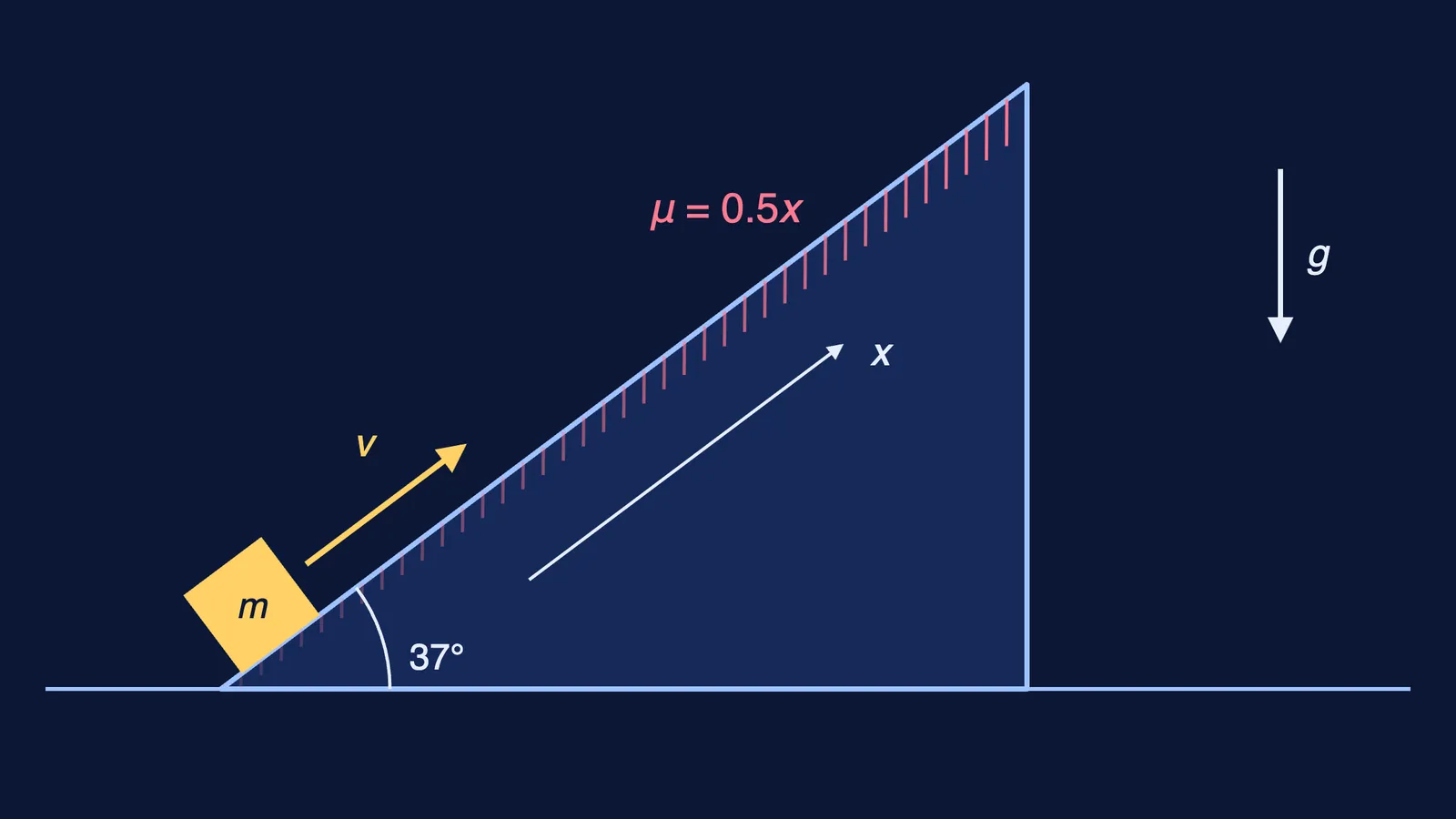
Q8 (hard). A 2 kg block is sent up a fixed 37° incline at 4 m/s from its foot. The incline is rough, and its friction coefficient grows with distance as μ = 0.5x, where x is the distance in metres up the incline from the foot. Take sin 37° = 0.6. Find how far up the incline the block slides before it stops, in centimetres.
Answer: 100. The normal force is mg cos 37° = 16 N, so friction is 0.5x × 16 = 8x N, and its work over the climb is ∫₀ˣ 8x dx = 4x² J. Gravity takes mg sin 37° × x = 12x J. The 16 J of kinetic energy pays for both: 4x² + 12x = 16, so x² + 3x − 4 = 0 and x = 1 m = 100 cm.
Trap: 85, from taking friction as constant at its final value instead of integrating.
How do you get the number right?
Read the unit in the stem first. Q2 wants millijoules and Q6 centimetres; typing 0.6 or 1.6 scores −1.
Round only at the last step. In Q7, keep 6/18 exact and round 33.3 to 33 at the end.
Use the g the question gives; 9.8 in place of 10 can shift a rounded answer.
Decide the sign before you type. Q3 wants a magnitude: 510, not −510.
Energy alone is rarely enough: Q4 and Q7 need momentum first, Q6 a force condition, and Q8 an integral for a force that changes with distance.
Can't picture where Q6's string goes slack? The Fermi Simulation Lab has interactive simulations for the ideas that are easier to see than to read.
For MCQ practice, try our Work, Energy and Power JEE Main questions with solutions.


