

On this page
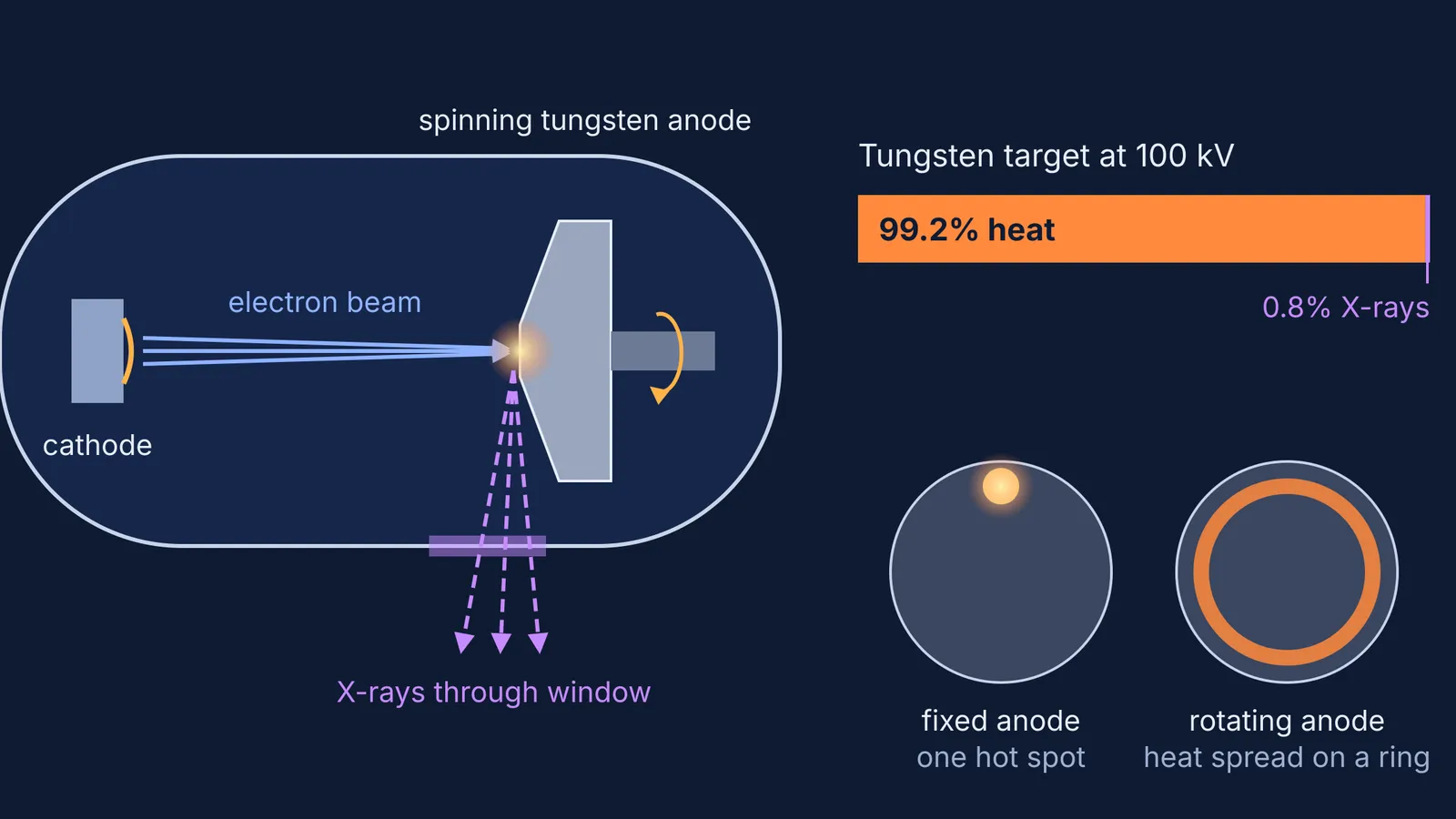
An X-ray tube is one of the least efficient machines in a hospital. Electrons are accelerated through tens of thousands of volts and slam into a metal target, and less than 1% of their energy comes out as X-rays. The rest heats the target. That one fact explains why tubes use tungsten, why the target in a CT scanner spins at thousands of revolutions per minute, and why a scanner has to pause to cool down. This post works out the efficiency for real tube settings and follows the heat.
How does an X-ray tube produce X-rays?
A heated tungsten filament (the cathode) releases electrons. A high voltage V between the cathode and the anode accelerates them, so each electron arrives with kinetic energy eV. At 100 kV that is 100 keV.
When an electron passes close to a nucleus in the target, it is deflected and slowed. A charge that decelerates radiates, and this "braking radiation" is called bremsstrahlung. Its photons can have any energy up to eV, which gives the shortest wavelength λ_min = hc/eV. That cut-off is worked in how tube voltage sets the X-ray cut-off wavelength, so it is not repeated here. A few electrons also knock out inner-shell electrons and produce the sharp characteristic lines.
Why is an X-ray tube so inefficient?
Most electrons do not lose their energy by radiating. They lose it in many small collisions with the target's atomic electrons, which ionise and excite atoms. That energy ends up as vibration of the lattice: heat. Only a small fraction of the electrons' path produces bremsstrahlung.
The IAEA's handbook Diagnostic Radiology Physics (Chapter 5) states that the efficiency of converting electrical power to bremsstrahlung is proportional to the product of tube voltage and atomic number, and that it is about 0.8% at 100 kV for tungsten. It adds that practically all the electrical power becomes heat, and that this causes most of the technical problems in X-ray tube design.
Writing this rule as an equation:
η ≈ k × Z × V
Fitting the IAEA figure for tungsten (Z = 74) at 100 kV gives k = 0.008 / (74 × 100,000 V) ≈ 1.1 × 10⁻⁹ V⁻¹. Textbooks quote k between about 0.9 and 1.1 × 10⁻⁹ V⁻¹, so treat every result below as approximate.
Two things follow:
Higher Z helps. Tungsten's Z = 74 makes it a good target, and its melting point of about 3,400 °C lets it survive the heat.
Higher voltage helps. At diagnostic energies η rises roughly in proportion to V, but it stays below about 1%.
The rule covers bremsstrahlung only. The IAEA handbook notes that characteristic K radiation contributes less than 10% of the energy output even at 150 kV, so leaving it out does not change the picture.
How much heat does an X-ray tube make?
The electrical power drawn by the tube is P = V × I. A handy shortcut: kilovolts × milliamperes = watts.
Worked example: three tubes (typical, illustrative settings)
Efficiency of tungsten at 70 kV. η = 1.1 × 10⁻⁹ × 74 × 70,000 = 0.0057, or 0.57%.
Efficiency of molybdenum at 28 kV. Mammography uses low voltages (the IAEA gives 25 to 40 kV) and often a molybdenum target, Z = 42. η = 1.1 × 10⁻⁹ × 42 × 28,000 = 0.0013, or 0.13%. Almost nothing becomes X-rays; mammography accepts this because it needs low-energy X-rays to show soft-tissue contrast.
A dental unit at 70 kV and 7 mA. P = 70 kV × 7 mA = 490 W. X-ray power = 0.0057 × 490 W = 2.8 W. Heat = 490 − 2.8 = 487 W.
A CT tube at 120 kV and 400 mA. P = 120,000 V × 0.400 A = 48,000 W = 48 kW. η = 1.1 × 10⁻⁹ × 74 × 120,000 = 0.98%. X-ray power ≈ 470 W, heat ≈ 47.5 kW.
Heat from a 0.5 s CT exposure. Q = 47,530 W × 0.5 s = 23.8 kJ.
What that would do to 1 kg of tungsten. With a specific heat of about 134 J kg⁻¹ K⁻¹, ΔT = Q / (mc) = 23,800 J / (1 kg × 134 J kg⁻¹ K⁻¹) ≈ 177 K, if the heat were spread through the whole kilogram.
Units check: V × A = W, W × s = J, and J / (kg × J kg⁻¹ K⁻¹) = K.
A rise of 177 K would be harmless. The problem is that the heat is not spread through a kilogram.
Why does the anode in a CT scanner rotate?
The electron beam is focused onto a small focal spot so that the image stays sharp. The IAEA handbook gives typical focal spot sizes of 0.6 to 2.0 mm. Tens of kilowatts arriving on a spot about a millimetre across would melt even tungsten in a fraction of a second.
The fix is to spin the target. The anode is a tungsten disc driven by an induction motor; the IAEA handbook gives speeds of about 3,000 to 10,000 rev/min. The beam stays still while the disc turns underneath it, so the heat is shared around a ring, the focal track, instead of one spot.
Fixed anode: heat lands on about 1 mm of target.
Rotating anode, 50 mm track radius: heat is spread along 2π × 50 mm = 314 mm of track, about 314 times as much target length.
At 9,000 rev/min, each point of the track passes under the beam every 6.7 ms and cools for the rest of the turn.
The disc then radiates its heat to the tube housing, which is cooled by oil. This is why a CT scanner tracks its tube's heat load and may wait between long scans.
Low-power tubes do not need this. The IAEA handbook notes that dental and portable units use a stationary tungsten target brazed to a copper block, which conducts the heat away. At 490 W for a fraction of a second, that is enough.
The hard part of this topic is picturing what happens inside the target. The Concept Library has explanations of X-ray production and bremsstrahlung that you can read alongside your NCERT chapter. How these X-rays are then absorbed differently by bone and tissue is covered in how X-rays show bones.
Quick checklist
Electrical power to the tube: P = V × I (kV × mA = W).
Bremsstrahlung efficiency η ≈ k × Z × V, with k ≈ 1.1 × 10⁻⁹ V⁻¹; about 0.8% for tungsten at 100 kV.
More than 99% of the power becomes heat in the anode.
Tungsten is used for its high Z and its melting point of about 3,400 °C.
A rotating anode spreads the heat around a focal track instead of one small spot.
Low-power dental tubes manage with a fixed anode on a copper block.


