

On this page
If you studied How Organisms Reproduce in Class 10, you met organisms that need no partner at all: an amoeba splits in two, a hydra grows a bud. That raises a fair question. If copying yourself is quicker and simpler, why do most plants and animals bother with sex? Experiments now help answer it.
What is the 'twofold cost of sex'?
The twofold cost of sex is the idea that an asexual female, whose offspring are all daughters, leaves twice as many egg-laying descendants as a sexual female who spends half her offspring on sons. John Maynard Smith set out this argument decades ago, as summarised in Gibson, Delph and Lively's 2017 paper in Evolution Letters.
Here is the arithmetic, assuming each female has 2 offspring and everything else is equal:
Generation 0: one asexual female and one sexual female.
Generation 1: the asexual female has 2 daughters. The sexual female has 1 daughter and 1 son.
Generation 2: the asexual line has 4 females. The sexual line still has 1 female (plus a son).
Generation 3: 8 asexual females against 1 sexual female.
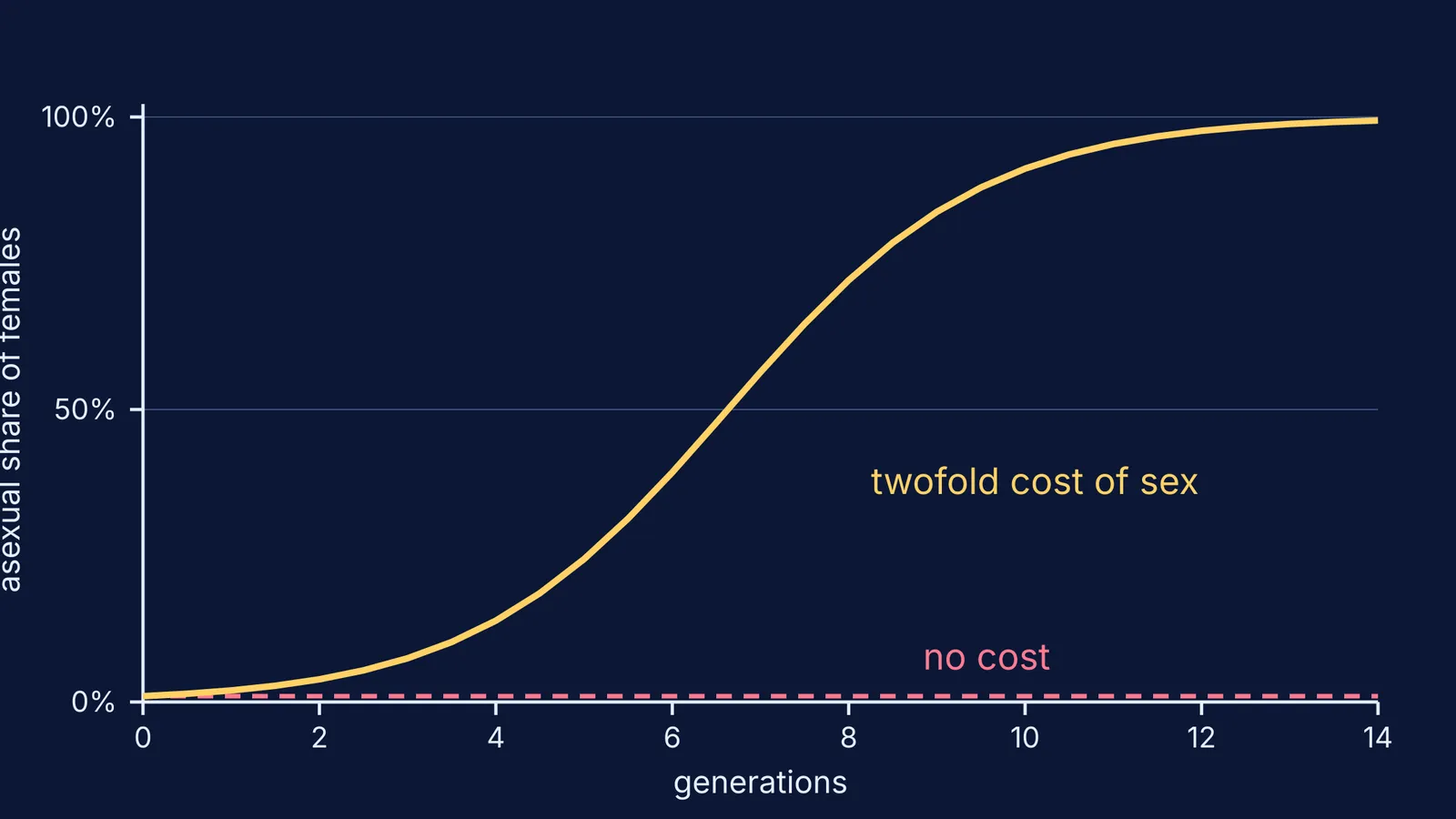
The asexual line doubles every generation while the sexual line only holds steady, so a clone starting at 1% of females would pass 50% within about 7 generations in this simple model.
This is not just a thought experiment. Gibson and colleagues kept mixed sexual and asexual New Zealand mud snails (*Potamopyrgus antipodarum*) from Lake Alexandrina in outdoor tanks from 2012 to 2015 and found that the asexual snails spread about as fast as a twofold cost predicts, with an estimated cost of about 2 (full text on PMC). So the cost is real.
Why did sexual reproduction evolve if asexual is faster?
There is no single agreed answer, but the main hypotheses share one feature. During meiosis, crossing over and independent assortment shuffle the parents' genes, so every offspring is a new combination. A clone's offspring are copies. The hypotheses differ on why new combinations are worth paying double for.
One caution before going on: sex did not evolve "in order to" do anything. Lineages that happened to reproduce sexually left more descendants under some conditions, which is how evolution works without a goal.
How do parasites make sex worth it?
The Red Queen hypothesis says parasites are under strong selection to infect the most common host genotypes, so hosts that produce variable offspring, some with rare genotypes, are more likely to escape infection, as the Lively Lab at Indiana University explains.
Two studies stand out:
Snails in the wild. In 1987 Curtis Lively compared how common males (a sign of sexual reproduction) were across New Zealand mud snail populations and reported in Nature that the pattern fitted selection by parasites, not a variable physical environment.
Worms in the lab. Morran and colleagues genetically controlled how the roundworm *Caenorhabditis elegans* mated and exposed it to the bacterium *Serratia marcescens*. When the bacteria were allowed to coevolve, self-fertilising populations were rapidly driven extinct, while outcrossing populations persisted (Science, 2011; summary on Phys.org).
Does sex help purge harmful mutations?
Every genome picks up harmful mutations. In a small clonal population they tend to pile up, because without sex there is no way to recombine a mutation-free genome; this one-way build-up is called Muller's ratchet. Andersson and Hughes tested it in *Salmonella typhimurium* grown asexually for 1,700 generations under conditions of strong genetic drift (chance changes in small populations), and found that 1% of the 444 lineages tested had suffered an obvious loss of fitness (PNAS, 1996).
Sex also helps with good mutations. McDonald, Rice and Desai evolved yeast (*Saccharomyces cerevisiae*) for about 1,000 generations, with a round of sex every 90 generations in the sexual lines. The sexual populations adapted faster, and in asexual populations substantially harmful mutations hitchhiked to fixation alongside useful ones, which recombination prevented (Nature, 2016). In plain words, sex lets natural selection keep the good mutation and drop the bad one it arrived with.
How do you answer this in an exam or viva?
For a board long answer or a viva, use three parts:
State the cost. Asexual females make only daughters, so an asexual lineage can grow about twice as fast; the 2017 snail experiment measured a cost of about 2.
Name the mechanism. Meiosis and fertilisation create new gene combinations every generation.
Give two payoffs with evidence. Variation helps hosts escape coevolving parasites (Morran 2011), and recombination stops harmful mutations piling up or hitchhiking (Andersson and Hughes 1996; McDonald 2016).
Check yourself: can you redo the generation-by-generation arithmetic without notes, and explain why the worm result depended on the parasite evolving? If the doubling is hard to picture, the Fermi Simulation Lab has interactive simulations for ideas that are easier to see than to read. For the background on genetic variation and meiosis, each concept has its own lesson in the Fermi Concept Library.
Next, revise the basics with our guide to how organisms reproduce for Class 10.


