

On this page
NCERT explains rusting as a tiny galvanic cell in which "one spot" of the iron behaves as the anode and another as the cathode. It never tells you which spot. The answer surprises most students: the anode, where iron actually dissolves, is the spot with the least oxygen. A single drop of salt water on a steel plate shows this beautifully, with colours that mark the anode and cathode for you.
What happens in Evans's water-drop experiment?
The British corrosion scientist Ulick Evans used this experiment in the 1920s to show that rusting is electrochemical. The usual school version goes like this:
Sand a piece of mild steel until it is bright, then wipe it with a little acetone or soapy water to remove grease. A dirty or oily surface gives a patchy result.
Make about 3% sodium chloride solution and add a few drops each of potassium ferricyanide, K₃[Fe(CN)₆], and phenolphthalein. This mixture is called ferroxyl indicator.
Place one large drop on the steel and leave it undisturbed.
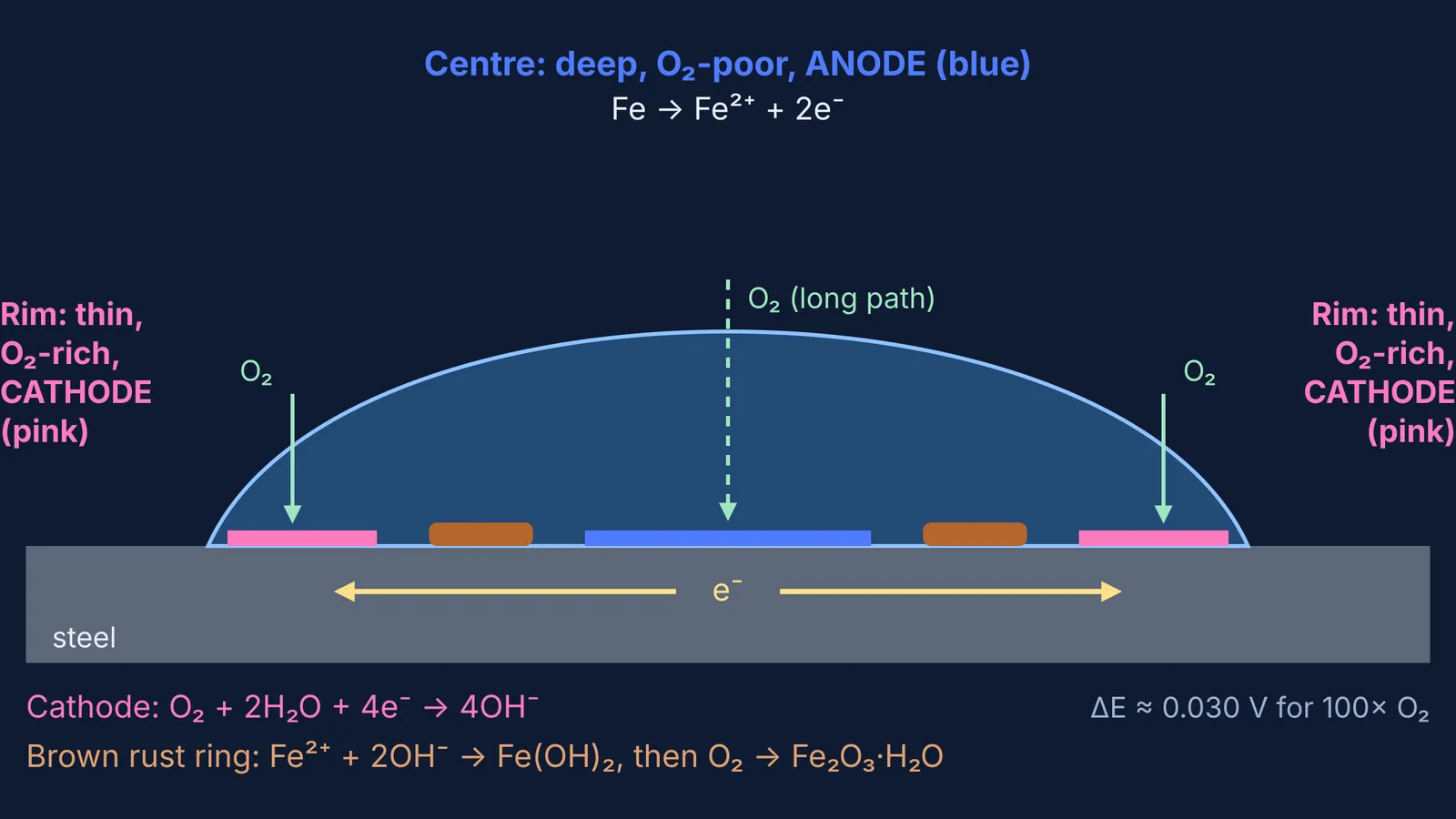
Within a few minutes the centre of the drop turns blue and a ring near the edge turns pink. Later, a brown ring of rust grows in the zone between them.
What do the blue and pink colours show?
Blue means Fe²⁺. Ferricyanide gives an intense blue with Fe²⁺ ions, the colour traditionally called Turnbull's blue. It is the same compound as Prussian blue, as explained in Prussian blue vs Turnbull's blue. Ferricyanide detects Fe²⁺, not Fe³⁺, so blue in the centre means iron is being oxidised there: Fe → Fe²⁺ + 2e⁻ (E° = −0.44 V). That is the anode.
Pink means OH⁻. Phenolphthalein turns pink in alkaline solution (above about pH 8.2). In a near-neutral salt drop, oxygen is reduced to hydroxide ions: O₂ + 2H₂O + 4e⁻ → 4OH⁻ (E° = +0.40 V). That is the cathode.
NCERT writes the cathode reaction in acid form, O₂ + 4H⁺ + 4e⁻ → 2H₂O. In a neutral salt drop there is very little H⁺, so the hydroxide form is the one that actually runs, and the pink colour is your evidence. Adding the two half-reactions: 2Fe + O₂ + 2H₂O → 2Fe²⁺ + 4OH⁻, with E°cell = 0.40 − (−0.44) = 0.84 V. For the acid-form cell and its ΔG, see corrosion as electrochemistry.
Why does the oxygen-poor centre become the anode?
Oxygen has to dissolve at the surface of the drop and diffuse down to the metal. Near the rim the water is thin, so oxygen reaches the steel quickly. At the centre the water is deeper, so the oxygen already there is used up early and is replaced only slowly.
The cathode reaction needs oxygen, so it settles where oxygen is plentiful: the rim. The electrons it needs must come from somewhere, and they come from iron dissolving at the place that cannot run the cathode reaction well: the oxygen-starved centre. The electrons travel through the metal from centre to rim, and ions carry the current back through the salt water. Cl⁻ moves towards the anode and Na⁺ towards the cathode to keep each region neutral.
Once the pattern starts, it reinforces itself. The rim becomes alkaline, which slows iron dissolving there. The centre collects Fe²⁺ and Cl⁻, and Fe²⁺ reacts slightly with water to make the solution a little acidic, which helps iron keep dissolving. So the anode and cathode stay where they began.
Why does rust form between the anode and cathode, not at the anode?
Rust needs Fe²⁺, OH⁻ and more oxygen to meet. Fe²⁺ spreads outwards from the centre and OH⁻ spreads inwards from the rim. They meet in a ring between the two zones:
Fe²⁺ + 2OH⁻ → Fe(OH)₂
4Fe(OH)₂ + O₂ → 2Fe₂O₃·H₂O + 2H₂O
So there are two different places to keep apart. The metal is lost at the anode, under the centre of the drop. The rust is deposited in the ring between anode and cathode.
How big is the voltage from an oxygen difference?
Treat the drop as an oxygen concentration cell. Both electrodes run the same reaction, O₂ + 2H₂O + 4e⁻ → 4OH⁻, but at different oxygen pressures. The idea is the same as in concentration cells, where only the concentration differs.
Worked example. Suppose the steel under the centre of a drop sees one hundredth of the oxygen that the rim sees. Assume the pH is the same at both places. How much more positive is the rim?
Write the Nernst equation for the oxygen electrode at 298 K, with n = 4: E = E° − (0.0591/4) log([OH⁻]⁴/p(O₂)).
Subtract the centre from the rim. E° and [OH⁻] are the same, so they cancel: ΔE = (0.0591/4) log(p(O₂, rim)/p(O₂, centre)).
Put in the ratio: ΔE = (0.0591/4) × log 100 = 0.01478 × 2 = 0.030 V.
Interpret. The rim, with more oxygen, has the more positive potential, so it is the cathode. The centre is the anode.
The log makes the voltage grow slowly. A tenfold oxygen difference gives 0.015 V, and a thousandfold difference gives 0.044 V. These numbers are illustrative, not measurements. A real drop also builds pH and chloride differences, which add to the effect.
Where do you see differential aeration in real life?
The same rule, oxygen-poor metal corrodes, explains rust in places that seem sheltered:
Under washers, bolt heads and overlapping plates. The thin gap is starved of oxygen, so the metal inside the crevice becomes the anode.
Under dirt, mud or a paint blister. Mud packed in a car's wheel arch keeps the steel below it short of oxygen, while the exposed edge acts as cathode.
Iron posts in water or soil. A post often corrodes most just below the waterline or ground line, because the strip at the waterline, where the water film is thin and oxygen-rich, acts as the cathode for the metal a little lower down.
Pits. The bottom of a pit is short of oxygen, so it stays the anode and keeps getting deeper.
Salt makes every one of these cells work faster, because it makes the water film a better conductor. That part of the story is in why iron rusts faster near the sea.
If electrode potentials and the Nernst equation still feel shaky, the Concept Library has a lesson on each, so you can fill the gap before tackling corrosion questions.
Can you try the drop experiment safely?
Yes, with a teacher, in a school lab. Use freshly sanded, degreased steel, or the pattern will be patchy. Potassium ferricyanide is low in toxicity, but never heat it or mix it with strong acid. Wear goggles and keep the drop still.
Quick checklist
The anode is the oxygen-poor region: the centre of the drop, a crevice, or metal under dirt.
The cathode is the oxygen-rich region: O₂ + 2H₂O + 4e⁻ → 4OH⁻ in neutral water.
Ferricyanide blue shows Fe²⁺ at the anode; phenolphthalein pink shows OH⁻ at the cathode.
Metal is lost at the anode, but rust is deposited between the anode and cathode.
An oxygen ratio of 100 gives about 0.030 V; the voltage is small but fixes the cell's layout.


