

On this page
Sooner or later every biology student asks it: if one sperm is enough, why does the body send hundreds of millions? The short answer is a funnel. Most sperm are lost long before they get near the egg, and the published numbers show how steep that funnel is.
How many sperm start the journey?
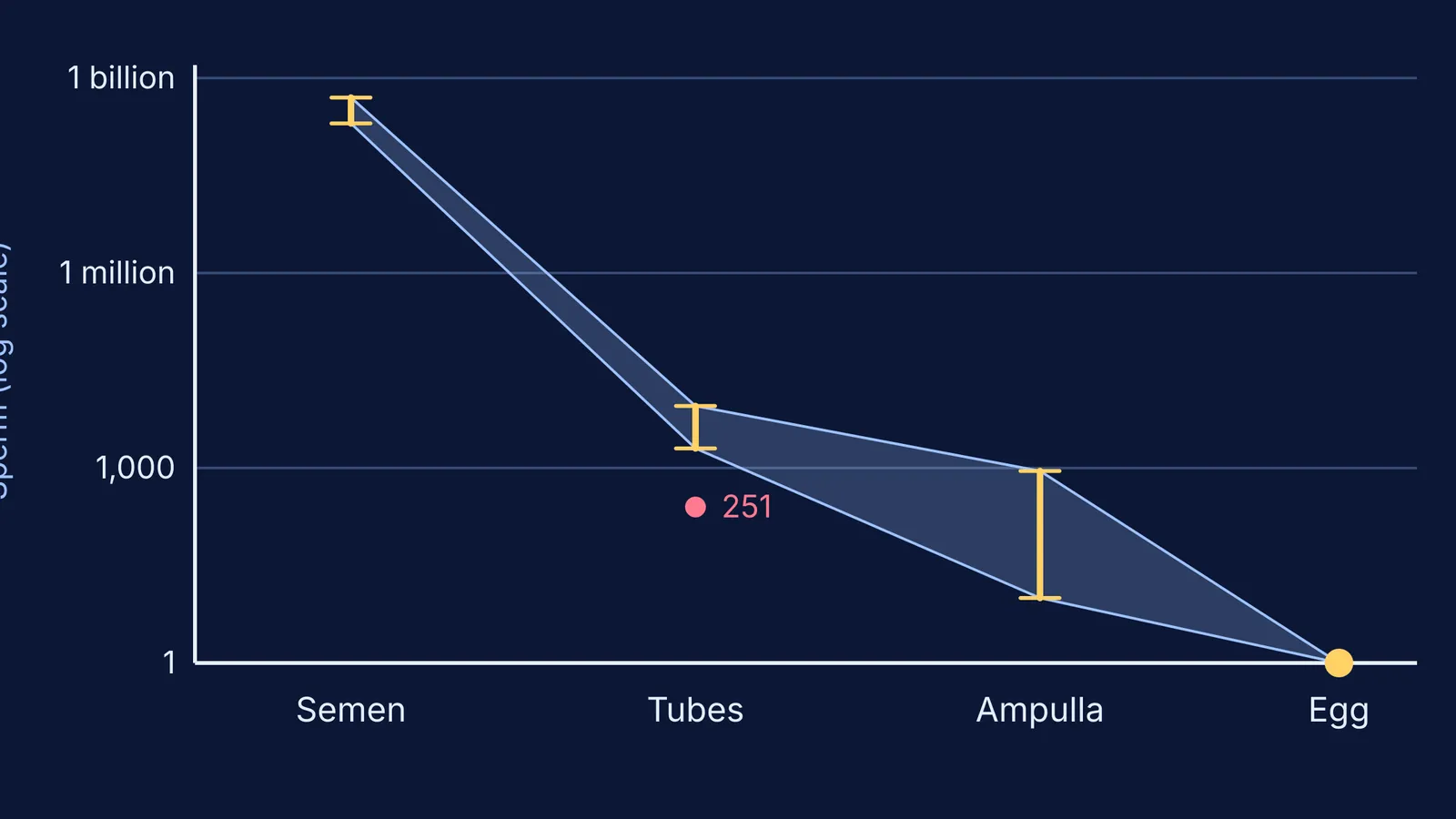
A single ejaculate of 1.5 to 5.0 ml of semen carries between 200 and 500 million sperm, according to a clinical chapter on sperm transport and capacitation by Robert Brannigan and Larry Lipshultz. The semen is deposited at the back of the vagina, close to the cervix.
The bottom of the funnel is the ampulla, the wide part of the fallopian tube where fertilisation happens. Of the millions of sperm inseminated, only tens to hundreds reach the ampulla, according to a 2016 review by Suarez and Wu in Molecular Human Reproduction. A 2026 review in Human Reproduction Update agrees: typically no more than a few hundred get near the egg.
Where do sperm get lost on the way to the egg?
The stages come from a review by Suarez and Pacey (2006), with numbers from the Brannigan and Lipshultz chapter.
The vagina. Normal vaginal pH is only 3.5 to 4.0, while sperm do best between pH 7.0 and 8.5. Alkaline semen raises vaginal pH to about 7.0 within seconds, for up to two hours. Even so, most sperm left in the vagina slow down within about 30 minutes, and almost all have stopped moving by 2 hours.
The cervix. Cervical mucus filters out sperm with poor shape and weak swimming, so only a minority enter the cervix. Some wait in folds called crypts and are released gradually.
The uterus. Muscular contractions may help sperm across the uterine cavity.
The uterotubal junction. A few thousand sperm swim through this narrow entrance to the tubes, which may act as a further functional barrier.
The tube and ampulla. Sperm are stored in a reservoir, then become capacitated and hyperactivated near ovulation so they can reach the ampulla and push through the cumulus and zona pellucida.
The hardest numbers come from Williams and colleagues (1993). Women having a planned hysterectomy were inseminated, and their tubes were examined 18 hours later. As the Brannigan and Lipshultz chapter reports, a median of only 251 sperm was recovered from both tubes, with a higher share of them in the ampulla on the side of the ovulating ovary. For what guides those last few, see the three cues sperm follow in the fallopian tube.
Why does the body need so many sperm?
Losses are steep at every stage. Starting with far fewer would leave close to none in the ampulla.
The tract selects as well as blocks. Cervical mucus filters out sperm with poor shape and weak swimming, as Suarez and Pacey describe, so the arrivals are not a random sample.
Timing is uncertain. Stored sperm are released over time, and some keep their ability to fertilise for up to 4 days, according to the teaching site embryology.ch. Suarez and Wu write that several guidance systems along the tract give greater assurance that enough capacitated sperm reach the oocyte.
Once one sperm fuses, changes in the zona pellucida block the rest, as the 2026 review explains. Our diagram of the layers around the human egg at ovulation shows what those last sperm must get through.
How do you work out the odds yourself?
The hero chart uses a log scale, where each gridline is 1,000 times the one below. Here is a worked example using round numbers inside the published ranges: 300 million sperm in semen (range 200 to 500 million, from Brannigan and Lipshultz), 3,000 entering the tubes ("a few thousand", from Suarez and Pacey) and 100 in the ampulla ("tens to hundreds", from Suarez and Wu).
Into the tubes: 3,000 / 300,000,000 = 1 in 100,000, or 0.001%.
Into the ampulla: 100 / 300,000,000 = 1 in 3 million.
Fertilisation: 1 of those 100, so about 1 in 300 million of the sperm that started.
In a long answer, use this checklist:
Name each barrier (vagina, cervix, uterus, uterotubal junction) and what it removes.
Give the orders of magnitude: hundreds of millions, then thousands, then hundreds, then one.
State that fertilisation happens in the ampulla, and that sperm need capacitation first.
Write the number your own textbook gives for sperm per ejaculate, since books quote different ranges.
For quick recall, our human reproduction mnemonics for NEET cover the rest of the chapter. If the stages are still hazy, the Fermi Concept Library covers every concept in biology, each with its own lesson and its place in the map. For ratio questions like the one above, the Fermi Problem Library has worked problems with a step-by-step solver that explains the reasoning rather than printing an answer.
Next time someone asks why millions of sperm are released for one egg, draw the funnel and put a number on each stage.


